Dual Latent Memory in Vision-Language-Action Models for Robotic Manipulation
arXiv · HuggingFace · ▲51
摘要(原文)
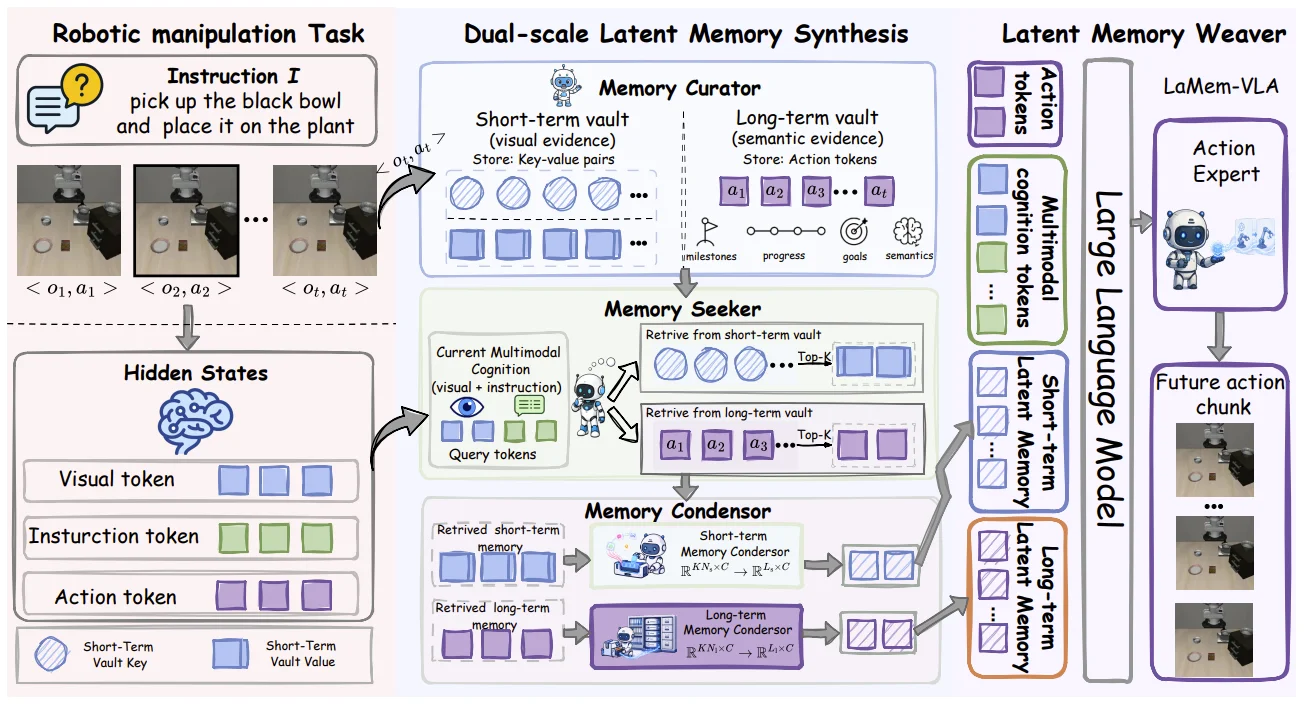
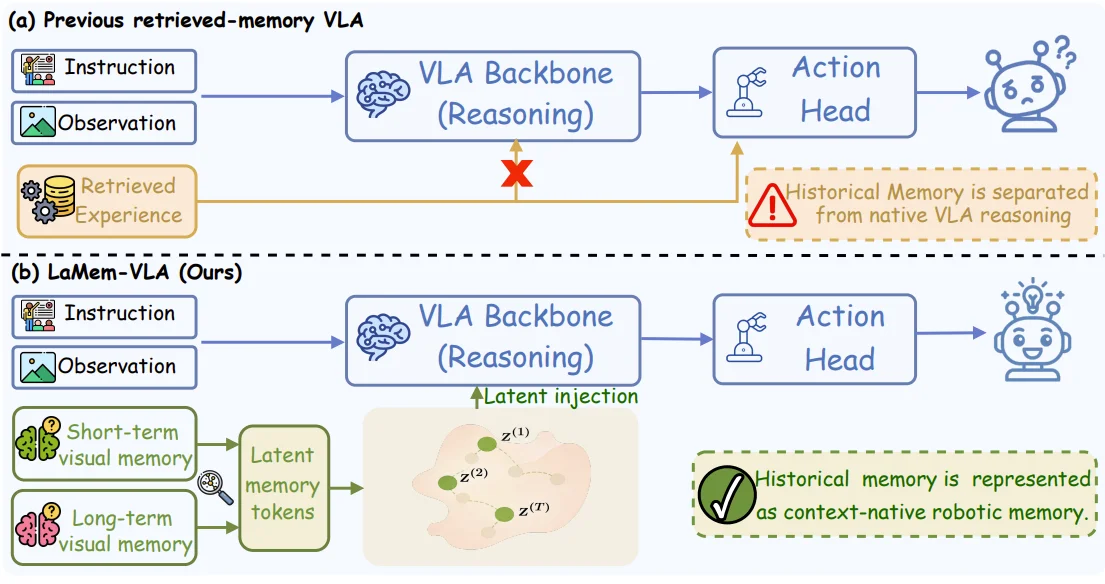
Mainstream Vision-Language-Action (VLA) models predict actions primarily from the current observation under a Markovian assumption, thus struggling with long-horizon, temporally dependent tasks. Existing memory-augmented VLAs either expand the observation window or retrieve history from the memory bank as auxiliary policy-side context. However, they leave memory outside the native latent embedding space of VLA reasoning, preventing historical experience from being fluidly interleaved with multimodal reasoning and action formation. To this end, we introduce LaMem-VLA, a latent-memory-native framework that reconstructs historical experience into latent memory tokens and directly interweaves them with VLA reasoning. At its core, LaMem-VLA introduces four coordinated components: (i) a curator that organizes historical experience into two complementary short-term and long-term memory vaults; (ii) a seeker that queries both vaults using the multimodal cognition to retrieve context-relevant evidence; (iii) a condenser that reconstructs the retrieved evidence into compact short-term and long-term latent memory tokens; and (iv) a weaver that injects these memory tokens with the current observation and instruction into one continuous embedding sequence. By representing, retrieving, and consuming historical experience entirely in the same continuous latent space, LaMem-VLA enables memory to directly participate in VLA reasoning and guide action generation under a bounded context. Extensive experiments on SimplerEnv and LIBERO demonstrate the superiority of our LaMem-VLA.
摘要(中译)
主流视觉-语言-动作(Vision-Language-Action, VLA)模型主要在马尔可夫假设下从当前观测中预测动作,因此在长期规划、时间依赖型任务中表现不佳。现有的增强记忆的VLA模型要么扩展观测窗口,要么从记忆库中检索历史作为辅助策略上下文。然而,它们将记忆置于VLA推理的原生潜在嵌入空间之外,导致历史经验无法与多模态推理和动作生成流畅地交织在一起。为此,我们提出了LaMem-VLA,一种原生潜在记忆框架,它将历史经验重构为潜在记忆令牌,并直接将它们与VLA推理交织在一起。其核心是四个协调组件:(i)一个管理者,将历史经验组织成两个互补的短期和长期记忆库;(ii)一个搜索器,使用多模态认知查询两个库以检索与上下文相关的证据;(iii)一个压缩器,将检索到的证据重构为紧凑的短期和长期潜在记忆令牌;(iv)一个编织器,将这些记忆令牌与当前观测和指令一起注入到一个连续的嵌入序列中。通过在相同的连续潜在空间中表示、检索和使用历史经验,LaMem-VLA使记忆能够直接参与VLA推理并在有限上下文中指导动作生成。在SimplerEnv和LIBERO上的大量实验证明了我们的LaMem-VLA的优越性。
背景剖析
背景剖析
1. 技术背景与真实需求
视觉-语言-动作(VLA)模型是机器人操作领域的核心技术,旨在让机器人通过理解视觉场景和语言指令来执行复杂任务(如组装、搬运)。这类技术的核心需求是让机器人具备长时程任务能力——例如,在“将桌子上的苹果放入冰箱”的任务中,机器人需要记住已完成的步骤(如“拿起苹果”)、当前状态(如“冰箱门是否打开”),并规划后续动作。然而,现有VLA模型大多假设“当前观察足以预测动作”(即马尔可夫性),导致它们在需要历史依赖的复杂任务中表现不佳,例如多步骤装配或动态环境中的适应性操作。
2. 之前的问题与局限
早期改进尝试通过两种方式引入记忆机制:
- 短期窗口扩展:将历史帧拼接或延长输入序列,但计算成本随时间窗口增长,且无法处理超出窗口的长时依赖。
- 外部记忆库:从外部存储中检索历史轨迹或token,但这些记忆与模型内部推理分离,导致历史信息无法与当前感知、语言理解直接交互。
这两种方法的核心缺陷是记忆与推理的脱节:历史经验未被整合到模型的原生嵌入空间中,无法自然参与视觉-语言-动作的联合推理过程。
3. 本文的解决思路
论文提出LaMem-VLA框架,通过原生潜伏记忆(latent memory)将历史经验直接融入模型推理。其核心设计包括:
- 双尺度记忆库:短期记忆存储当前任务的视觉细节(如物体位置),长期记忆保存语义信息(如任务进度)。
- 统一嵌入空间:历史记忆被压缩为与模型原生嵌入兼容的token,与当前观察、语言指令共同参与推理。
- 动态检索与编织:模型根据当前状态动态查询相关历史,并将记忆token“编织”到推理序列中,使历史信息直接影响动作生成。
4. 与前人工作的关键差异
与以往方法不同,LaMem-VLA的关键创新在于记忆的内生性:
- 历史记忆不再作为外部辅助上下文,而是与视觉-语言推理共享同一嵌入空间,实现“感知-理解-记忆-动作”的端到端融合。
- 双尺度记忆设计同时支持视觉主导的短期细节和语义主导的长期上下文,解决了单一记忆机制的局限性。
这一设计使机器人能够像人类一样,通过“回忆相关经验”来指导复杂任务的执行,而非仅依赖当前观察做出反应。