Dual Latent Memory in Vision-Language-Action Models for Robotic Manipulation
arXiv · HuggingFace · ▲51
Abstract (verbatim)
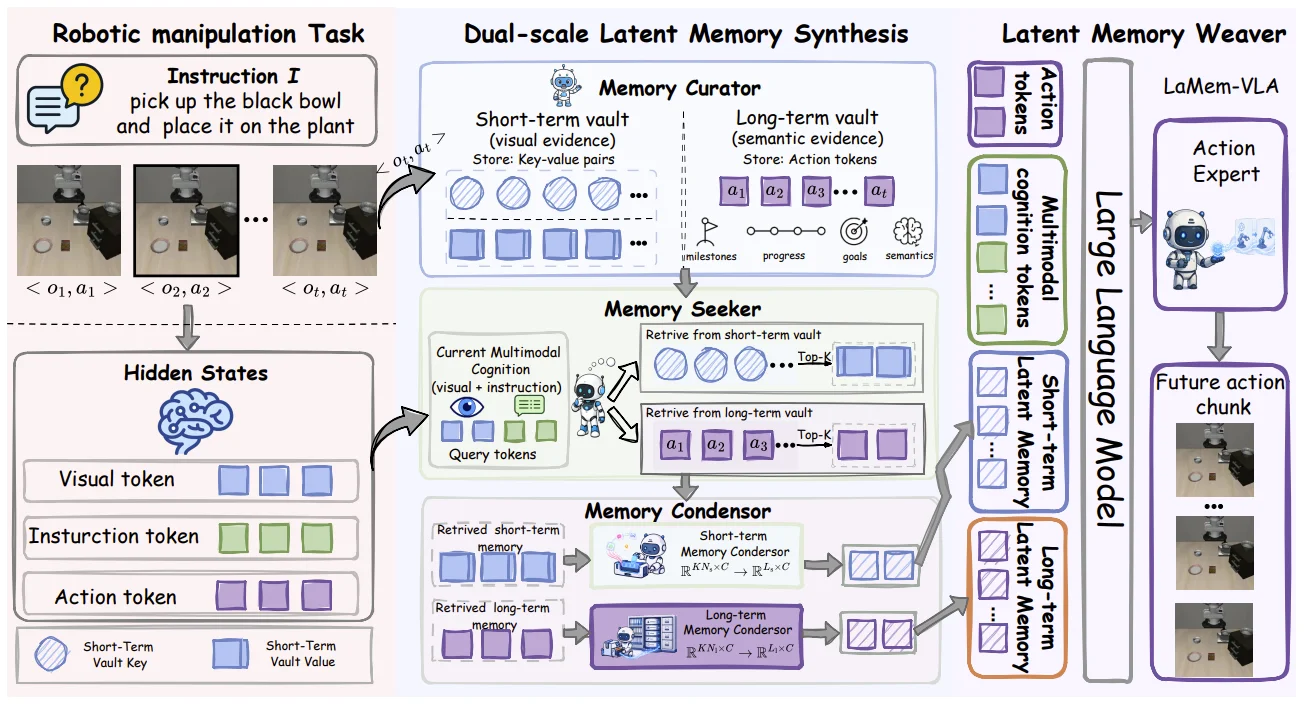
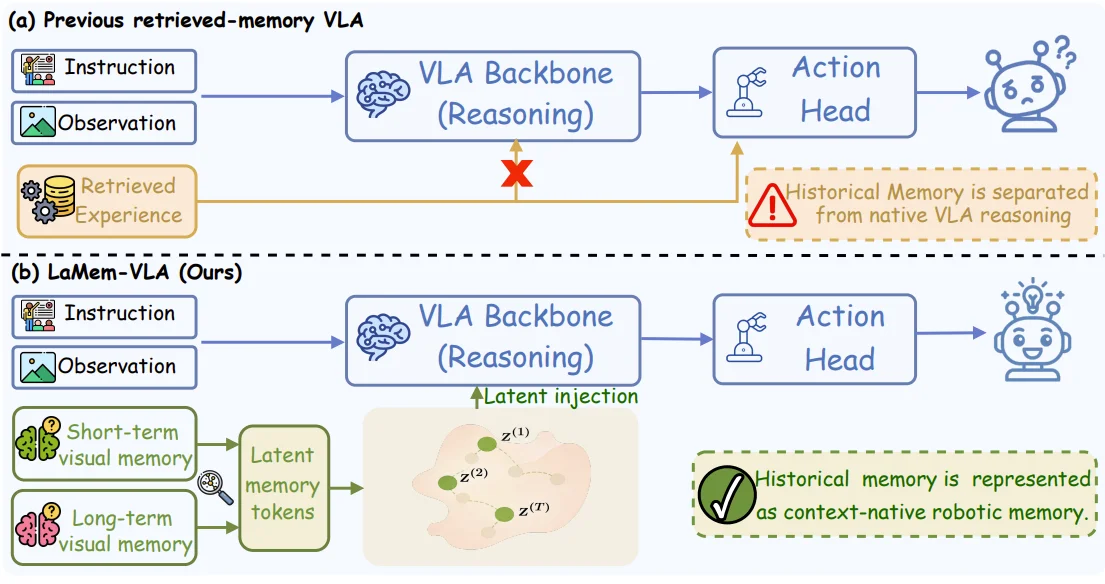
Mainstream Vision-Language-Action (VLA) models predict actions primarily from the current observation under a Markovian assumption, thus struggling with long-horizon, temporally dependent tasks. Existing memory-augmented VLAs either expand the observation window or retrieve history from the memory bank as auxiliary policy-side context. However, they leave memory outside the native latent embedding space of VLA reasoning, preventing historical experience from being fluidly interleaved with multimodal reasoning and action formation. To this end, we introduce LaMem-VLA, a latent-memory-native framework that reconstructs historical experience into latent memory tokens and directly interweaves them with VLA reasoning. At its core, LaMem-VLA introduces four coordinated components: (i) a curator that organizes historical experience into two complementary short-term and long-term memory vaults; (ii) a seeker that queries both vaults using the multimodal cognition to retrieve context-relevant evidence; (iii) a condenser that reconstructs the retrieved evidence into compact short-term and long-term latent memory tokens; and (iv) a weaver that injects these memory tokens with the current observation and instruction into one continuous embedding sequence. By representing, retrieving, and consuming historical experience entirely in the same continuous latent space, LaMem-VLA enables memory to directly participate in VLA reasoning and guide action generation under a bounded context. Extensive experiments on SimplerEnv and LIBERO demonstrate the superiority of our LaMem-VLA.
Background
Background Analysis
1. Technical Context and Real-World Needs
Vision-Language-Action (VLA) models are a core technology in robotic manipulation, enabling robots to perform complex tasks (e.g., assembly, object rearrangement) by understanding visual scenes and language instructions. A key challenge is long-horizon task capability—for example, a robot needs to remember completed steps (e.g., "picking an apple") and plan subsequent actions (e.g., "opening the fridge") in a multi-step task like "putting an apple in the fridge." However, most existing VLA models assume current observations alone suffice to predict actions (Markovian assumption), struggling with tasks requiring history-dependent reasoning.
2. Limitations of Previous Approaches
Prior improvements introduced memory mechanisms in two ways:
- Short-term window extension: Concatenating historical frames or extending input sequences, but computational costs grow with window size, and long dependencies beyond the window are ignored.
- External memory banks: Retrieving historical trajectories or tokens from external storage, but these remain decoupled from the model’s internal reasoning, preventing seamless interaction between history and current perception/language understanding.
The core issue is the disconnect between memory and reasoning: Historical experience is not integrated into the model’s native embedding space, limiting its ability to participate in visual-language-action reasoning.
3. Proposed Solution
LaMem-VLA introduces a native latent memory framework to embed historical experience directly into the model’s reasoning process. Key components include:
- Dual-scale memory vaults: Short-term memory stores visual details (e.g., object positions), while long-term memory preserves semantic context (e.g., task progress).
- Unified embedding space: Retrieved history is compressed into tokens compatible with the model’s native embedding, allowing joint reasoning with current observations and instructions.
- Dynamic retrieval and weaving: The model queries relevant history based on the current state and "weaves" memory tokens into the reasoning sequence, directly influencing action generation.
4. Key Differences from Prior Work
Unlike previous methods, LaMem-VLA’s innovation lies in memory’s endogenous nature:
- Historical memory is no longer an external auxiliary context but integrated into the same embedding space as visual-language reasoning, enabling end-to-end fusion of perception, understanding, memory, and action.
- Dual-scale memory supports both visually grounded short-term details and semantically rich long-term context, addressing limitations of single-memory mechanisms.
This design allows robots to "recall relevant experience" to guide complex tasks, rather than reacting solely to current observations.