RynnWorld-4D: 4D Embodied World Models for Robotic Manipulation
arXiv · HuggingFace · ▲89
摘要(原文)
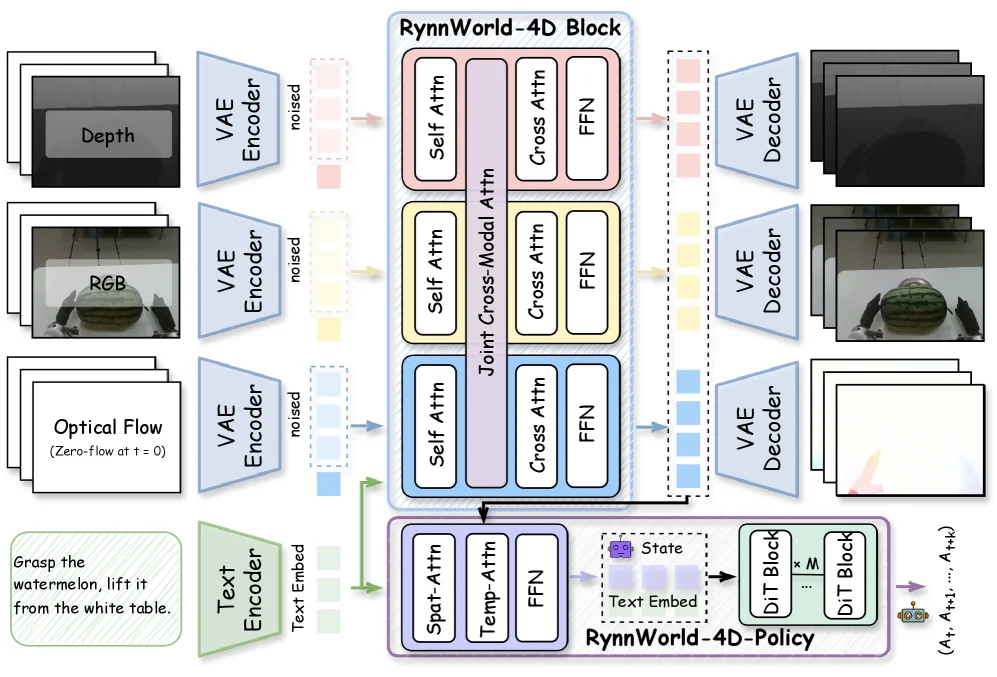
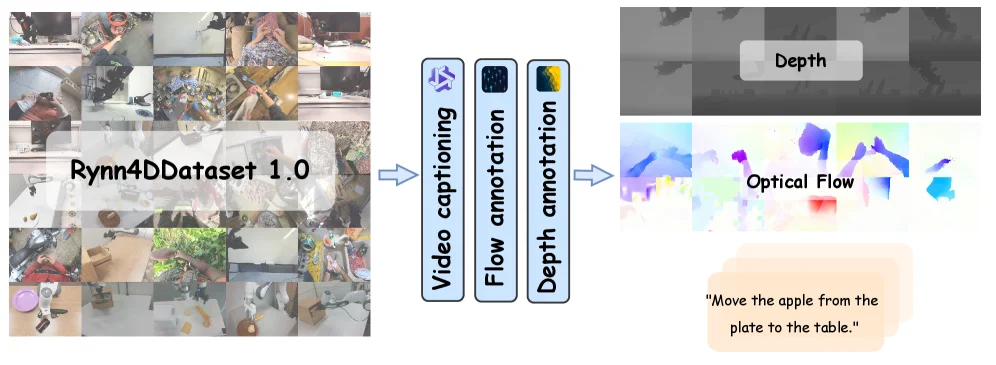
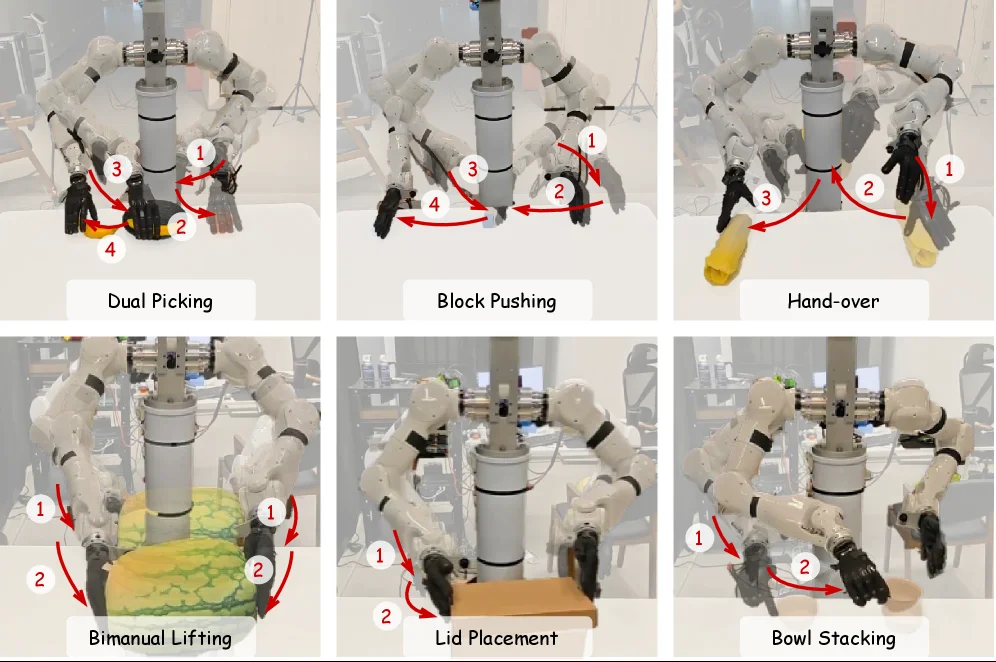
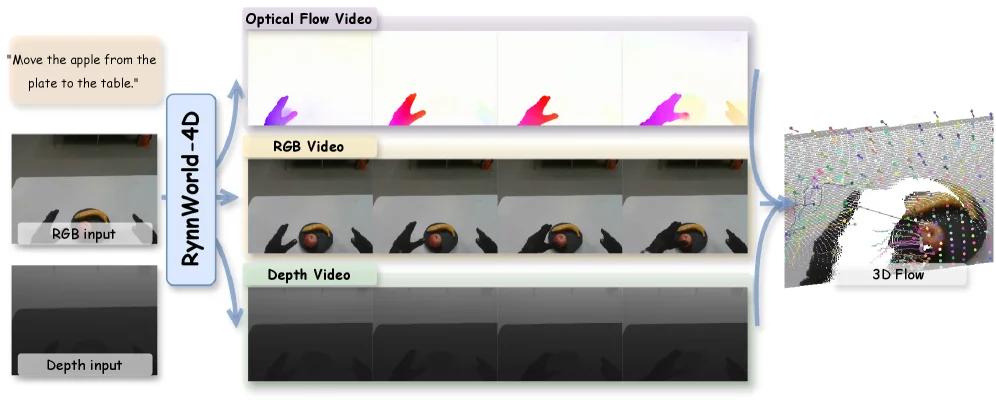
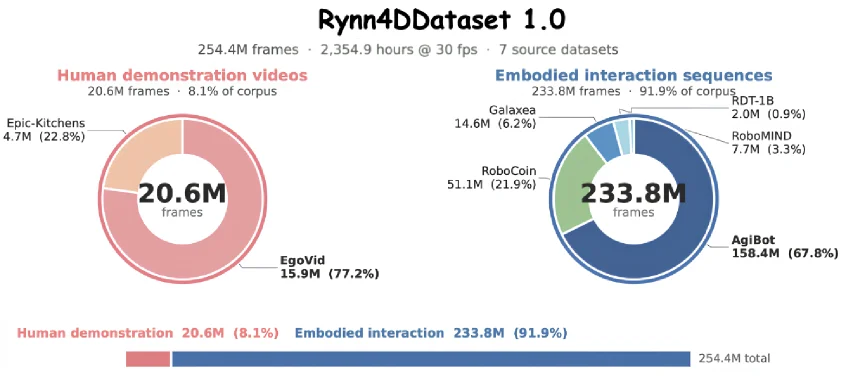
Robotic manipulation in the open world requires not only recognizing what a scene looks like, but also anticipating how its 3D structure moves under interaction. We argue that synchronized RGB, depth, and optical flow, namely RGB-DF, provide a physically grounded representation that captures the underlying 4D dynamics of a scene. Compared to 2D pixel videos, this multi-modal synergy aligns visual appearance with geometric structure and temporal motion, creating a representation space significantly closer to the low-level end-effector actions demanded by robotic systems, thereby narrowing the gap between world prediction and policy learning. Building on this insight, we introduce RynnWorld-4D, a generative model that co-produces future RGB frames, depth maps, and optical flow from a single RGB-D image and a language instruction within one unified diffusion process. This 4D world model features a tri-branch architecture that integrates cross-modal attention with frame-wise 3D RoPE, ensuring that appearance, geometry, and motion evolve consistently. To supply training data at scale, we curate Rynn4DDataset 1.0, a massive dataset of over 254.4 million frames across egocentric human and robotic manipulation videos with high-quality pseudo-labels for depth and optical flow. We further propose RynnWorld-4D-Policy, an inverse dynamics head that consumes the internal 4D representations of RynnWorld-4D in a single forward pass, bypassing expensive multi-step denoising, to output robot actions in a closed-loop manner. Experiments show that RynnWorld-4D produces temporally and spatially coherent 4D predictions, and that RynnWorld-4D-Policy achieves state-of-the-art performance on real-world dexterous bimanual manipulation tasks, particularly excelling in tasks demanding spatial precision and temporal coordination.
摘要(中译)
在开放世界中进行机器人操作不仅需要识别场景的外观,还需要预测其3D结构在交互作用下的运动方式。我们认为,同步的RGB(红绿蓝)、深度(depth)和光流(optical flow),即RGB - DF,提供了一种具有物理基础的表示方式,能够捕捉场景的潜在4D(四维)动态。与2D像素视频相比,这种多模态协同作用将视觉外观与几何结构和时间运动相结合,创建了一个表示空间,该空间显著更接近机器人系统所需的低级末端执行器动作,从而缩小了世界预测和策略学习之间的差距。基于这一见解,我们引入了RynnWorld - 4D,这是一个生成模型,在一个统一的扩散过程中,从单个RGB - D(红绿蓝 - 深度)图像和语言指令中共同生成未来的RGB帧、深度图和光流。这个4D世界模型具有三分支架构,将跨模态注意力与逐帧3D RoPE(旋转位置编码,Rotation - Position Encoding)相结合,确保外观、几何和运动一致发展。为了大规模提供训练数据,我们整理了Rynn4DDataset 1.0,这是一个包含超过2.544亿帧的大型数据集,涵盖了以自我为中心的人类和机器人操作视频,并为深度和光流提供了高质量的伪标签。我们进一步提出了RynnWorld - 4D - Policy,这是一个逆动力学头,在单次前向传播中消耗RynnWorld - 4D的内部4D表示,绕过昂贵的多步去噪过程,以闭环方式输出机器人动作。实验表明,RynnWorld - 4D能够生成时间和空间上一致的4D预测,而RynnWorld - 4D - Policy在现实世界的灵巧双手操作任务中取得了最先进的性能,特别是在需要空间精度和时间协调的任务中表现尤为出色。
背景剖析
背景剖析
1. 技术背景与真实需求
在开放世界中,机器人需要具备理解环境并预测交互后果的能力。例如,当机器人抓取或移动物体时,它不仅需要识别当前场景的视觉外观,还需要预判物体在受力后的3D运动轨迹(如掉落、滑动或碰撞)。这种能力对现实任务(如家务协作、工业装配或医疗辅助)至关重要,因为机器人必须在动态环境中做出快速、安全的决策。传统方法依赖2D图像或单一模态(如深度图),但无法同时处理空间结构和时间动态,导致预测不准确或动作不协调。
2. 先前方法的局限性
现有研究主要面临两个核心问题:
- 2D表示的不足:基于像素的生成模型(如视频扩散模型)虽然能生成逼真的视觉效果,但缺乏几何和运动信息,导致无法精确估计物体的6自由度(6-DoF)位置或深度,进而影响机器人的交互精度。
- 3D/4D方法的缺陷:基于神经辐射场(NeRF)或结构从运动(SfM)的方法要么计算成本高昂(如场景特定优化),要么缺乏生成未来状态的能力(如仅能重建静态点云)。此外,这些方法通常需要多视图输入或难以扩展到复杂场景。
3. 本文的解决方案
论文提出了一种名为RynnWorld-4D的4D世界模型,通过同步生成RGB图像、深度图和光流(RGB-DF)来捕捉场景的4D动态。其核心思路是:
- 多模态协同表示:将深度和光流作为中间表示,将2D像素与3D几何及运动关联起来,既保留了视频扩散模型的生成能力,又显式编码了几何信息。
- 统一生成框架:使用一个三分支变压器模型,在共享的去噪过程中同步生成三种模态,并通过交叉注意力机制确保它们的一致性。
- 高效训练数据:构建了Rynn4DDataset 1.0,包含超过2.5亿帧的具身操作视频(人类和机器人),并自动标注深度和光流,解决了大规模4D数据稀缺的问题。
- 实时策略学习:通过RynnWorld-4D-Policy直接从4D表示中提取机器人动作,避免了传统方法中耗时的迭代去噪过程,实现高频闭环控制。
4. 与前人工作的关键差异
- 表示方式的创新:不同于纯2D或纯3D方法,RynnWorld-4D使用RGB-DF作为中间表示,平衡了生成能力与几何物理一致性。
- 模型设计的简洁性:通过共享的扩散模型架构和交叉模态注意力,避免了多阶段推理或场景特定优化。
- 数据利用的高效性:利用伪标签自动生成大规模4D数据,而非依赖昂贵的人工标注或有限的多视图输入。
这一工作为具身智能提供了一个更接近机器人实际动作空间的表示框架,并在实时操作任务中展示了优越性能。