RynnWorld-4D: 4D Embodied World Models for Robotic Manipulation
arXiv · HuggingFace · ▲89
Abstract (verbatim)
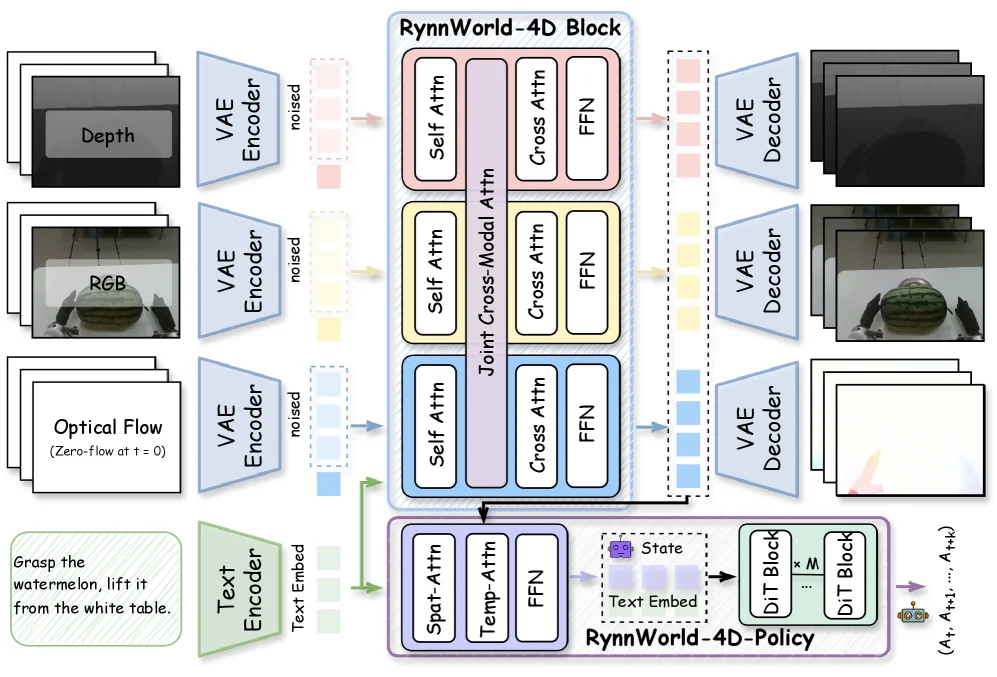
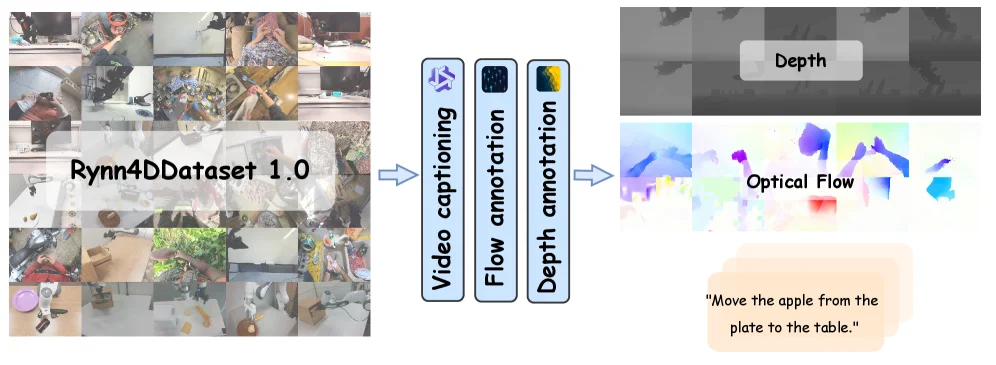
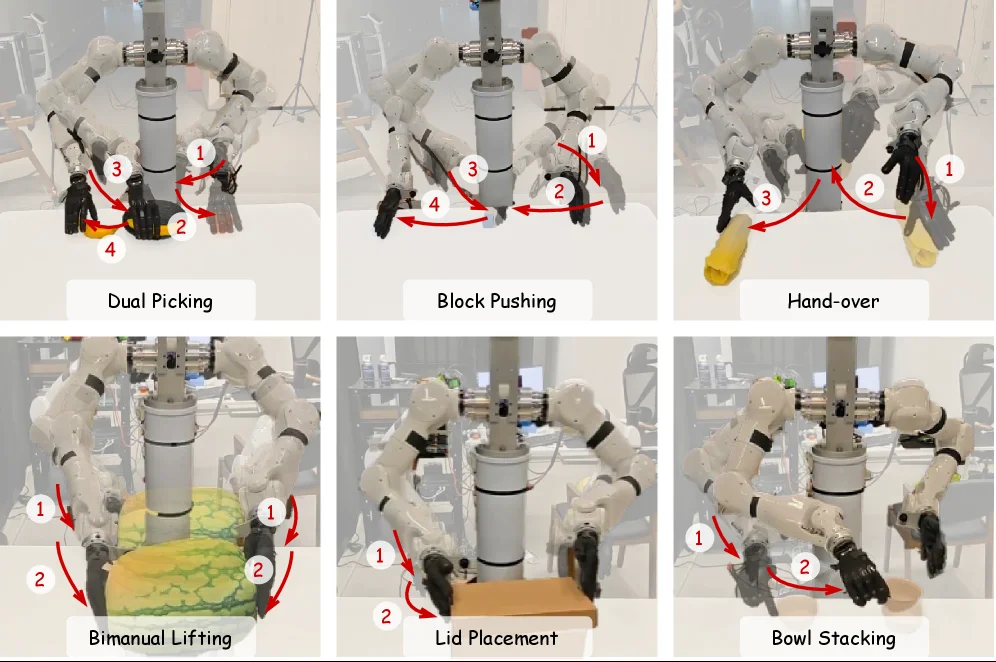
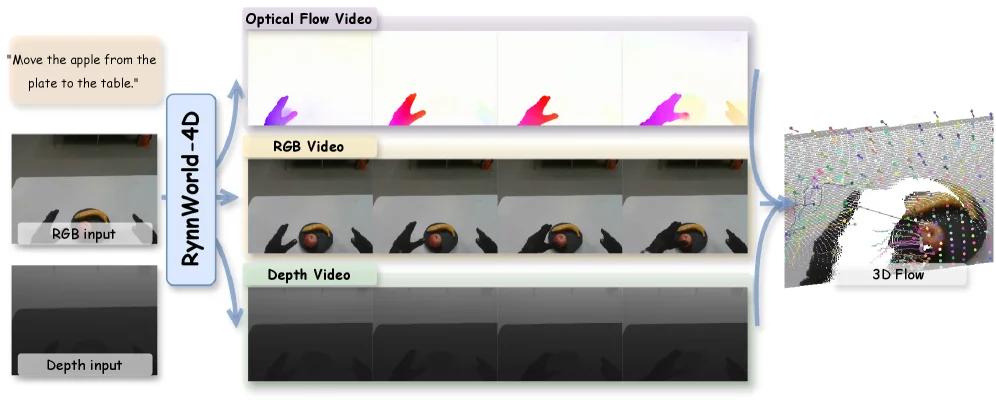
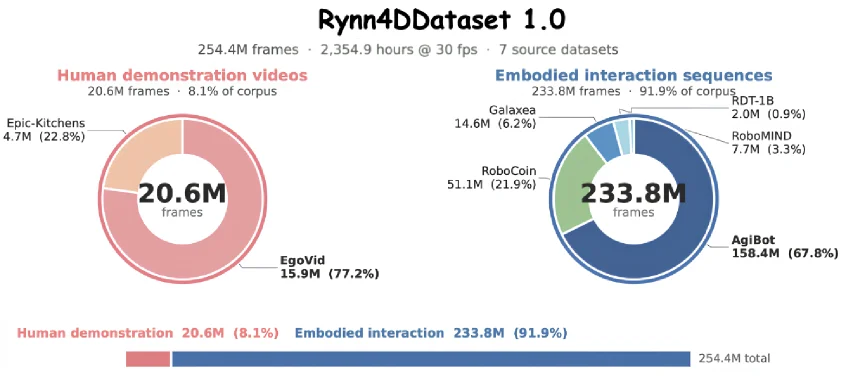
Robotic manipulation in the open world requires not only recognizing what a scene looks like, but also anticipating how its 3D structure moves under interaction. We argue that synchronized RGB, depth, and optical flow, namely RGB-DF, provide a physically grounded representation that captures the underlying 4D dynamics of a scene. Compared to 2D pixel videos, this multi-modal synergy aligns visual appearance with geometric structure and temporal motion, creating a representation space significantly closer to the low-level end-effector actions demanded by robotic systems, thereby narrowing the gap between world prediction and policy learning. Building on this insight, we introduce RynnWorld-4D, a generative model that co-produces future RGB frames, depth maps, and optical flow from a single RGB-D image and a language instruction within one unified diffusion process. This 4D world model features a tri-branch architecture that integrates cross-modal attention with frame-wise 3D RoPE, ensuring that appearance, geometry, and motion evolve consistently. To supply training data at scale, we curate Rynn4DDataset 1.0, a massive dataset of over 254.4 million frames across egocentric human and robotic manipulation videos with high-quality pseudo-labels for depth and optical flow. We further propose RynnWorld-4D-Policy, an inverse dynamics head that consumes the internal 4D representations of RynnWorld-4D in a single forward pass, bypassing expensive multi-step denoising, to output robot actions in a closed-loop manner. Experiments show that RynnWorld-4D produces temporally and spatially coherent 4D predictions, and that RynnWorld-4D-Policy achieves state-of-the-art performance on real-world dexterous bimanual manipulation tasks, particularly excelling in tasks demanding spatial precision and temporal coordination.
Background
Background Analysis
1. Technical Context and Real-World Needs
In open-world robotics, understanding and predicting environmental interactions is critical. For example, when a robot grasps or moves an object, it must anticipate the 3D motion of objects (e.g., dropping, sliding, or colliding) under interaction. This capability is essential for real-world tasks like household assistance, industrial assembly, or medical support, where robots must make fast and safe decisions in dynamic environments. Traditional methods relying on 2D images or single modalities (e.g., depth maps) fail to jointly handle spatial structure and temporal dynamics, leading to inaccurate predictions or uncoordinated actions.
2. Limitations of Previous Approaches
Existing research faces two core challenges:
- Shortcomings of 2D representations: Pixel-based generative models (e.g., video diffusion models) produce realistic visuals but lack geometric and motion information, making precise 6-DoF estimation or depth-aware interaction difficult.
- Deficiencies in 3D/4D methods: Approaches like Neural Radiance Fields (NeRF) or Structure-from-Motion (SfM) are either computationally expensive (e.g., scene-specific optimization) or lack future-state generation (e.g., static point cloud reconstruction). They also often require multi-view inputs or struggle to scale to complex scenes.
3. Proposed Solution
The paper introduces RynnWorld-4D, a 4D world model that predicts synchronized RGB, depth, and optical flow (RGB-DF) to capture scene dynamics. Key innovations include:
- Multi-modal coherent representation: Depth and optical flow link 2D pixels to 3D geometry and motion, retaining the generative power of video diffusion models while explicitly encoding physical constraints.
- Unified generation framework: A tri-branch transformer generates all modalities in a shared denoising loop, with cross-attention ensuring consistency.
- Efficient training data: Rynn4DDataset 1.0 provides 254M+ frames from human and robotic manipulation videos with auto-generated depth/optical flow labels, addressing the scarcity of large-scale 4D data.
- Real-time policy learning: RynnWorld-4D-Policy extracts robot actions directly from 4D representations in a single forward pass, bypassing slow iterative denoising for high-frequency control.
4. Key Differences from Prior Work
- Representation innovation: Unlike pure 2D or 3D methods, RynnWorld-4D uses RGB-DF to balance generative capability with geometric consistency.
- Model simplicity: Shared diffusion architecture and cross-modal attention avoid multi-stage inference or scene-specific tuning.
- Data efficiency: Pseudo-labels generate large-scale 4D data, reducing reliance on manual annotation or limited multi-view inputs.
This work provides a representation closer to robot action spaces and demonstrates state-of-the-art performance in real-time manipulation tasks.