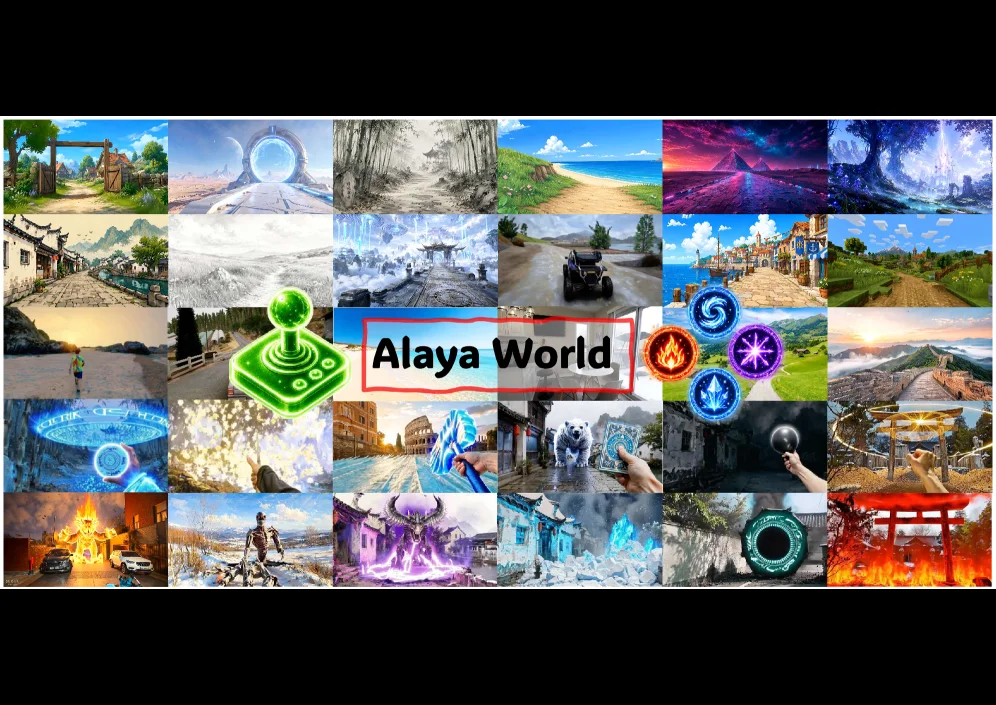
AlayaWorld: Long-Horizon and Playable Video World Generation
arXiv · HuggingFace · ▲85
摘要(原文)
Game worlds have traditionally been built through labor-intensive production pipelines, making them costly to develop, difficult to customization, and expensive to modify after deployment. Recent advances in video world models offer a fundamentally different paradigm. Rather than explicitly authoring every component of a virtual environment, these models autoregressively synthesize future observations conditioned on the current world state and user interactions, enabling playable worlds to be generated online. Trained on both gameplay recordings and real-world videos, they can capture diverse visual appearances and physical dynamics, opening new opportunities for interactive applications beyond gaming, including embodied intelligence. In this paper, we present AlayaWorld, a full-stack open-source framework for building interactive generative worlds. AlayaWorld enables open-ended real-time interaction, allowing users to freely navigate and perform diverse actions such as combat, spell casting, and monster summoning. The framework unifies the complete development-from data preparation model architecture, model training, inference acceleration, and deployment-within a modular and extensible architecture. Alongside the framework, we release reproducible pipelines, reference implementations, evaluation tools, and comprehensive documentation, establishing a practical foundation for future research and real-time applications of generative world models.
摘要(中译)
游戏世界传统上是通过劳动密集型的生产流程构建的,这使得它们的开发成本高昂、难以定制,并且在部署后修改起来也很昂贵。视频世界模型的最新进展提供了一种根本不同的范式。这些模型不是明确地编写虚拟环境的每个组件,而是根据当前世界状态和用户交互自回归地合成未来观测结果,从而使可游玩的世界能够在线生成。它们在游戏玩法记录和真实世界视频上进行训练,能够捕捉多样的视觉外观和物理动态,为游戏之外的交互应用(包括具身智能)开辟了新的机会。在本文中,我们介绍了AlayaWorld,这是一个用于构建交互式生成世界的全栈开源框架。AlayaWorld支持开放式的实时交互,允许用户自由导航并执行各种动作,如战斗、施法和召唤怪物。该框架将完整的开发过程(从数据准备、模型架构、模型训练、推理加速到部署)统一在一个模块化且可扩展的架构中。除了框架之外,我们还发布了可复现的流程、参考实现、评估工具和全面的文档,为生成世界模型的未来研究和实时应用奠定了实用基础。
背景剖析
背景剖析
1. 技术背景与真实需求
虚拟世界(如游戏场景或模拟环境)的核心价值在于其交互性——用户能通过行动影响环境,并获得连贯的反馈。这类技术不仅用于娱乐(如3D游戏),还扩展到机器人仿真、具身智能研究等领域,需要环境既真实又可动态响应。传统方法依赖人工逐帧设计场景、规则和物理效果,成本高昂且难以修改。例如,开发一个开放世界游戏可能需要数百人团队耗时数年,而一旦发布,新增内容或调整规则几乎需要重构整个系统。视频生成模型的出现提供了一种新可能:通过学习现实或游戏视频中的规律,模型可以“按需合成”虚拟世界的动态,减少人工干预。
2. 先前方法的局限性
尽管视频生成模型(如Genie、Matrix等)能自动合成视觉内容,但应用于交互式世界时仍面临四大挑战:
- 可控性不足:用户行动是否真的自由?例如,能否无限制探索或打破预设物理规则?
- 一致性缺失:环境变化是否符合自然逻辑?比如物体碰撞、光影变化是否合理?
- 长期稳定性差:长时间生成时,画面是否会“漂移”(如物体变形或场景崩坏)?
- 实时性要求:能否在低延迟下实时渲染?这对交互体验至关重要。
现有方法要么牺牲自由度(如预定义规则),要么在长期运行中失效,无法同时满足交互性与真实性。
3. 本文的解决思路
AlayaWorld通过模块化架构直接应对这些挑战:
- 自回归生成:基于用户输入(如移动、攻击)预测下一帧,避免手动设计规则。
- 多模块协同:例如,相机控制模块(AdaLN风格)确保视角平滑;历史压缩模块减少冗余计算;错误库(Error Bank)修复长期生成的偏差。
- 全栈优化:从数据准备到部署的全流程设计,支持低延迟实时交互。
其核心是让模型在无预设约束的情况下,自主学习世界的物理规律和视觉模式。
4. 与前人工作的关键差异
与以往视频生成模型相比,AlayaWorld的独特性在于:
- 开放性:用户行动不受限于预定义脚本,支持“无限探索”(如游戏中自由战斗或召唤怪物)。
- 长期稳定性:通过历史压缩和错误修正机制,解决长时间运行的画面漂移问题。
- 全栈开源:提供从训练到部署的完整工具链,而非仅发布模型权重。
这种方法将虚拟世界的创建从“人工工程”转向“数据驱动的生成”,为具身智能等新兴领域提供了更灵活的基础。