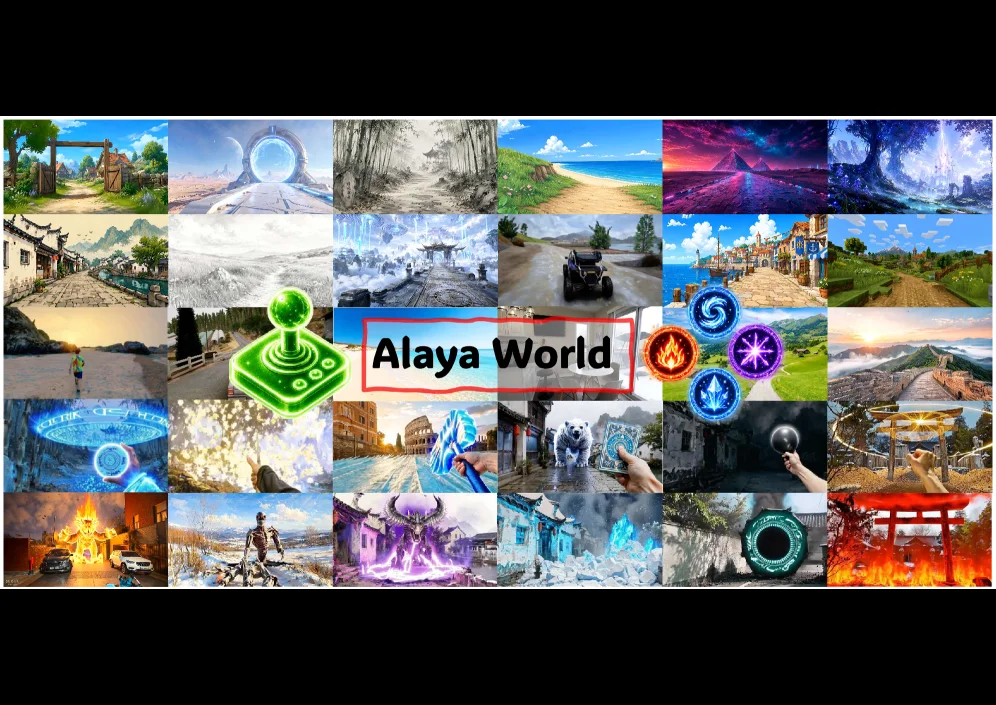
AlayaWorld: Long-Horizon and Playable Video World Generation
arXiv · HuggingFace · ▲85
Abstract (verbatim)
Game worlds have traditionally been built through labor-intensive production pipelines, making them costly to develop, difficult to customization, and expensive to modify after deployment. Recent advances in video world models offer a fundamentally different paradigm. Rather than explicitly authoring every component of a virtual environment, these models autoregressively synthesize future observations conditioned on the current world state and user interactions, enabling playable worlds to be generated online. Trained on both gameplay recordings and real-world videos, they can capture diverse visual appearances and physical dynamics, opening new opportunities for interactive applications beyond gaming, including embodied intelligence. In this paper, we present AlayaWorld, a full-stack open-source framework for building interactive generative worlds. AlayaWorld enables open-ended real-time interaction, allowing users to freely navigate and perform diverse actions such as combat, spell casting, and monster summoning. The framework unifies the complete development-from data preparation model architecture, model training, inference acceleration, and deployment-within a modular and extensible architecture. Alongside the framework, we release reproducible pipelines, reference implementations, evaluation tools, and comprehensive documentation, establishing a practical foundation for future research and real-time applications of generative world models.
Background
Background Analysis
1. Technical Context and Real-World Needs
Virtual worlds (e.g., game environments or simulations) rely on interactivity—users act upon the environment, which responds coherently. This technology is critical not only for entertainment (e.g., 3D games) but also for fields like robotics and embodied AI, where environments must be both realistic and dynamically responsive. Traditional methods require manual, labor-intensive design of scenes, rules, and physics, making them expensive to develop and modify. For example, creating an open-world game can take years and hundreds of people, and post-launch changes often demand rebuilding the system. Video generation models offer an alternative: by learning patterns from real or game videos, they can synthesize dynamic worlds "on-demand," reducing manual effort.
2. Limitations of Previous Methods
While video generation models (e.g., Genie, Matrix) excel at synthesizing visuals, applying them to interactive worlds faces four key challenges:
- Limited controllability: Can users act freely (e.g., explore infinitely or break physical rules)?
- Inconsistency: Do environmental changes (e.g., collisions, lighting) follow natural logic?
- Long-horizon instability: Does the world "drift" over time (e.g., objects deform or scenes break)?
- Real-time performance: Can it render low-latency frames for smooth interaction?
Existing methods either restrict freedom (e.g., predefine rules) or fail under long-term use, failing to balance interactivity and realism.
3. Proposed Solution
AlayaWorld addresses these challenges with a modular architecture:
- Autoregressive generation: Predicts next frames based on user input (e.g., movement, attacks), eliminating manual rule-writing.
- Collaborative modules: For example, an AdaLN-style camera-control module ensures smooth视角切换; a history-compression module reduces redundancy; an Error Bank fixes long-term drift.
- Full-stack optimization: End-to-end design from data preparation to deployment supports real-time interaction.
The core idea is to let the model autonomously learn physical and visual patterns without predefined constraints.
4. Key Differences from Prior Work
AlayaWorld stands out by:
- Open-endedness: Users can perform unrestricted actions (e.g., free combat or monster summoning).
- Long-term stability: History compression and error correction prevent visual drift during extended use.
- Full-stack openness: Provides end-to-end tools (training to deployment), not just model weights.
This shifts world creation from "manual engineering" to "data-driven generation," enabling flexible foundations for emerging fields like embodied AI.