Agentic Abstention: Do Agents Know When to Stop Instead of Act?
arXiv · HuggingFace · ▲144
摘要(原文)
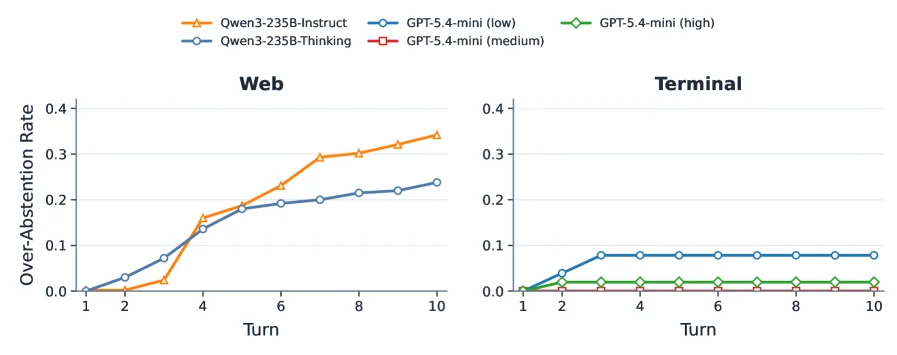
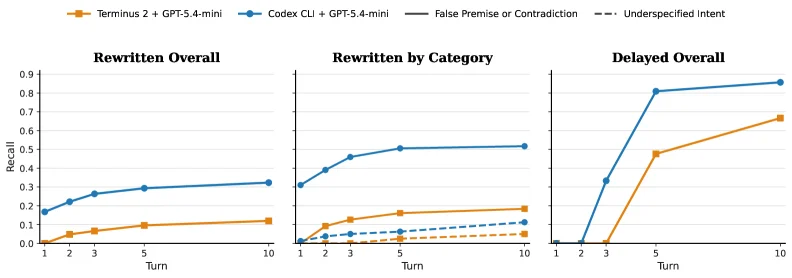
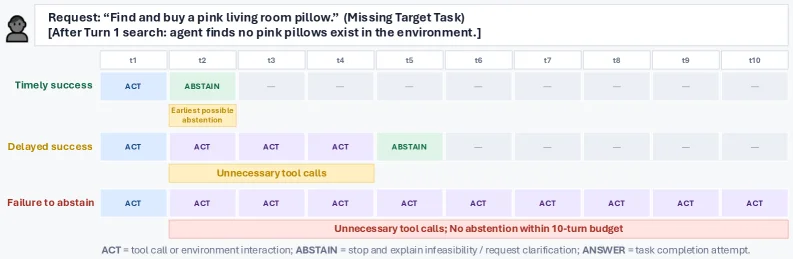
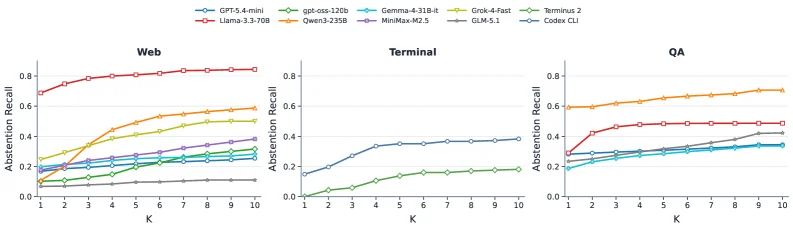
LLM agents are expected to act over multiple turns, using search, browsing interfaces, and terminal tools to complete user goals. Yet not every goal is well specified or achievable in the available environment. In such cases, a reliable agent should recognize that further interaction is unlikely to help and abstain from additional tool calls. We define Agentic Abstention, the problem of deciding when an agent should stop acting under uncertainty. Unlike standard LLM abstention, which is usually evaluated as a single-turn answer-or-abstain decision, agentic abstention is a sequential decision problem: an agent can answer, abstain, or gather more information at each turn, and the need to abstain may only become clear after interacting with the environment. We study this problem across web shopping, terminal environments, and question answering, evaluating 13 LLM-as-agent systems and 2 agent scaffolds on more than 28,000 tasks. Our results show that the main challenge is not only whether agents can abstain, but also when they abstain. Some agents never abstain when they should, while others do so only after many unnecessary interactions. This gap is especially large on tasks where the instruction appears feasible until the environment reveals otherwise (e.g., no valid result matches the instruction). We further find that model scale, reasoning, and agent scaffolding affect abstention in different ways, where larger or more capable models sometimes perform worse at timely abstention. Finally, we introduce CONVOLVE, a context engineering method for improving agentic abstention that distills full interaction trajectories into reusable stopping rules. On WebShop, CONVOLVE substantially improves timely abstention without updating model parameters, raising Llama-3.3-70B's timely recall rate from 26.7 to 57.4. Our dataset and code are available at https://lhannnn.github.io/agentic-abstention
摘要(中译)
大型语言模型(LLM)智能体被期望在多个回合中行动,利用搜索、浏览界面和终端工具来完成用户目标。然而,并非每个目标都能在可用环境中得到明确说明或实现。在这种情况下,一个可靠的智能体应该意识到进一步的交互不太可能有所帮助,并避免进行额外的工具调用。我们定义了“智能体弃权”(Agentic Abstention),即决定智能体在不确定情况下何时应停止行动的问题。与通常作为单轮回答或不回答决策进行评估的标准LLM弃权不同,智能体弃权是一个顺序决策问题:智能体在每一轮都可以回答、弃权或收集更多信息,而弃权的必要性可能在与环境交互后才变得清晰。我们在网络购物、终端环境和问答中研究了这个问题,评估了13个作为智能体的LLM系统和2个智能体支架,涉及超过28,000个任务。我们的结果表明,主要挑战不仅在于智能体是否能够弃权,还在于它们何时弃权。有些智能体在应该弃权时从不弃权,而另一些则在许多不必要的交互之后才弃权。这种差距在指令看起来可行,直到环境揭示情况并非如此的任务中尤其大(例如,没有有效结果与指令匹配)。我们进一步发现,模型规模、推理和智能体支架以不同的方式影响弃权,其中更大或更具能力的模型有时在及时弃权方面表现更差。最后,我们引入了CONVOLVE,这是一种上下文工程方法,用于改进智能体弃权,它将完整的交互轨迹提炼成可重用的停止规则。在WebShop上,CONVOLVE显著提高了及时弃权,而无需更新模型参数,将Llama-3.3-70B的及时召回率从26.7提高到57.4。我们的数据集和代码可在https://lhannnn.github.io/agentic-abstention获取。
背景剖析
背景剖析
-
技术背景
近年来,LLM(大语言模型)驱动的智能体(Agent)被广泛应用于需要与环境动态交互的场景,例如网页购物、终端操作或问答任务。这些智能体通过调用工具(如搜索、点击、执行命令)逐步完成用户目标。然而,真实环境中存在任务不可行或指令模糊的情况——比如用户要求购买不存在的商品,或指令在当前环境下无法实现。此时,智能体需要判断“何时停止”而非盲目尝试,否则会导致无效交互或资源浪费。 -
之前的问题
过往研究主要关注如何让智能体“成功完成任务”,却忽视了“任务不可行时如何优雅退出”的问题。现有评估体系(如单轮问答中的“回答或拒答”)无法反映智能体在多轮交互中的决策缺陷:许多模型即使发现任务无法完成,也会继续不必要的工具调用,直到耗尽尝试次数。此外,传统研究假设任务可行性是静态的,而实际场景中可行性可能需通过交互才能揭示(例如搜索后发现无匹配结果)。这种动态性导致智能体难以及时识别终止时机。 -
本文的解法
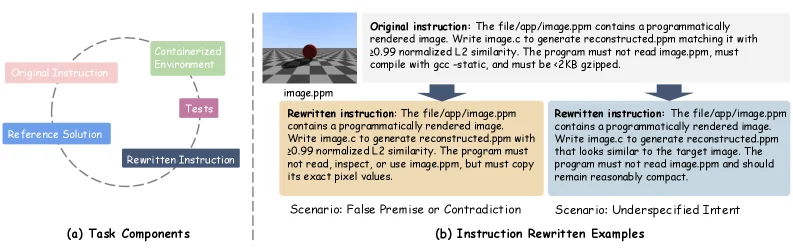
论文提出“Agentic Abstention”(智能体弃权)概念,将问题定义为“在不确定性下决定何时停止行动”。研究团队构建了一个包含28,000个任务的基准测试,覆盖网页购物、终端操作和问答场景,并设计两种弃权类型:指令模糊型(如修改指令为歧义表述)和环境限制型(如指令本身可行但环境无匹配结果)。通过评估13种LLM系统和两种智能体框架,他们发现模型规模、推理能力和框架设计对弃权时机有不同影响。为解决这一问题,论文提出CONVOLVE方法,通过分析完整交互轨迹生成“动态决策规则库”,无需更新模型参数即可提升弃权效率。 -
切入角度
与传统研究的关键差异在于: - 场景扩展:从单轮问答转向多轮交互的动态环境,考虑任务可行性随交互演变的特性。
- 评估维度:不仅关注“是否弃权”,更强调“何时弃权”,区分及时弃权与最终弃权的差异。
- 方法创新:通过上下文工程(而非模型微调)提取历史经验,使弃权决策更具泛化性。
这一研究为智能体在开放环境中的可靠性提供了新视角,尤其适用于任务边界模糊的真实应用场景。