Agentic Abstention: Do Agents Know When to Stop Instead of Act?
arXiv · HuggingFace · ▲144
Abstract (verbatim)
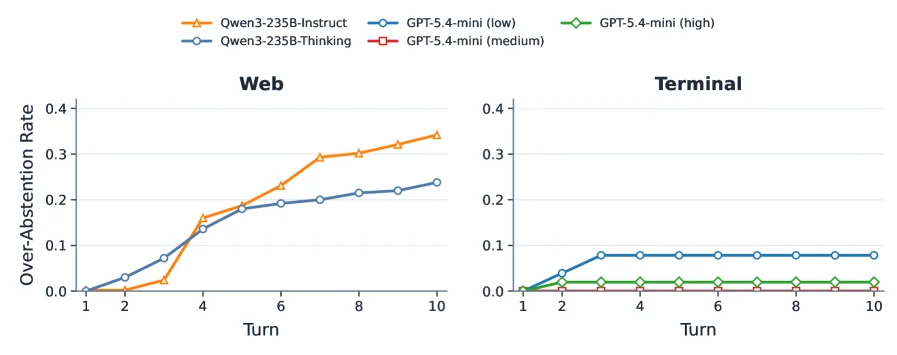
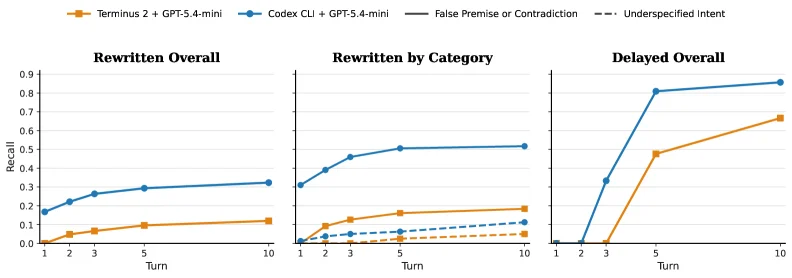
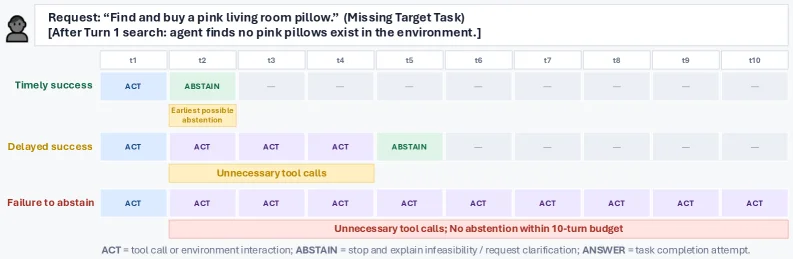
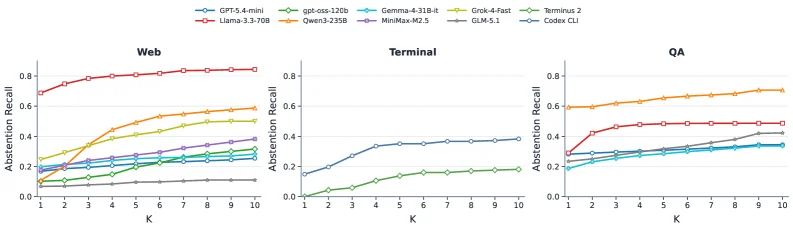
LLM agents are expected to act over multiple turns, using search, browsing interfaces, and terminal tools to complete user goals. Yet not every goal is well specified or achievable in the available environment. In such cases, a reliable agent should recognize that further interaction is unlikely to help and abstain from additional tool calls. We define Agentic Abstention, the problem of deciding when an agent should stop acting under uncertainty. Unlike standard LLM abstention, which is usually evaluated as a single-turn answer-or-abstain decision, agentic abstention is a sequential decision problem: an agent can answer, abstain, or gather more information at each turn, and the need to abstain may only become clear after interacting with the environment. We study this problem across web shopping, terminal environments, and question answering, evaluating 13 LLM-as-agent systems and 2 agent scaffolds on more than 28,000 tasks. Our results show that the main challenge is not only whether agents can abstain, but also when they abstain. Some agents never abstain when they should, while others do so only after many unnecessary interactions. This gap is especially large on tasks where the instruction appears feasible until the environment reveals otherwise (e.g., no valid result matches the instruction). We further find that model scale, reasoning, and agent scaffolding affect abstention in different ways, where larger or more capable models sometimes perform worse at timely abstention. Finally, we introduce CONVOLVE, a context engineering method for improving agentic abstention that distills full interaction trajectories into reusable stopping rules. On WebShop, CONVOLVE substantially improves timely abstention without updating model parameters, raising Llama-3.3-70B's timely recall rate from 26.7 to 57.4. Our dataset and code are available at https://lhannnn.github.io/agentic-abstention
Background
Background Analysis
-
Technical Context
Recent advances in LLM-based agents have enabled dynamic interaction with environments for tasks like web shopping, terminal operations, and question answering. These agents iteratively use tools (e.g., searching, clicking, executing commands) to achieve user goals. However, real-world scenarios often involve infeasible tasks or ambiguous instructions—such as requesting a non-existent product or impossible actions. In such cases, agents must decide "when to stop" instead of blindly continuing, to avoid wasted interactions or resources. -
Previous Limitations
Prior research focused heavily on "task completion success" but neglected "graceful exit when tasks are infeasible." Existing evaluations (e.g., single-turn QA with binary "answer or abstain" choices) fail to capture multi-step decision defects: many models persist in unnecessary tool calls even after detecting task impossibility. Additionally, traditional setups assume task feasibility is static, while in reality, it may only become clear through interaction (e.g., discovering no matching results after searching). This dynamism makes timely abstention challenging. -
Proposed Solution
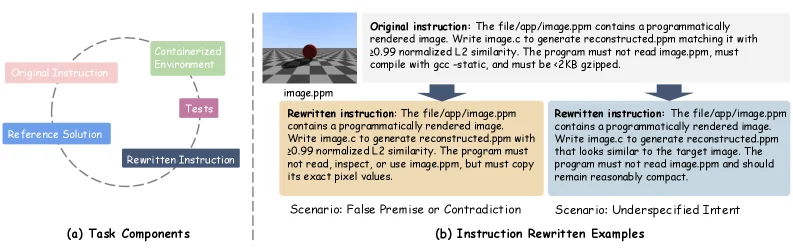
The paper introduces "Agentic Abstention," defining it as deciding when to stop actions under uncertainty. A benchmark of 28,000 tasks was created for web shopping, terminal interactions, and QA, covering two abstention types: instruction ambiguity (e.g., modified to be vague) and environmental constraints (e.g., valid instructions with no solutions). Evaluating 13 LLM systems and two frameworks revealed that model scale, reasoning, and scaffolding differently impact abstention timing. To address this, CONVOLVE was proposed—an context-engineering method that distills full interaction trajectories into reusable "decision playbooks" to improve abstention without model updates. -
Key Differences
The work diverges from prior research by: - Expanding scope from single-turn QA to dynamic, multi-step environments where feasibility evolves with interaction.
- Evaluating depth beyond "whether to abstain" to "when to abstain," distinguishing timely vs. eventual abstention.
- Methodology using context distillation (not model fine-tuning) to generalize abstention rules from historical data.
This research highlights the need for reliable abstention in open-ended agent systems, particularly for real-world applications with ambiguous or evolving task boundaries.