RecGPT-V3 Technical Report
arXiv · HuggingFace · ▲19
Abstract (verbatim)
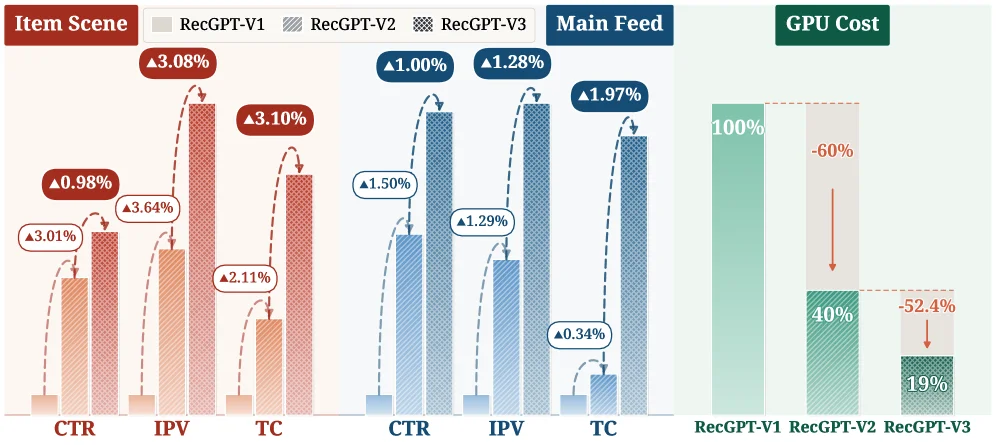
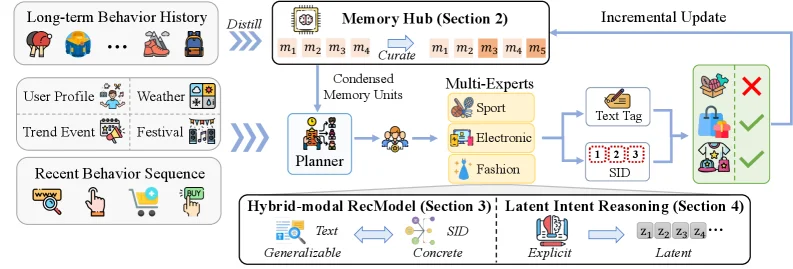
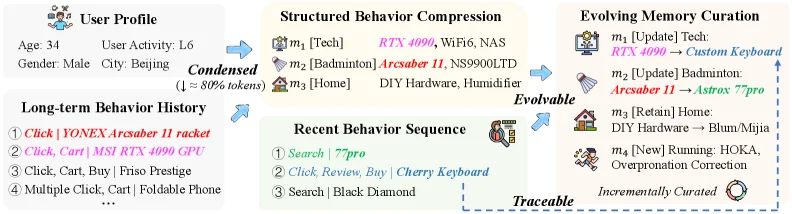
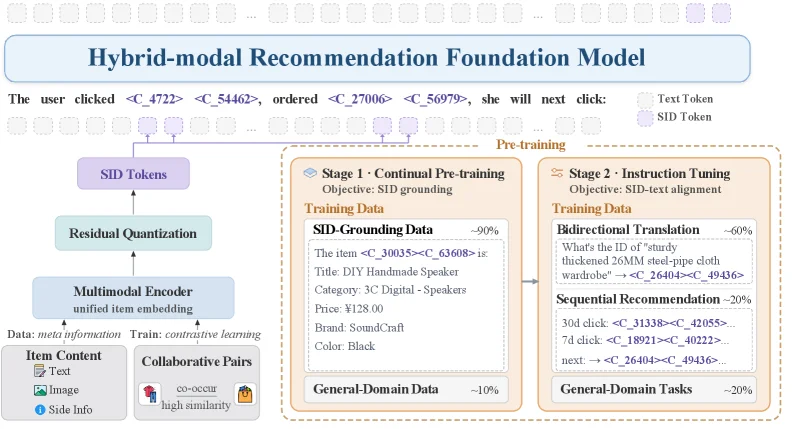
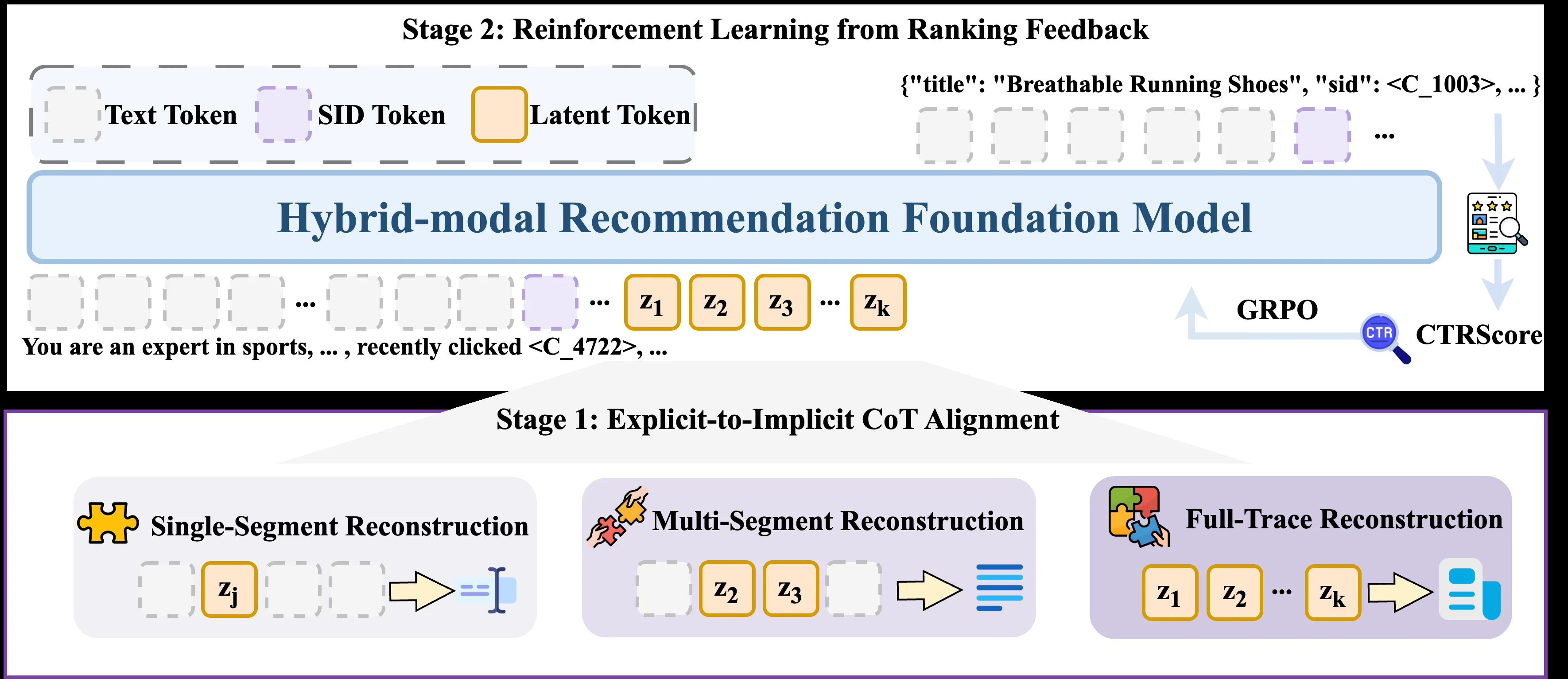
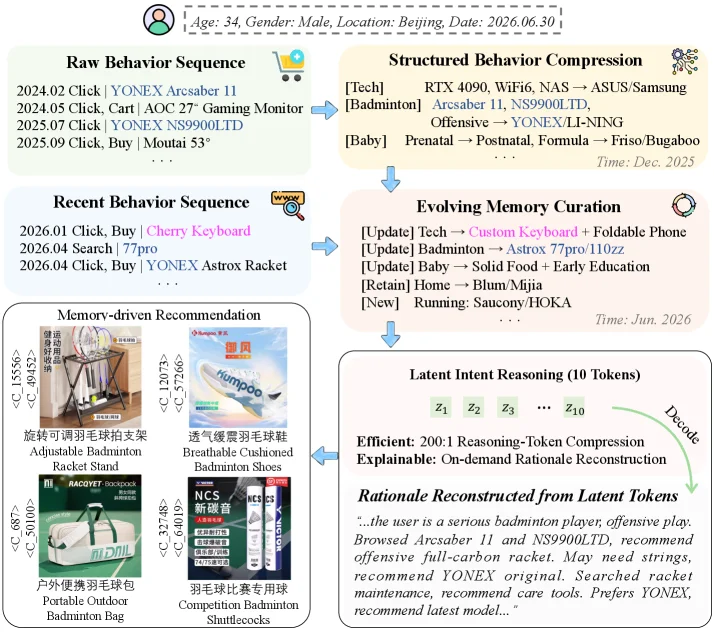
Large language models (LLMs) are transforming recommender systems from matching co-occurrence patterns in historical behavior toward reasoning about the intent that drives it. RecGPT-V1 pioneered this paradigm on Taobao by centering user understanding, and RecGPT-V2 scaled it via coordinated multi-agent reasoning; both are deployed in production with consistent gains in user experience and commercial outcomes. However, operating RecGPT at scale reveals three challenges: (1) stateless behavior modeling, where each request reprocesses full user history, wasting computation and discarding prior analysis; (2) a tag-to-item information bottleneck, where natural-language tags form a lossy channel between user understanding and item grounding; and (3) inefficient explicit reasoning, whose lengthy chain-of-thought incurs untenable latency and compute overhead. We present RecGPT-V3, a stateful, hybrid-modal recommender that reasons over natural language for open-world knowledge and Semantic IDs (SIDs) for concrete item grounding. A Memory Hub maintains structured, continually evolving user memory that distills long-horizon behavior into condensed units, cutting user-modeling computation by 55.8%. A Hybrid-modal Foundation Model allows the LLM jointly reason over text tags and SIDs, opening a high-bandwidth channel into the item space. Latent Intent Reasoning internalizes verbose rationales into compact learnable latent tokens that remain decodable into readable explanations, lowering output token cost by 200x. Deployed in Taobao's "Guess What You Like" feed, RecGPT-V3 achieves consistent gains in large-scale online A/B tests: IPV +1.28%, CTR +1.00%, TC +1.97%, GMV +3.97%, while cutting end-to-end serving resource consumption by 52.4%.
Background
Background Analysis
1. Technical Context and Real-World Needs
Recommender systems are the backbone of internet services like e-commerce and content platforms, aiming to understand user needs and match them with relevant items. Traditional methods rely on statistical patterns in historical behavior (e.g., collaborative filtering, sequential models) to predict "the next likely interaction." However, this "correlation-based" approach has fundamental limitations: it cannot interpret the underlying intent behind user actions (e.g., a user buying a badminton racket may reflect a "sports need" rather than mere historical preference). As users demand more personalized experiences, recommendation systems must shift from "mechanical matching" to "intent reasoning"—not just predicting behavior but understanding the motivations (interests, needs, contexts) driving it.
2. Limitations of Previous Approaches
While large language models (LLMs) enable intent reasoning, existing LLM-based recommenders face three key challenges:
- Stateless behavior modeling: Each request reprocesses the entire user history, causing redundant computation and failing to accumulate long-term insights (e.g., a user’s interest from six months ago is reanalyzed repeatedly, while recent actions are underweighted).
- Tag-to-item bottleneck: LLMs infer intent via natural-language tags (e.g., "badminton racket"), but tags lack fine-grained alignment with specific items (e.g., a tag like "badminton racket" maps to millions of products, making precise matching impossible).
- Inefficient explicit reasoning: Long Chain-of-Thought (CoT) explanations improve interpretability but incur high latency and computational costs, making them impractical for large-scale real-time services.
3. Proposed Solutions
RecGPT-V3 addresses these issues with three innovations:
- Memory-Augmented User Modeling: A "Memory Hub" compresses long-term user behavior into structured memory units (e.g., "sports enthusiast," "recently interested in photography"), avoiding redundant computation while preserving critical context.
- Hybrid-Modal Reasoning: Combines natural language (for open-ended intent) with Semantic IDs (SIDs, encoding item semantics), enabling LLMs to reason directly over item semantics and eliminate the gap between text and concrete items.
- Latent Intent Reasoning: Collapses lengthy CoT into compact "latent tokens," reducing token costs by 200x while retaining interpretability (rationales can be decoded on demand).
4. Key Differences from Prior Work
RecGPT-V3’s breakthrough lies in shifting from "stateless, unimodal, explicit reasoning" to "stateful, hybrid-modal, latent reasoning":
- Unlike RecGPT-V1/V2, it avoids reprocessing full histories by accumulating user knowledge in a structured memory.
- Unlike pure-text LLM systems, it introduces SIDs as a second modality for precise item alignment.
- Unlike traditional explicit CoT, it balances efficiency and interpretability by compressing reasoning into learnable latent tokens.
Deployed on Taobao’s "Guess What You Like" scenario, RecGPT-V3 improved user engagement (e.g., CTR +1.00%) and business metrics (e.g., GMV +3.97%) while reducing compute costs by 52.4%, marking a critical step toward scalable, cost-effective LLM-driven recommendation systems.