SearchOS-V1: Towards Robust Open-Domain Information-Seeking Agent Collaboration
arXiv · HuggingFace · ▲60
摘要(原文)
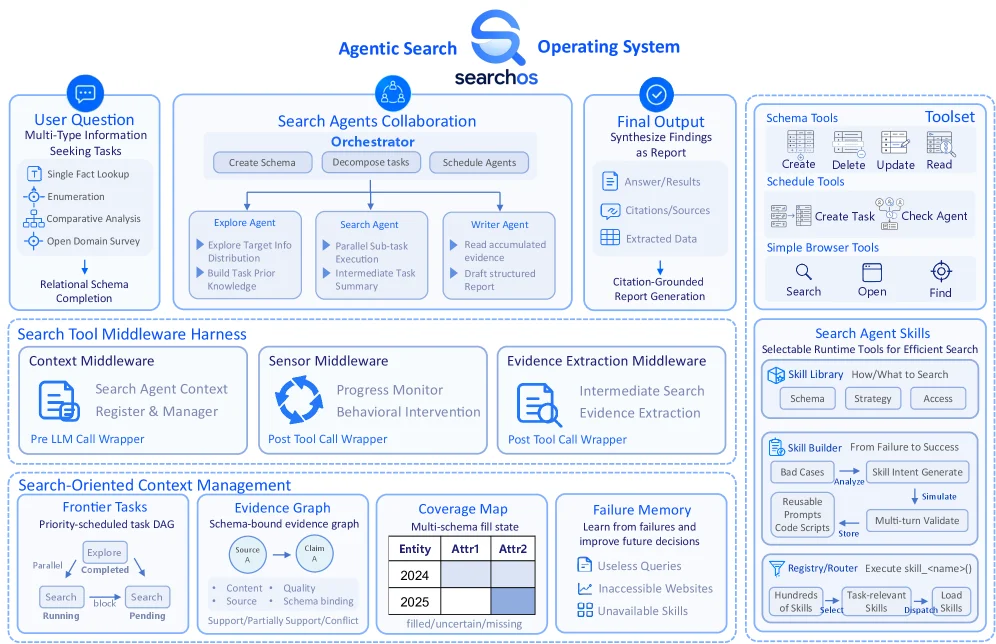
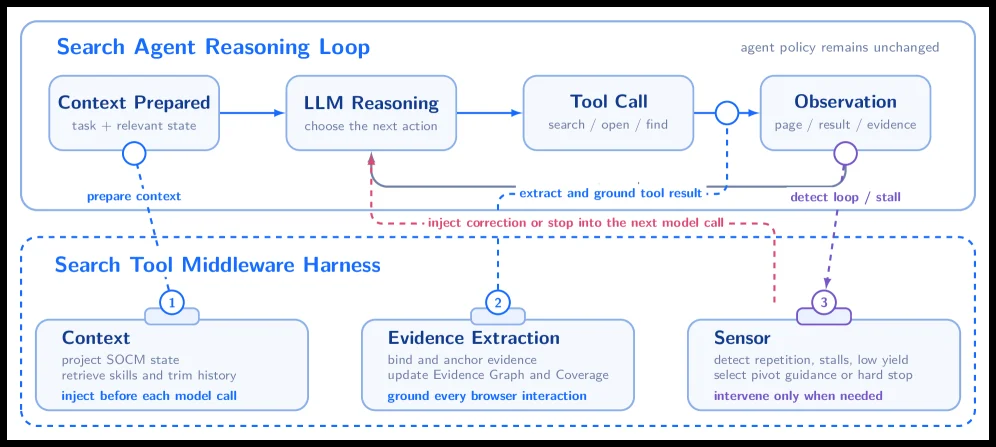
Recent advances in Tool-Integrated Large Language Models have made web search a core capability of information-seeking agents. However, as interaction histories grow, agents increasingly struggle to track task progress. When search attempts fail to yield useful evidence, current single- and multi-agent systems can become trapped in repetitive loops, wasting search budgets and ultimately compromising the quality and completeness of the final output. We introduce SearchOS, a system-level multi-agent framework that turns fragile, implicit search progress into explicit, persistent, and shared state. First, we formulate open-domain information seeking as relational schema completion with grounded citations, where agents discover entities, populate attributes across linked tables, and anchor each value to source evidence. Then we design Search-Oriented Context Management (SOCM), which externalizes the evolving state into Frontier Task, an Evidence Graph, a Coverage Map, and Failure Memory. Built on SOCM, SearchOS applies a pipeline-parallel scheduling mechanism that overlaps the execution of sub-agents and continuously refills freed slots with tasks targeting unresolved coverage gaps to improve utilization and throughput. To schedule and control the execution of search agents, SearchOS introduces a Search Tool Middleware Harness that intercepts model and tool interactions to record grounded evidence and react to stalls or budget exhaustion, and provides a reusable hierarchical skill system comprising strategy and access skills to augment the agents' search process and avoid repeating failed search patterns across runs. On WideSearch and GISA, SearchOS leads all metrics among the evaluated single- and multi-agent baselines, paving the way toward robust information-seeking collaboration.
摘要(中译)
最近,工具集成大型语言模型(Tool-Integrated Large Language Models)的进步使网络搜索成为信息寻求代理(information-seeking agents)的核心能力。然而,随着交互历史的增长,代理越来越难以跟踪任务进度。当搜索尝试未能产生有用的证据时,当前的单代理和多代理系统可能会陷入重复循环,浪费搜索预算,并最终损害最终输出的质量和完整性。我们引入了SearchOS,这是一个系统级多代理框架,它将脆弱的、隐式的搜索进度转变为明确的、持久的和共享的状态。首先,我们将开放域信息寻求(open-domain information seeking)表述为具有基于证据的引用的关系模式完成(relational schema completion),其中代理发现实体,填充链接表中的属性,并将每个值锚定到源证据。然后我们设计了面向搜索的上下文管理(Search-Oriented Context Management,SOCM),它将不断发展的状态外部化为前沿任务(Frontier Task)、证据图(Evidence Graph)、覆盖图(Coverage Map)和失败记忆(Failure Memory)。基于SOCM,SearchOS应用了管道并行调度机制,该机制重叠子代理的执行,并不断用针对未解决覆盖缺口的任务填充空闲插槽,以提高利用率和吞吐量。为了调度和控制搜索代理的执行,SearchOS引入了一个搜索工具中间件框架(Search Tool Middleware Harness),该框架拦截模型和工具交互以记录基于证据的引用,并对停滞或预算耗尽做出反应,并提供一个可重用的分层技能系统,包括策略和访问技能,以增强代理的搜索过程并避免在运行中重复失败的搜索模式。在WideSearch和GISA上,SearchOS在所有评估的单代理和多代理基线中引领了所有指标,为稳健的信息寻求协作铺平了道路。
背景剖析
背景剖析
技术背景:随着工具集成大模型(LLM)的发展,信息检索代理已能通过网页搜索、浏览和推理来扩展知识边界,解决开放域的长任务(如结构化问答或事实核查)。这类技术广泛应用于需要整合多源信息的场景,例如学术研究、商业分析或智能助手。核心需求是让代理能可靠地跟踪任务进度、避免重复劳动,并生成可验证的答案。
之前的问题:现有方法在处理复杂任务时面临两大挑战。首先,随着交互历史增长,代理难以跟踪已完成和待完成的部分,导致证据丢失、冗余收集或矛盾结论。例如,当搜索无果时,单一代理可能陷入重复无效搜索的循环,浪费资源。其次,简单增加代理数量并不能解决问题——并行工作可能导致重复劳动、意见分歧或资源闲置。根本原因在于传统方法将计划、进度和失败视为临时对话内容,而非系统级状态,导致长期任务缺乏可持续性和可追溯性。
本文的解法:论文提出SearchOS框架,通过以下思路解决这些问题:
1. 关系型搜索建模:将开放域信息检索转化为“关系模式补全”任务,明确实体、属性和证据的关联,使进度可衡量。
2. 显式状态管理:引入“搜索导向上下文管理(SOCM)”,将执行状态(如未完成任务、证据图、覆盖地图)外部化,供所有代理共享。
3. 流水线并行调度:采用类似GPU训练的流水线机制,动态分配未完成的任务,提高资源利用率。
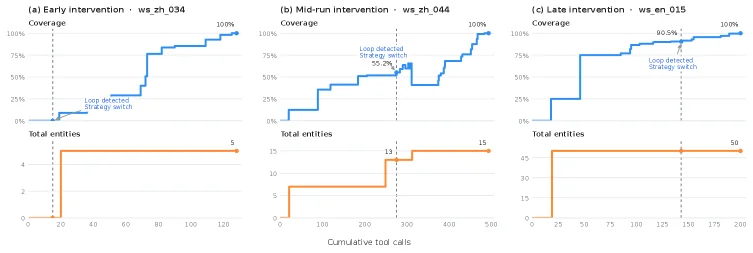
4. 中间件控制:通过“搜索工具中间件”监控和管理代理行为,避免重复错误并强制执行预算。
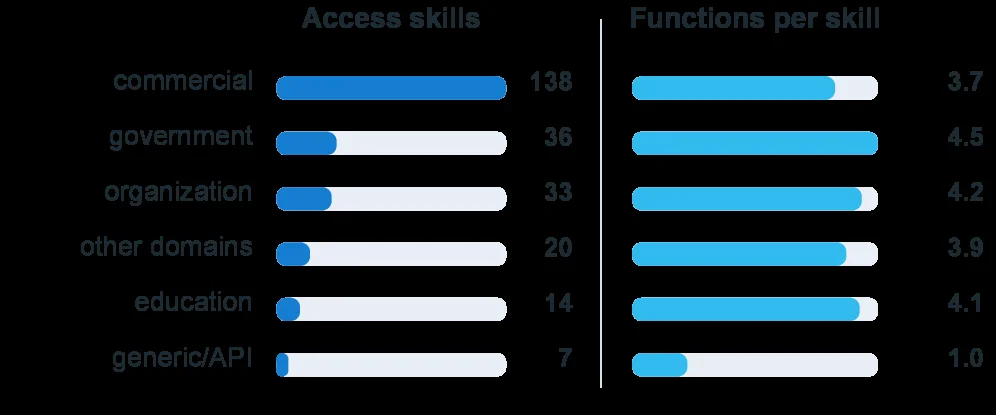
5. 分层技能系统:分离通用搜索策略和特定网站访问技能,提升跨任务的复用性。
切入角度:与先前工作相比,SearchOS的关键差异在于:
- 从隐式到显式状态:将任务进度从对话历史中提取为系统级状态,避免依赖代理记忆。
- 从单代理到多代理协作:通过共享状态和动态调度实现高效协作,而非简单并行。
- 从任务特定到可复用技能:设计分层技能系统,支持跨场景复用,而非为每个任务重新学习。
这些创新使SearchOS在实验中显著优于现有基线,为构建鲁棒的信息检索协作系统奠定了基础。