Read It Back: Pretrained MLLMs Are Zero-Shot Reward Models for Text-to-Image Generation
arXiv · HuggingFace · ▲82
Abstract (verbatim)
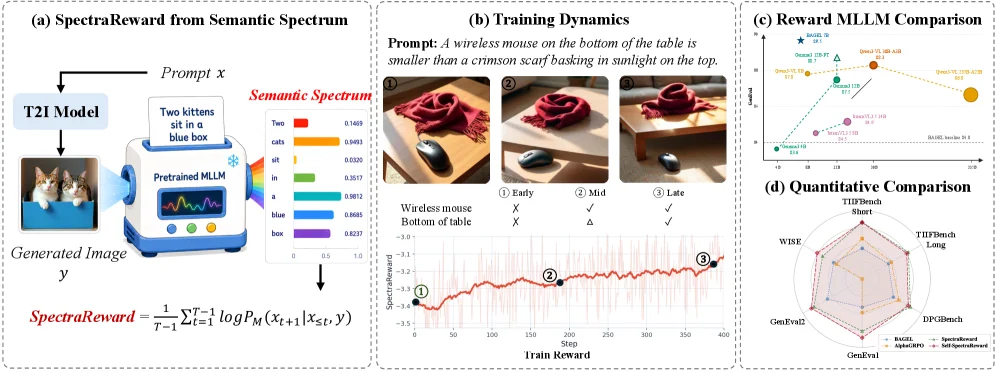
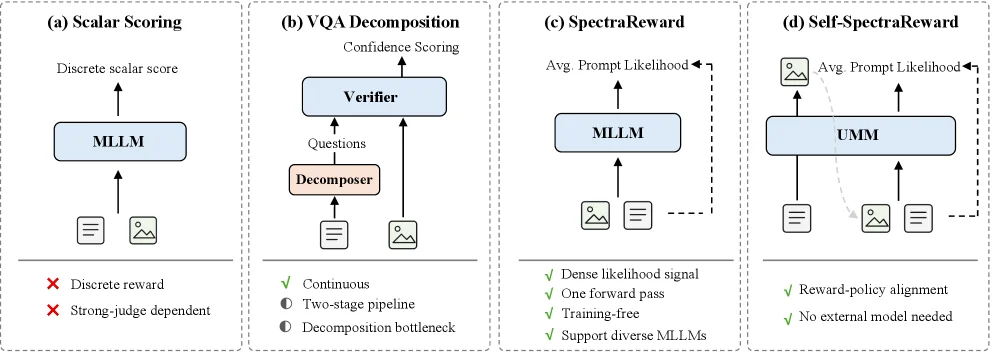
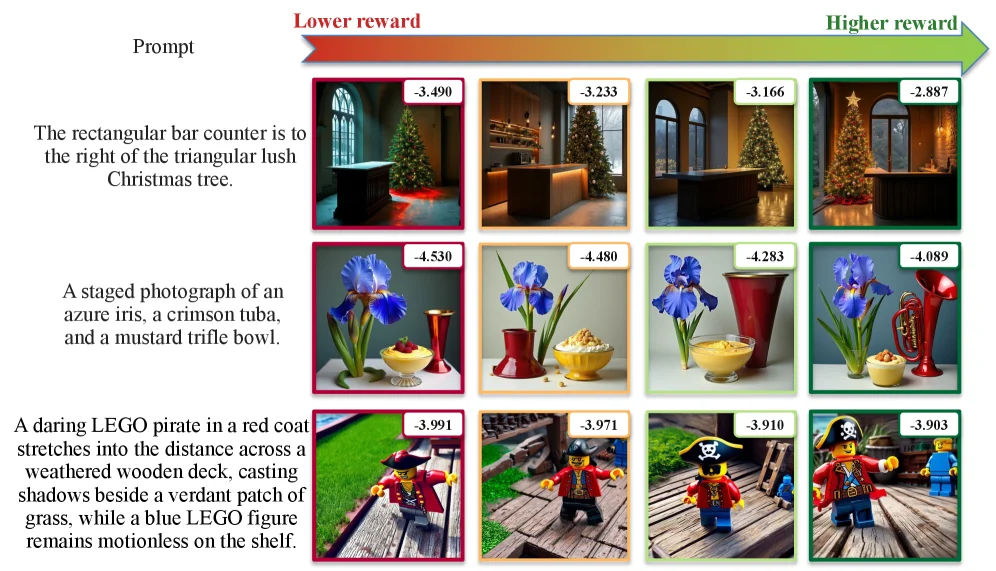
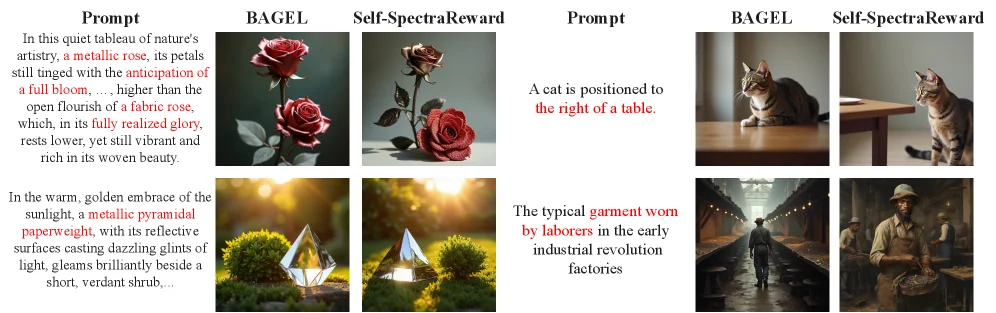
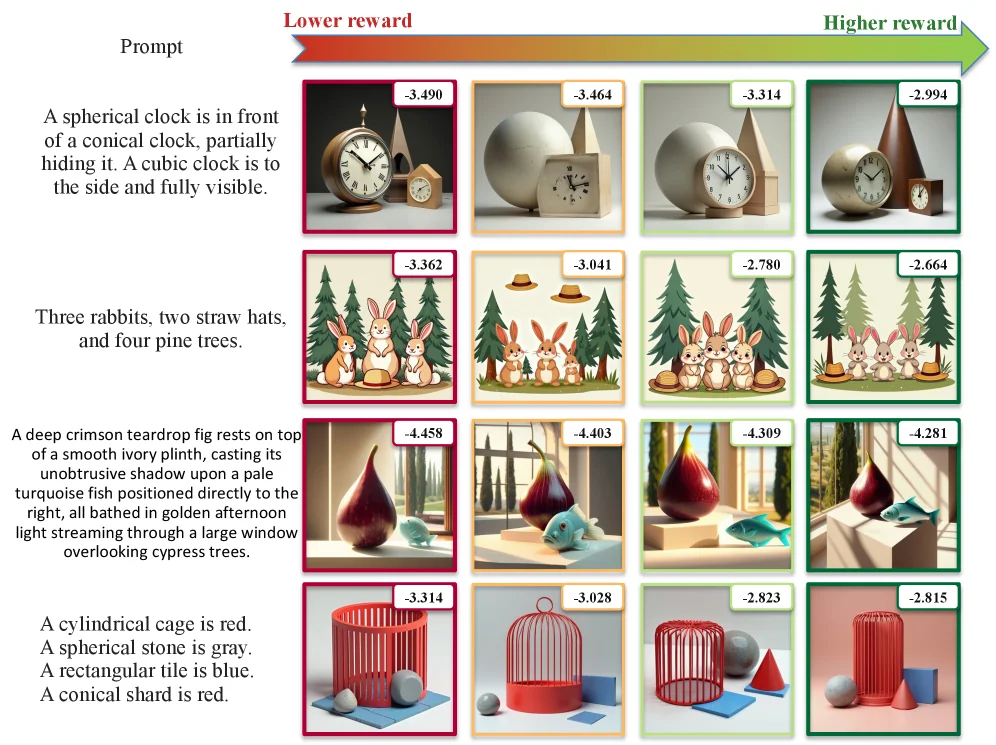
In this paper, we propose SpectraReward, a training-free reward function that turns pretrained MLLMs into off-the-shelf reward models for image-generation reinforcement learning. Instead of asking the MLLM to judge a generated image or answer decomposed verification questions, SpectraReward measures how well the original prompt can be recovered from the generated image through a single image-conditioned, teacher-forced forward pass. We use the average image-conditioned prompt log-likelihood as the reward, directly reusing the MLLM's pretrained image-text alignment ability without preference labels, reward-model fine-tuning. We further introduce Self-SpectraReward, a special case for unified multimodal models where the policy's own understanding branch serves as the reward model for its generation branch, forming a closed-loop self-improving framework without external reward models or external knowledge. Extensive experiments validate SpectraReward through a broad image-generation RL study covering two diffusion models, three RL algorithms, nine reward MLLM backbones from four MLLM families spanning 4B to 235B parameters, and five out-of-distribution text-to-image benchmarks. Results show that both SpectraReward and Self-SpectraReward significantly and consistently improve generation performance and outperform prior MLLM-derived reward training methods. Further analysis reveals that larger reward MLLMs are not always better, while Self-SpectraReward can match or surpass much larger external reward models, suggesting that reward-policy alignment is a key factor for effective image-generation RL. Project Page: https://huangrh99.github.io/SpectraReward/
Background
Background Analysis
Image generation technology has advanced rapidly in recent years, evolving from specialized text-to-image models to unified multimodal models (UMMs) that integrate visual understanding and generation capabilities. Reinforcement learning (RL) has emerged as a powerful post-training technique to enhance compositional fidelity and instruction-following, but its effectiveness hinges on two critical components: the optimization algorithm and the reward model. The reward model, in particular, determines the upper limit of the policy's performance, yet designing an efficient and reliable one remains challenging.
Previous approaches fall into two categories: those relying on human preference annotations, which are expensive to collect and iterate, and those repurposing pretrained multimodal large models (MLLMs) as zero-shot reward sources. While the latter avoids training costs, it suffers from issues like reward calibration sensitivity and scoring noise, or introduces complex engineering workflows for question decomposition. Existing methods thus fail to meet the need for a reward model that is simultaneously preference-label-free, training-free, and ready-to-use.
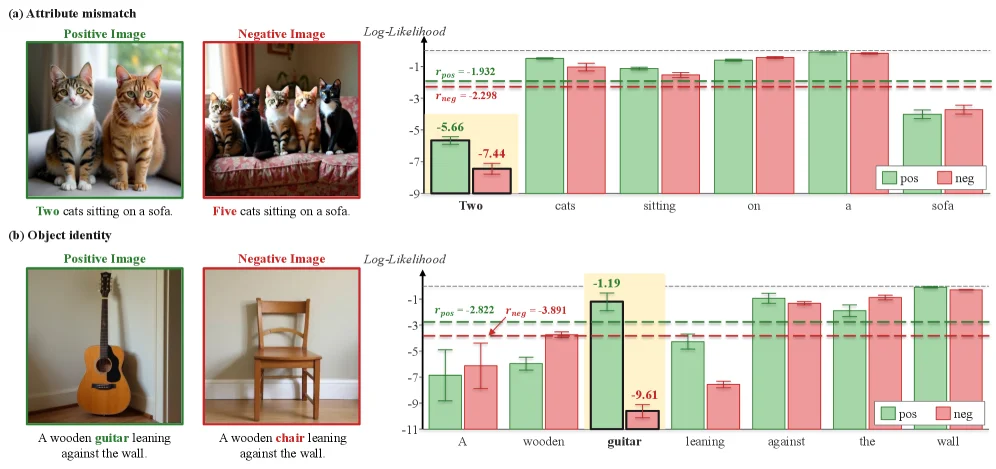
This paper proposes SpectraReward, which repurposes pretrained MLLMs as reward models by measuring how well generated images can "read back" the original prompts—specifically by computing the average log-likelihood of the prompt tokens conditioned on the image. For unified multimodal models, it introduces Self-SpectraReward, where the model's own understanding branch provides rewards for its generation branch, forming a closed-loop self-improvement framework without external dependencies.
Key differences from prior work include: 1) Instead of asking MLLMs to judge image quality or answer decomposed questions, SpectraReward uses a single forward pass to compute prompt recovery; 2) Self-SpectraReward leverages the model's internal architecture for reward-policy alignment, unlike previous methods relying on external models; 3) Experiments show that reward-policy distribution alignment matters more than sheer model scale, challenging conventional wisdom. This approach achieves better performance while maintaining efficiency.