LightMem-Ego: Your AI Memory for Everyday Life
arXiv · HuggingFace · ▲47
Abstract (verbatim)
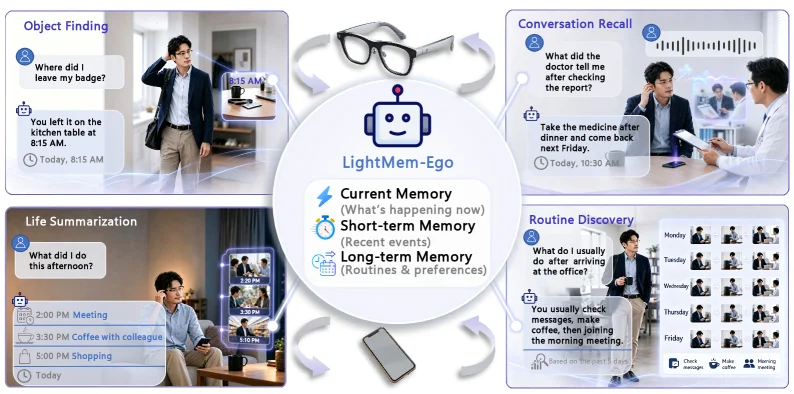
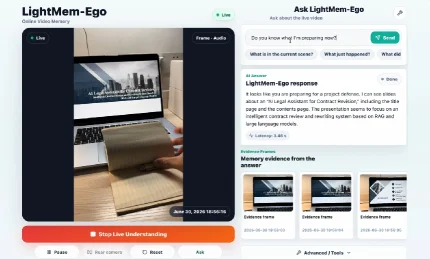
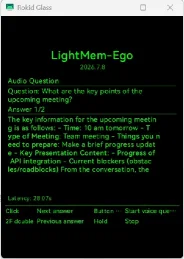
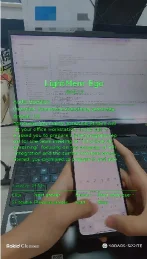
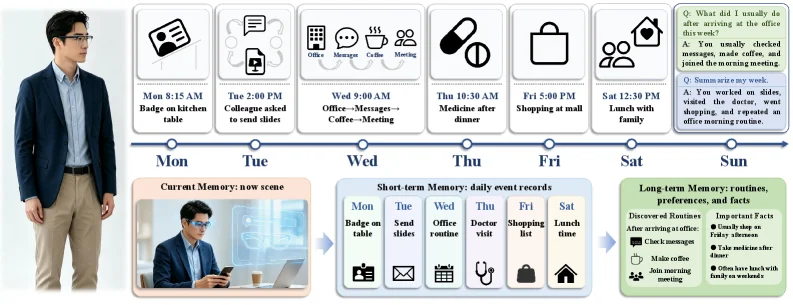
Personal AI assistants on mobile and wearable devices continuously perceive users' daily lives through visual and audio streams. However, answering queries about past experiences requires lightweight multimodal memory that can continuously accumulate, organize, and retrieve long-term experiences, which remains challenging. To address this challenge, we present LightMem-Ego, a lightweight streaming multimodal memory system for everyday-life assistance. The system continuously captures egocentric visual and audio streams, aligns them on a shared timeline, and organizes them into a hierarchical memory consisting of current, short-term, and long-term memory. Given a user query, LightMem-Ego dynamically routes retrieval to the appropriate memory level and generates answers grounded in multimodal evidence. The demonstration can be deployed on smartphones and AI glasses, supporting object finding, conversation recall, life summarization, routine discovery, and personalized assistance. Code is available at https://github.com/zjunlp/LightMem-Ego.
Background
With the widespread adoption of smartphones and smart glasses, personal AI assistants are becoming increasingly integral to our daily lives. These devices continuously capture users' visual and audio information, providing rich data on daily experiences for AI assistants. However, existing AI assistants still face challenges when handling queries related to users' past experiences.
In terms of technical background, this type of technology is mainly applied to personal memory assistance in daily life. For example, it can help users find lost items, recall recent conversations, summarize daily activities, and analyze long-term habits and routines. These functions can significantly improve users' quality of life and efficiency.
Previous problems mainly focused on three aspects: Firstly, daily experiences come in the form of continuous visual-audio streams without clear event boundaries, making it difficult for AI assistants to transform these raw observations into coherent event-level experiences. Secondly, how to effectively organize continuously accumulated experiences into current, short-term, episodic, and semantic memories while maintaining the efficiency of long-term deployment is also a challenge. Finally, user queries usually span multiple time ranges, requiring dynamic routing across different memory levels rather than relying on a single context window or flat retrieval storage.
To address these issues, this paper proposes the LightMem-Ego system. The system connects lightweight smartphone or smart glasses clients to a backend that receives egocentric visual-audio streams, divides recent observations into events, and organizes them into a three-level memory hierarchy: current memory for ongoing context, short-term memory for recent micro-events, and long-term memory for consolidated events and semantic facts. When answering questions, a memory router selects evidence based on the temporal scope and intent of the query, enabling the system to provide reliable answers about the present, recent past, and long-term routines in a unified interface.
The key difference from previous work is that LightMem-Ego adopts a streaming multimodal memory system approach, which can continuously capture, organize, retrieve, and reason about daily life experiences. This allows the system to better adapt to users' actual needs and provide more accurate and efficient assistance in various tasks.