ABot-AgentOS: A General Robotic Agent OS with Lifelong Multi-modal Memory
arXiv · HuggingFace · ▲84
Abstract (verbatim)
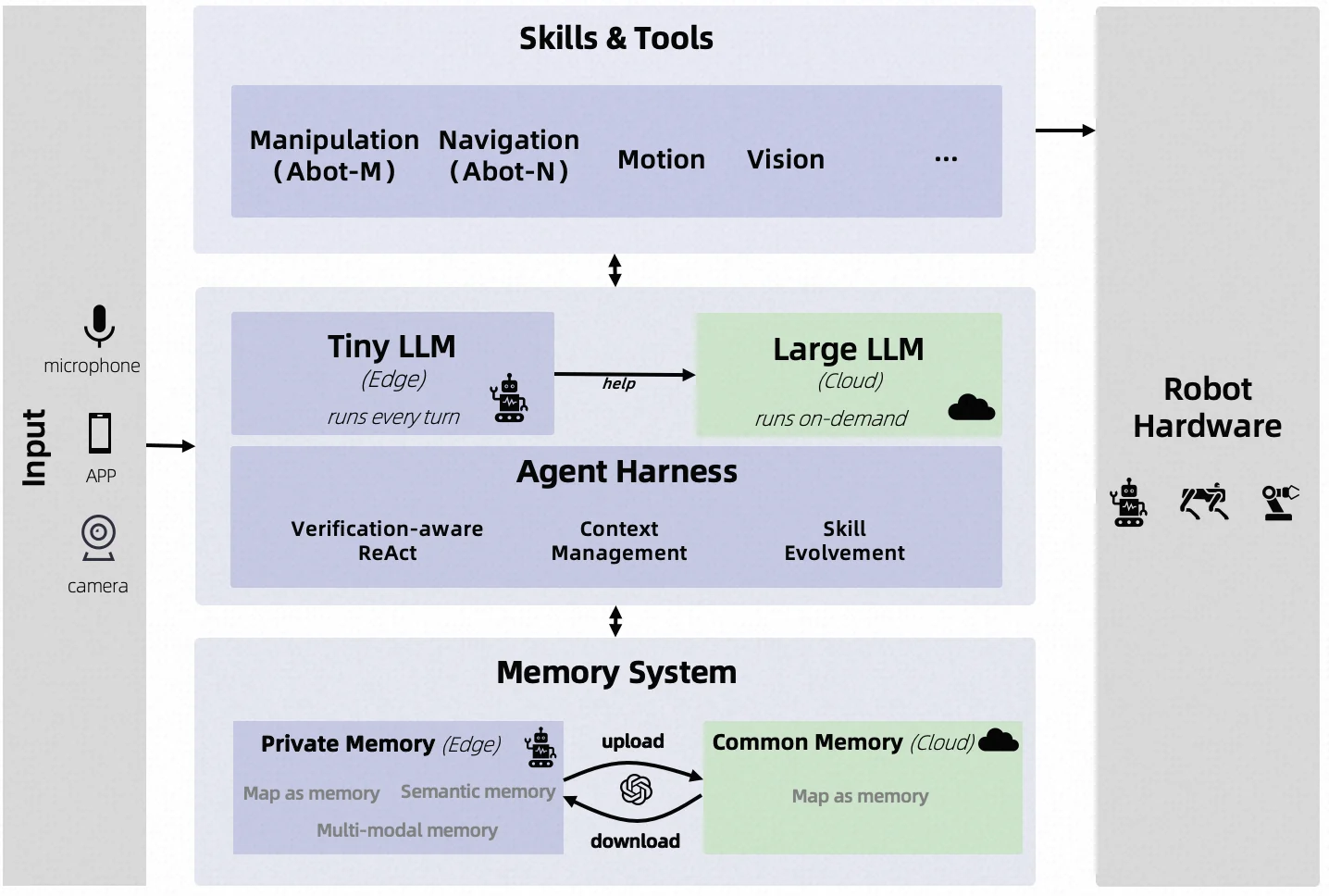
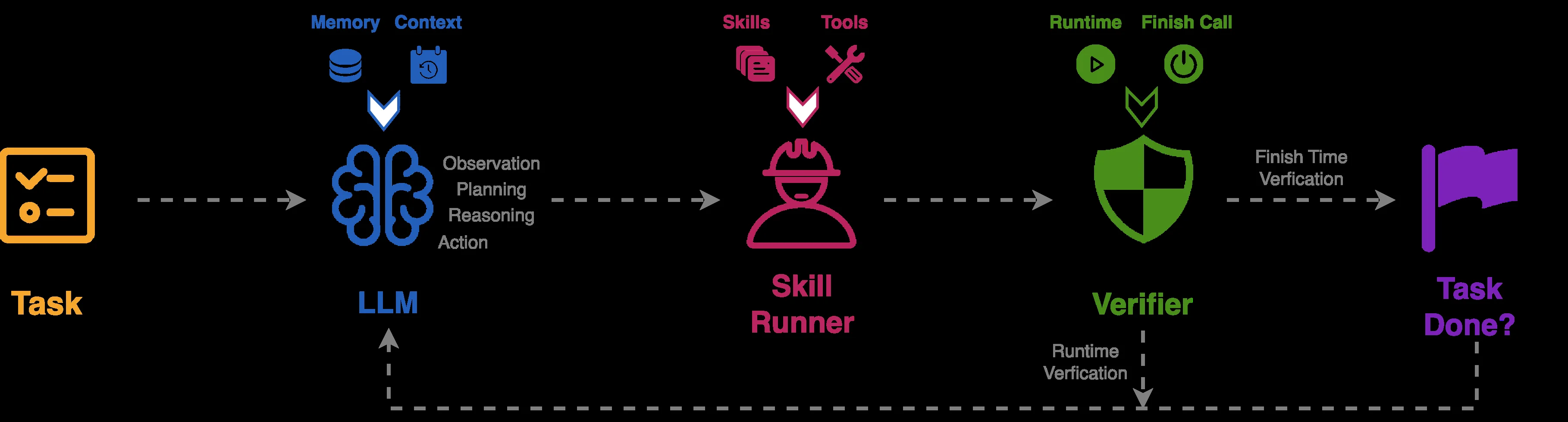
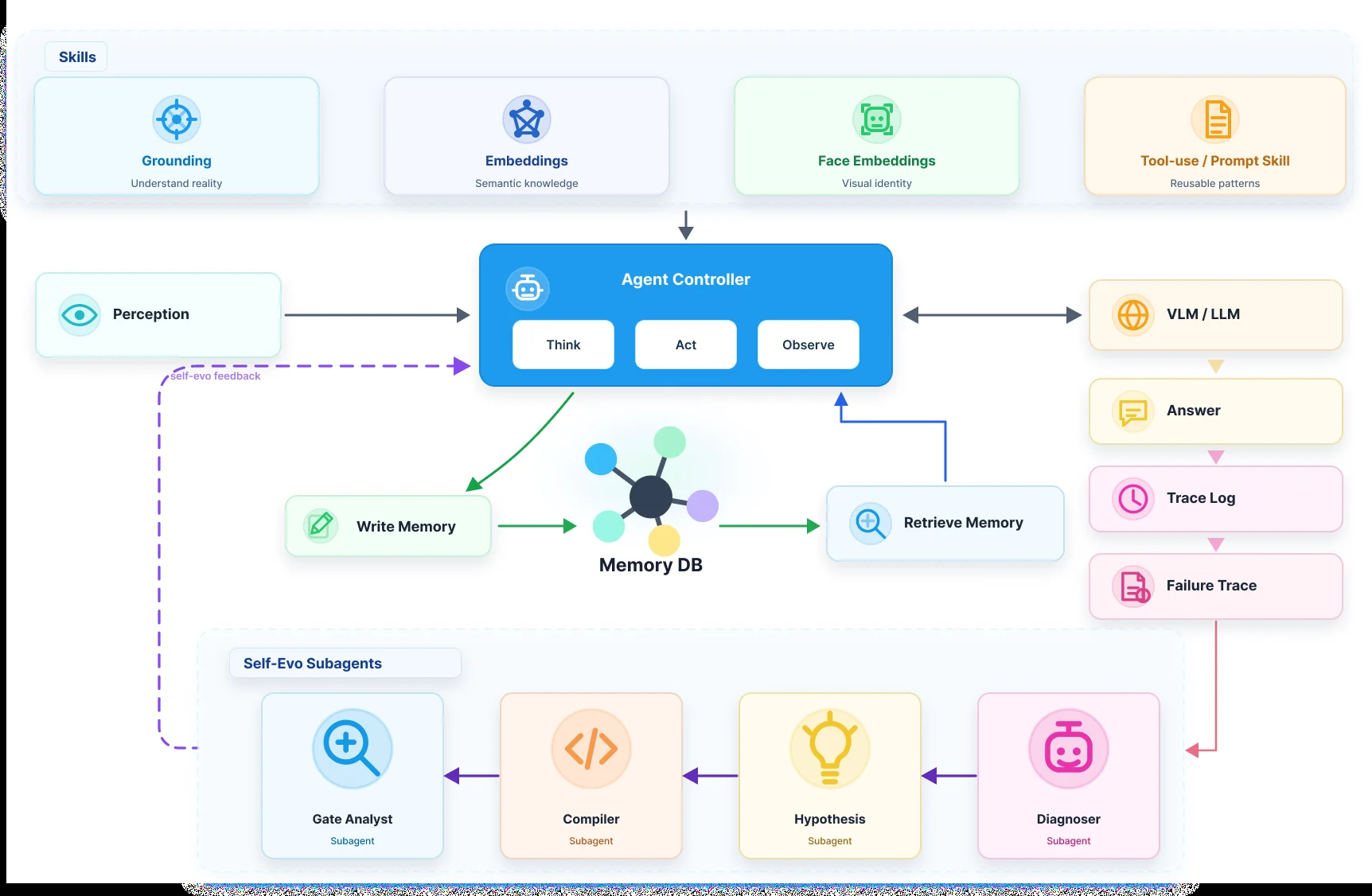
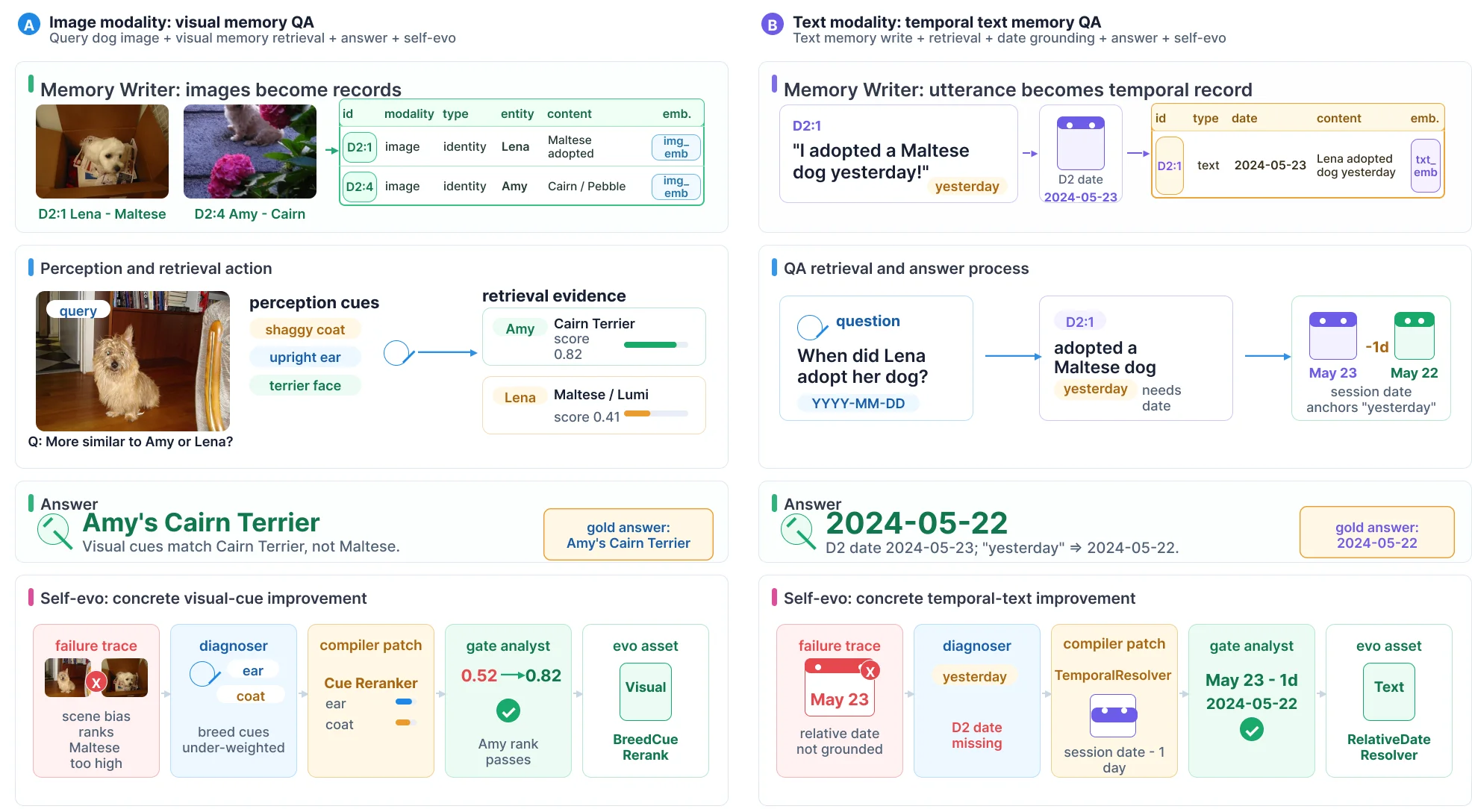
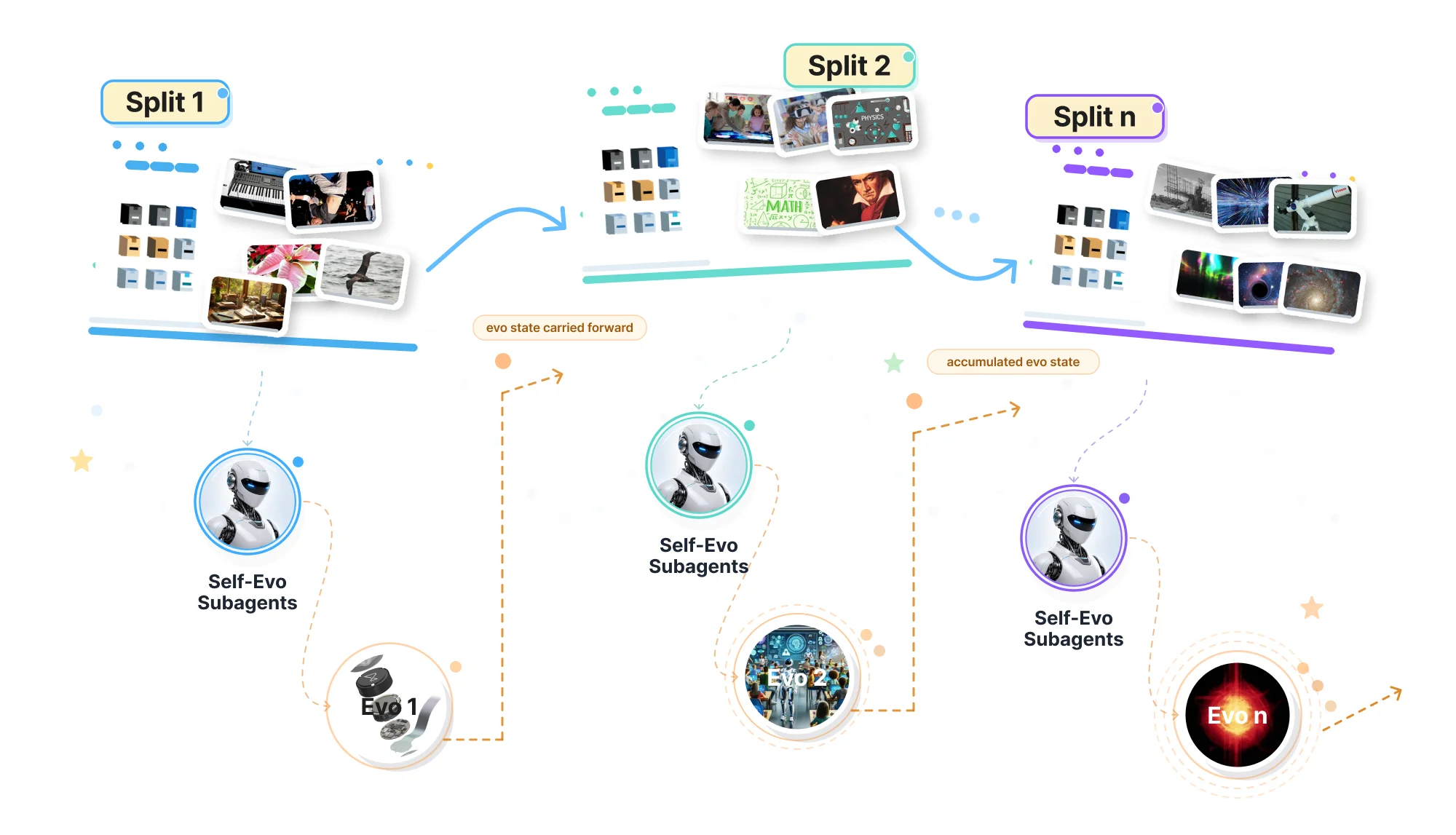
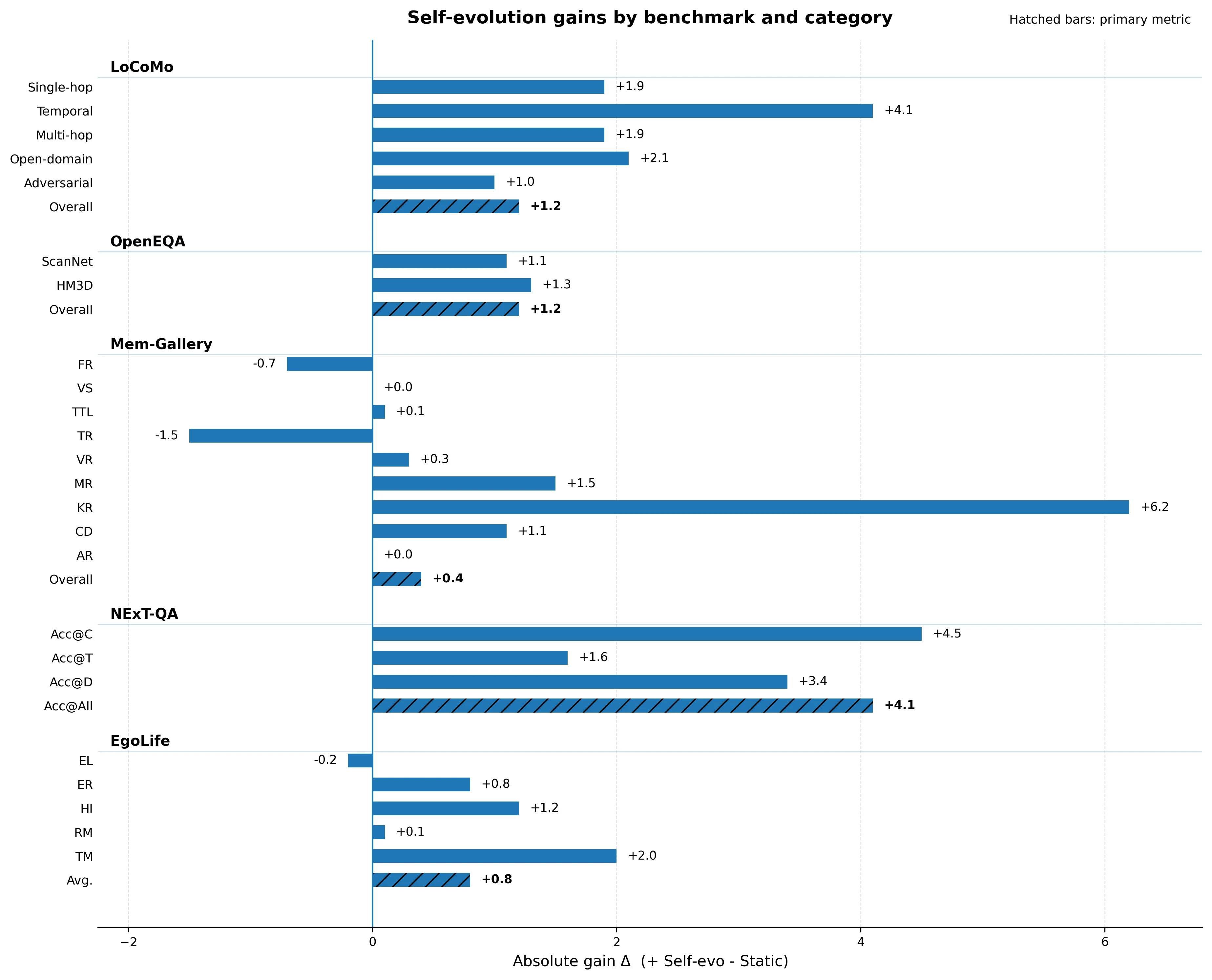
Recent VLM and VLA systems have improved robotic perception and action prediction, yet long-horizon embodied agents still require a general runtime layer for reasoning, memory, tool use, verification, and cross-embodiment execution. We present ABot-AgentOS, a general robotic Agent Operating System that sits above low-level controllers and provides a deliberative agent layer for scene-conditioned planning, context-isolated skill execution, multi-stage verification, multi-modal memory, and edge-cloud collaboration. To evaluate such systems, we introduce EmbodiedWorldBench, an executable benchmark with 16 indoor, outdoor, and hybrid scenes, four difficulty levels, and over 200 tasks involving navigation, object search, NPC dialogue, dynamic events, and trace-grounded scoring. ABot-AgentOS further introduces Universal Multi-modal Graph Memory, a persistent source-grounded substrate that converts dialogue, visual observations, spatial context, temporal relations, and task traces into typed nodes and edges. A failure-driven self-evolution loop converts diagnosed memory failures into gated runtime evo-assets that are promoted only to later evaluation splits, preventing current-split ground-truth leakage while enabling continual improvement. On an initial EmbodiedWorldBench subset, ABot-AgentOS improves over a single-controller baseline in both task success and goal completion. Across memory benchmarks, ABot-AgentOS Static achieves 87.5 on LoCoMo, 59.9 on OpenEQA EM-EQA, 88.6 on Mem-Gallery, and 76.5 Acc@All on NExT-QA; self-evolution further improves LoCoMo to 88.7, OpenEQA to 60.4, and Mem-Gallery to 89.0. These results suggest that a general Agent OS layer can improve long-horizon embodied execution while providing persistent, auditable memory for continual interaction.
Background
Background Analysis
1. Technical Context and Real-World Needs
As robotics advances, there is growing demand for AI to move beyond digital tasks (e.g., chatbots or image recognition) to perform complex, long-horizon tasks in the physical world—such as home assistance, industrial inspection, or dynamic collaboration. This "embodied intelligence" requires solving three core challenges: how to translate complex instructions into reliable actions, how to adapt a single system to different robot morphologies (e.g., humanoid vs. quadrupedal robots), and how to enable robots to retain critical information over time (e.g., "I couldn’t find the key in this room last time, so I should check the drawer this time"). These needs drive a shift from "single-task execution" to "sustained autonomous decision-making."
2. Limitations of Previous Approaches
Despite progress in vision-language models (VLMs) and robot control, existing systems face three major bottlenecks:
- Disconnect between reasoning and execution: Many systems directly map AI model outputs to actions, lacking an intermediate layer for task decomposition, verification, or error handling (e.g., a robot might pick up a cup without considering if it’s full of water).
- Lack of morphological generalization: Existing solutions are often tied to specific hardware or environments (e.g., lab-only robotic arms), making cross-body adaptation costly.
- Limited memory systems: Traditional memory solutions store only text or short-term data, failing to persistently associate multimodal information (e.g., visual observations, dialogue history, and spatial relationships), which prevents robots from learning from long-term experiences (e.g., forgetting previously encountered obstacles).
3. Proposed Solution
ABot-AgentOS addresses these issues through three innovations:
- General robotic OS architecture: A "agent layer" is inserted between low-level controllers (e.g., motion control) and high-level AI models to handle task planning, tool use, and error recovery. This layer acts as a "manager," coordinating modules like speech understanding, visual navigation, and skill invocation while supporting diverse robot morphologies.
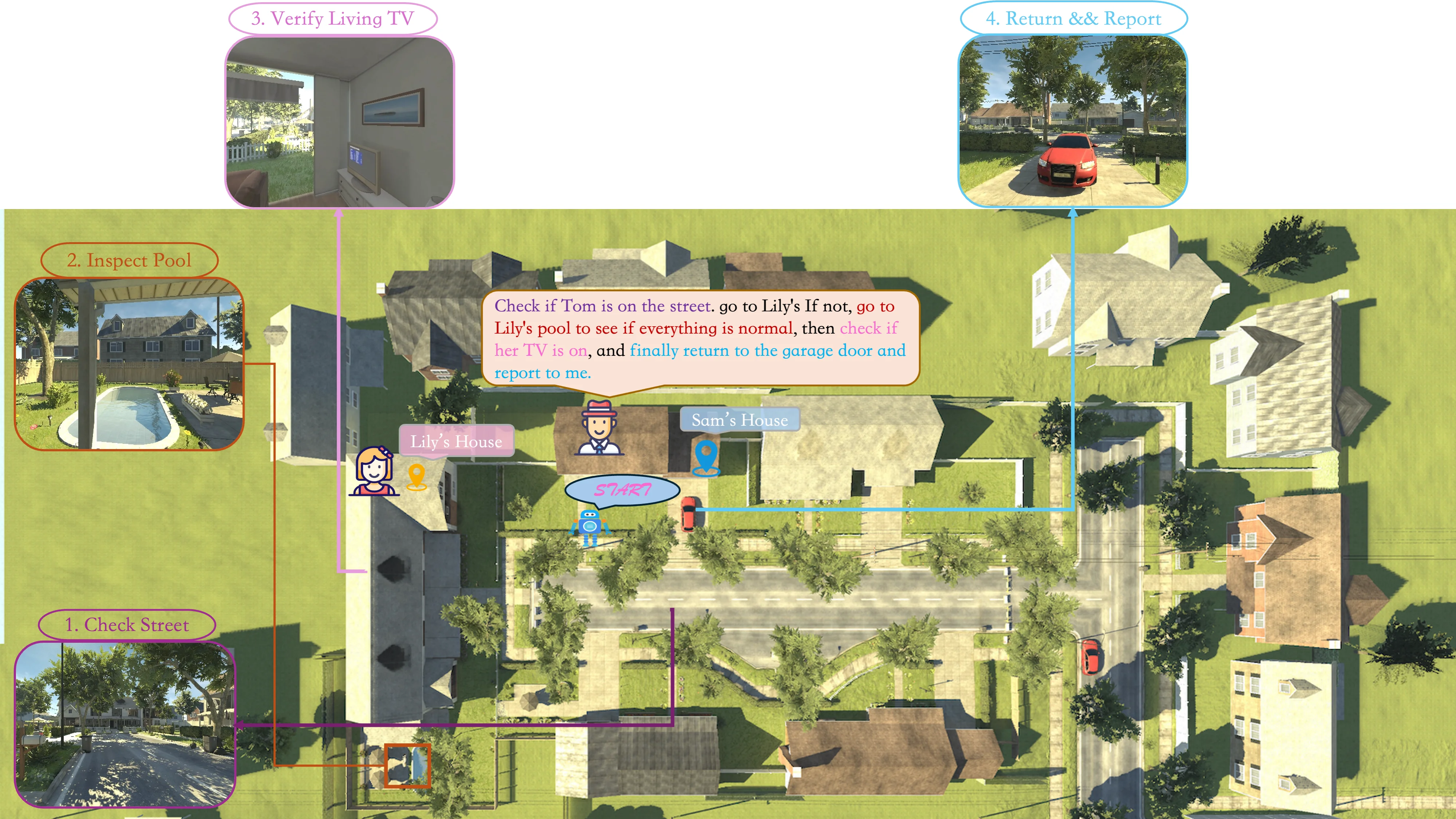
- Dynamic benchmarking: EmbodiedWorldBench is designed to evaluate long-horizon capabilities in complex scenarios (e.g., dialoguing with humans, dynamic obstacle avoidance) across indoor, outdoor, and hybrid environments.
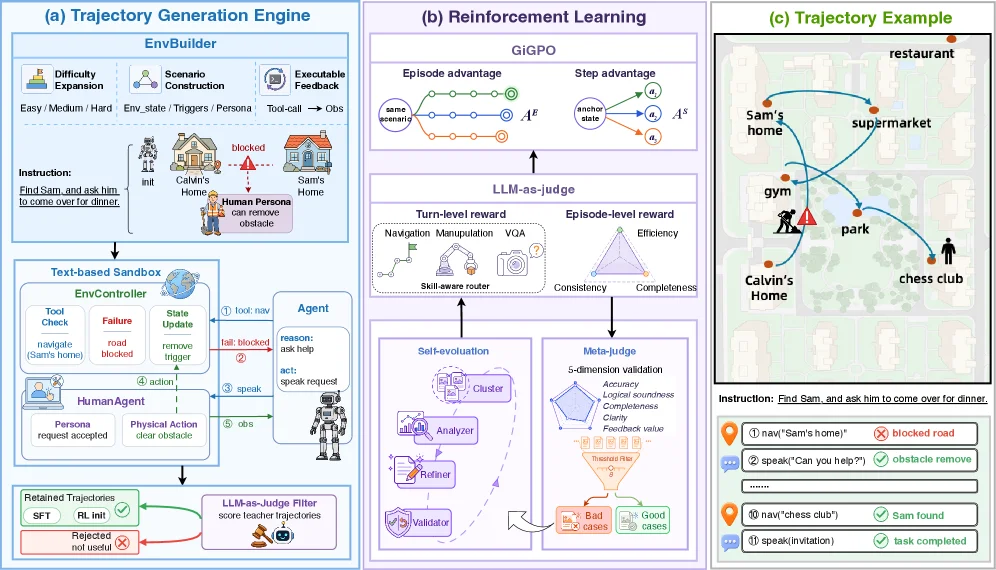
- Multimodal memory system: Robot experiences (e.g., dialogues, visual observations, task traces) are stored as structured "graph memory," with failure analysis enabling automatic optimization (e.g., if a task fails, the system records the reason and avoids repeating it).
4. Key Differences and Innovations
Compared to prior work, ABot-AgentOS’s breakthroughs lie in:
- Layered decoupling: Separating cognitive reasoning from physical execution makes the system more flexible and scalable.
- Cross-morphology generalization: Plugin-based design supports diverse robots rather than optimizing for a single device.
- Evolvable memory: Memory is not just storage but continuously improves via "failure-driven learning," making robots smarter over long-term interactions.
This system provides a foundation for embodied intelligence to transition from lab prototypes to real-world applications, enabling robots to "think, remember, act, and learn" like humans.