🌊 Tide

Information moves like the tide. We pick the waves worth studying.

中文

← Today's tide

Published 2026-07-09 · National Yang Ming Chiao Tung University · Cheng-De Fan, Chun-Wei Tuan Mu, Chen-Wei Chang et al.

LongE2V: Long-Horizon Event-based Video Reconstruction, Prediction, and Frame Interpolation with Video Diffusion Models

arXiv · HuggingFace · ▲28

Abstract (verbatim)

Recovering high-quality video from sparse event streams is a challenging task. Regression methods often blur textures, while existing generative models struggle with long-term stability. We propose LongE2V, a novel approach that leverages pre-trained video diffusion priors to jointly handle event-based video reconstruction, prediction, and frame interpolation. By fine-tuning a foundational video model, our approach achieves high data efficiency and superior perceptual quality. We introduce Autoregressive Unrolling and Adaptive Context Switching to mitigate temporal drift in extremely long sequences. We also propose Reencoding Alignment with Cross Residual Correction to ensure precise bidirectional consistency during frame interpolation. Furthermore, Event Voxel Density Augmentation ensures robustness across varying sensor resolutions. Extensive experiments on real-world benchmarks demonstrate that LongE2V outperforms state-of-the-art methods across all three tasks, exhibiting exceptional temporal coherence and zero-shot generalization. Project page: https://cdfan0627.github.io/LongE2V-page/

Background

Event cameras, inspired by biological vision, capture asynchronous brightness changes with microsecond precision and high dynamic range, making them critical for high-speed scenarios like industrial inspection or autonomous driving. The core challenge is reconstructing high-fidelity videos from sparse, intensity-free event streams—a task complicated by real-world demands for detail preservation, long-term coherence, and zero-shot frame interpolation.

Previous approaches faced fundamental limitations: regression-based models (e.g., E2VID) suffered from "regression-to-the-mean," blurring textures, while naive diffusion models accumulated errors in long sequences and produced ghosting artifacts in interpolation. Early methods relied on task-specific architectures (CNNs/RNNs or Transformers), forcing trade-offs between reconstruction, prediction, and interpolation. These failures stemmed from event data’s sparsity and asynchronicity, which traditional algorithms struggled to process consistently over time.

LongE2V addresses these issues by leveraging pre-trained video diffusion models (VDMs) as a unified framework. Its key innovations include: 1) Treating reconstruction, prediction, and interpolation as conditional generation tasks driven by event voxels; 2) Introducing "Autoregressive Unrolling" and "Adaptive Context Switching" to dynamically adjust temporal dependencies, mitigating drift in long sequences; 3) Using "Reencoding Alignment with Cross Residual Correction" to ensure temporal consistency in interpolation. A novel "Event Voxel Density Augmentation" further enhances robustness across sensor resolutions.

Unlike prior work, LongE2V uniquely unifies multiple tasks under a single diffusion-based paradigm, avoids task-specific architectures, and explicitly tackles long-term stability through dynamic temporal modeling. Experiments show it outperforms state-of-the-art methods in all three tasks, achieving superior perceptual quality, stability, and zero-shot generalization—addressing gaps left by both traditional methods and naive generative approaches.
Method, Figure by Figure

M E T H O D1 / 5

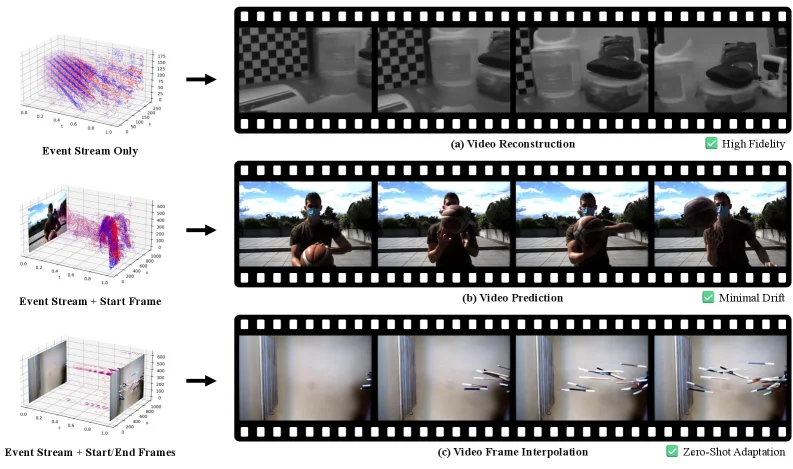
Figure 1. Event-based video generation. We leverage pre-trained video diffusion priors to address three distinct inverse problems within a single architecture. Depending on the input condition, our model performs: (a) Video Reconstruction , recovering high-fidelity textures from sparse event streams, (b) Video Prediction , generating long-term sequences from a single start frame with minimal drift via our autoregressive unrolling strategy, and (c) Video Frame Interpolation , achieving zero-shot adaptation to synthesize intermediate frames by leveraging event dynamics as temporal guidance.

This figure (Figure 1) from the paper "LongE2V: Long-Horizon Event-based Video Reconstruction, Prediction, and Frame Interpolation with Video Diffusion Models" clearly illustrates how the proposed method (LongE2V) utilizes pre-trained video diffusion models to address three distinct inverse problems in event-based video generation. The image is divided into three main sections (a, b, c), each showcasing a different task and its corresponding input-output flow.

First, we examine the leftmost column, which displays three different input conditions, each represented by a visualization of an event stream. Event streams are typically visualized as 3D voxel grids, where color and density represent the location and intensity of events over time.

  1. First Row (a) Video Reconstruction:

    • Input Condition: The left side shows "Event Stream Only." This means the model only has access to the spatiotemporal information from events, without any initial image frames.
    • Information Flow: An arrow points from the "Event Stream Only" voxel plot to a sequence of reconstructed video frames on the right.
    • Output Result: The right side shows a sequence of reconstructed video frames. These frames exhibit "High Fidelity," as indicated by the green checkmark. This demonstrates that the method can recover high-quality texture details from sparse event streams.
    • Method Operation: This section illustrates how the model reconstructs video using only event data. Through the pre-trained video diffusion model, LongE2V can infer clear image content from the dynamic information contained in events.
  2. Second Row (b) Video Prediction:

    • Input Condition: The left side shows "Event Stream + Start Frame." This means the model has both the spatiotemporal event information and the first frame of the sequence.
    • Information Flow: An arrow points from the "Event Stream + Start Frame" voxel plot (and implicitly the start frame, though not explicitly shown) to a sequence of predicted video frames on the right.
    • Output Result: The right side shows a sequence of predicted video frames. These frames exhibit "Minimal Drift," as indicated by the green checkmark. This indicates that the method can generate long-term stable video sequences based on the start frame and event stream, without significant cumulative errors or visual drift.
    • Method Operation: This section illustrates how the model performs video prediction. Using an "Autoregressive Unrolling" strategy, the model can progressively generate subsequent frames while maintaining temporal consistency. The event stream provides guidance on dynamic changes, while the start frame sets the initial state.
  3. Third Row (c) Video Frame Interpolation:

    • Input Condition: The left side shows "Event Stream + Start/End Frames." This means the model has the first and last frames of the sequence, along with the intermediate event stream.
    • Information Flow: An arrow points from the "Event Stream + Start/End Frames" voxel plot (and implicitly the start and end frames, though not explicitly shown) to a sequence of interpolated video frames on the right.
    • Output Result: The right side shows a sequence of interpolated intermediate video frames. This method has "Zero-Shot Adaptation" capability, as indicated by the green checkmark. This means the model can synthesize natural intermediate frames using event dynamics as temporal guidance, even if it hasn't been explicitly trained on specific scenes.
    • Method Operation: This section illustrates how the model performs video frame interpolation. By leveraging dynamic information from the event stream and the constraints from the start and end frames, the model estimates the image content at intermediate time points. The "Zero-Shot Adaptation" highlights the model's generalization ability.

In summary, this figure reveals the core operational mechanisms of the LongE2V method: * The method is based on a pre-trained video diffusion model, fine-tuned to handle event-based video generation tasks. * It can perform three different tasks depending on the input conditions: video reconstruction (event stream only), video prediction (event stream + start frame), and video frame interpolation (event stream + start/end frames). * For video reconstruction, it recovers high-fidelity textures from sparse events. * For video prediction, it generates long-term stable sequences from a single start frame and event stream, minimizing drift. * For video frame interpolation, it synthesizes intermediate frames using event dynamics as temporal guidance, achieving zero-shot adaptation. * The figure also implies the use of "Autoregressive Unrolling" and "Adaptive Context Switching" to handle temporal drift in long sequences, and "Reencoding Alignment with Cross Residual Correction" to ensure bidirectional consistency during frame interpolation.

This figure intuitively demonstrates the effectiveness of LongE2V across different tasks, emphasizing its advantages in data efficiency, perceptual quality, and temporal coherence.

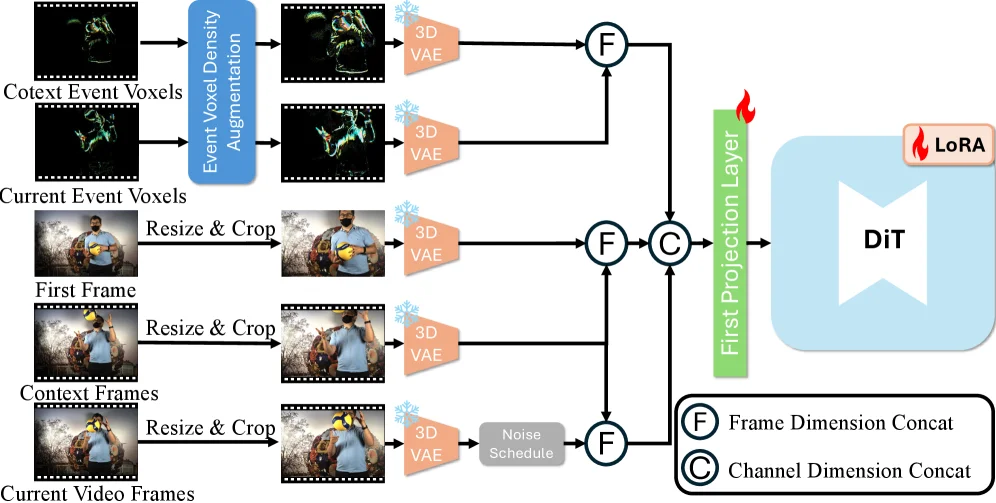
Figure 4. Overview of our training pipeline. To enhance robustness against sensor variations, input event voxels undergo Event Voxel Density Augmentation, and the first frame, context frames, and current video frames are synchronously resized and cropped to ensure spatial alignment. All inputs are encoded into latents via a frozen 3D VAE. These latents are aligned and fused through frame dimension concatenation and channel dimension concatenation. Finally, we expand and fully fine-tune the First Projection Layer to accommodate the additional event channels, while the DiT backbone is efficiently fine-tuned using LoRA.

This figure presents an overview of the training pipeline proposed in the paper "LongE2V: Long-Horizon Event-based Video Reconstruction, Prediction, and Frame Interpolation with Video Diffusion Models." It details the entire process from input data to model training, aiming to enhance robustness against sensor variations and effectively handle joint event-based video reconstruction, prediction, and frame interpolation tasks.

The flow and processing of data are as follows:

  1. Input Data Processing:

    • Event Voxels: There are two types of event voxel inputs: "Cotext Event Voxels" (likely a typo for "Context Event Voxels") and "Current Event Voxels." These event voxels first pass through a module called "Event Voxel Density Augmentation." The purpose of this module is to enhance robustness against varying sensor resolutions by altering the density of event voxels to simulate different sensor characteristics.
    • Frames: There are three types of frame inputs: "First Frame," "Context Frames," and "Current Video Frames." These frames undergo a "Resize & Crop" operation synchronously to ensure spatial alignment, meaning they have the same dimensions and position.
  2. Latent Representation Encoding:

    • The processed event voxels and frames are separately fed into a "frozen 3D VAE" (frozen 3D Variational Autoencoder). The term "frozen" implies that the VAE's weights are not updated during training; it is used solely to encode the input data into latent representations. Each input (whether augmented event voxels or adjusted frames) is encoded into a latent representation, depicted in the figure as orange blocks with snowflake icons, suggesting they are in a preprocessed or encoded state.
  3. Alignment and Fusion of Latent Representations:

    • The encoded latent representations need to be aligned and fused for subsequent processing.
    • For the latent representations of the frames (from "First Frame," "Context Frames," and "Current Video Frames"), a "Noise Schedule" module is shown, which is a typical component in diffusion models used to control the noise level during the denoising process.
    • All latent representations (including both event voxels and image frames) are fused using two methods:
      • Frame Dimension Concat (F): This refers to concatenation along the frame dimension. Multiple circular nodes labeled "F" in the figure indicate this operation.
      • Channel Dimension Concat (C): This refers to concatenation along the channel dimension. A single circular node labeled "C" indicates this operation.
    • These concatenation operations (F and C) combine the latent representations from different modalities (events and images) and time steps into a unified feature representation.
  4. Model Input and Fine-tuning:

    • The fused feature representation is then fed into the "First Projection Layer." The task of this layer is to expand and fully fine-tune to accommodate the additional event channels. This layer is represented in green in the figure with a flame icon, possibly indicating a critical processing step or a point requiring special attention.
    • Finally, the processed features are input into the "DiT" (Diffusion Transformer) model backbone. The DiT module is shown in blue with a "LoRA" label. LoRA (Low-Rank Adaptation) is an efficient fine-tuning technique that allows for updating only a small subset of parameters while freezing most of the model's weights, thus improving training efficiency and data efficiency.

In summary, this figure illustrates a training pipeline that first preprocesses input event voxels and frames (enhancement and spatial alignment), then encodes them into latent representations. These latent representations are fused through frame and channel dimension concatenation. Subsequently, the fused features are adjusted by a specially designed projection layer and finally input into a DiT model fine-tuned using LoRA technology. The entire process aims to leverage the prior knowledge of pre-trained video diffusion models to effectively handle event-based video tasks and address issues like temporal drift in long sequences and bidirectional consistency during frame interpolation.

This figure clearly reveals how the LongE2V method operates: it utilizes multi-modal inputs (events and images), latent space representations, feature fusion, and efficient model fine-tuning strategies to achieve high-quality event-based video reconstruction, prediction, and frame interpolation.

Figure 5. Reencoding Alignment and Cross Residual Correction. To address temporal misalignment caused by the discrepancy between latent-space and pixel-space flipping, we propose Reencoding Alignment. The denoised latents, Z ^ 0 f ​ w ​ d \hat{Z}_{0}^{fwd} and Z ^ 0 b ​ w ​ d \hat{Z}_{0}^{bwd} , are decoded into pixel space, flipped temporally ( F ​ l ​ i ​ p p ​ i ​ x Flip_{pix} ), and then re-encoded via the 3D VAE to yield the aligned latents Z ~ 0 f ​ w ​ d \tilde{Z}_{0}^{fwd} and Z ~ 0 b ​ w ​ d \tilde{Z}_{0}^{bwd} . To mitigate information loss inherent in this re-encoding process, we employ Cross Residual Correction. We calculate the residual difference between the original and the re-encoded latents (e.g., the subtraction node Z ^ 0 f ​ w ​ d − Z ¯ 0 f ​ w ​ d \hat{Z}_{0}^{fwd}-\bar{Z}_{0}^{fwd} ) and inject this detail information into the opposite branch. Specifically, the forward residual is added to the backward aligned latents Z ~ 0 b ​ w ​ d \tilde{Z}_{0}^{bwd} to produce the final corrected latents Z 0 ′ ⁣ b ​ w ​ d Z^{\prime bwd}_{0} , and symmetrically, the backward residual is injected into Z ~ 0 f ​ w ​ d \tilde{Z}_{0}^{fwd} to obtain Z 0 ′ ⁣ f ​ w ​ d Z^{\prime fwd}_{0} . This symmetric Cross Injection mechanism promotes temporal consensus between branches while preserving fine-grained details. Light-colored boxes represent information loss.

This diagram illustrates the workflow of the Reencoding Alignment and Cross Residual Correction mechanisms proposed in the paper, designed to address temporal misalignment caused by flipping in latent and pixel spaces, while mitigating information loss during the reencoding process.

Components and Information Flow:

  1. Initial Latents:
  2. On the left, we start with $\hat{Z}_0^{\text{fwd}}$ (forward latent), and on the right, $\hat{Z}_0^{\text{bwd}}$ (backward latent). These latents are derived from the encoding process of a 3D VAE, representing the latent space of video frames.
  3. Decoding and Forward Flipping (Forward Frames Path):
  4. $\hat{Z}_0^{\text{fwd}}$ is first decoded by a 3D VAE (the orange "3D VAE" module in the diagram) to generate forward frames.
  5. The forward frames undergo a Flip_{pix} operation (pixel-wise temporal flipping, i.e., reversing the frame sequence in the temporal dimension), resulting in "Flipped forward frames."
  6. These flipped forward frames are then encoded again by the 3D VAE to produce $\tilde{Z}_0^{\text{fwd}}$ (aligned forward latent). During this reencoding, information loss occurs (represented by the light-colored box in the diagram), corresponding to $\bar{Z}_0^{\text{fwd}}$ (the reencoded forward latent, which differs from $\hat{Z}_0^{\text{fwd}}$).
  7. Decoding and Backward Flipping (Backward Frames Path):
  8. Similarly, $\hat{Z}_0^{\text{bwd}}$ is decoded by the 3D VAE to generate backward frames.
  9. The backward frames undergo a Flip_{pix} operation (temporal flipping, e.g., reversing the frame sequence), resulting in "Flipped backward frames."
  10. These flipped backward frames are encoded again by the 3D VAE to produce $\tilde{Z}_0^{\text{bwd}}$ (aligned backward latent), with information loss also occurring, corresponding to $\bar{Z}_0^{\text{bwd}}$.
  11. Cross Residual Correction:
  12. Calculate the residuals between the original latents and the reencoded latents (i.e., the "subtraction nodes"):
    • Forward residual: $\hat{Z}_0^{\text{fwd}} - \bar{Z}_0^{\text{fwd}}$ (the subtraction operation indicated by the blue arrow in the diagram).
    • Backward residual: $\hat{Z}_0^{\text{bwd}} - \bar{Z}_0^{\text{bwd}}$ (the subtraction operation indicated by the green arrow in the diagram).
  13. Inject the forward residual into the aligned backward latent $\tilde{Z}_0^{\text{bwd}}$ (the addition operation indicated by the blue arrow in the diagram), resulting in the final corrected backward latent $Z_0'^{\text{bwd}}$.
  14. Symmetrically, inject the backward residual into the aligned forward latent $\tilde{Z}_0^{\text{fwd}}$ (the addition operation indicated by the green arrow in the diagram), resulting in the final corrected forward latent $Z_0'^{\text{fwd}}$.
  15. This "cross-injection" mechanism ensures temporal consistency between the two branches (forward and backward) while preserving fine-grained details.

How the Method Works:

  • Reencoding Alignment: By decoding latents into pixel frames, performing temporal flipping, and reencoding them into latents, this step resolves temporal misalignment caused by flipping in latent and pixel spaces. This generates aligned latents $\tilde{Z}_0^{\text{fwd}}$ and $\tilde{Z}_0^{\text{bwd}}$, but information loss occurs during the process (light-colored box).
  • Cross Residual Correction: Calculate the residuals between the original latents and the reencoded latents, and inject these residuals cross-wise into the opposite branch. This compensates for the information loss during reencoding and enhances temporal consistency between the two branches. For example, forward detail information (residuals) is added to the aligned backward latent, and backward detail information is added to the aligned forward latent, resulting in more accurate and detail-rich corrected latents $Z_0'^{\text{fwd}}$ and $Z_0'^{\text{bwd}}$.

Results and Conclusion (Inferred from the Diagram's Logic):

  • The diagram demonstrates how aligning latents ($\tilde{Z}_0^{\text{fwd}}$ and $\tilde{Z}_0^{\text{bwd}}$) and applying cross residual correction addresses temporal misalignment and information loss.
  • The final corrected latents ($Z_0'^{\text{fwd}}$ and $Z_0'^{\text{bwd}}$) should exhibit better temporal consistency and detail preservation compared to the original $\hat{Z}_0^{\text{fwd}}$ and $\hat{Z}_0^{\text{bwd}}$ or the aligned $\tilde{Z}_0^{\text{fwd}}$ and $\tilde{Z}_0^{\text{bwd}}$. This is crucial for tasks such as video reconstruction, prediction, and frame interpolation.
  • This mechanism ensures precise consistency between bidirectional (forward and backward) latents while preserving fine-grained details, thereby enhancing the performance of the method.

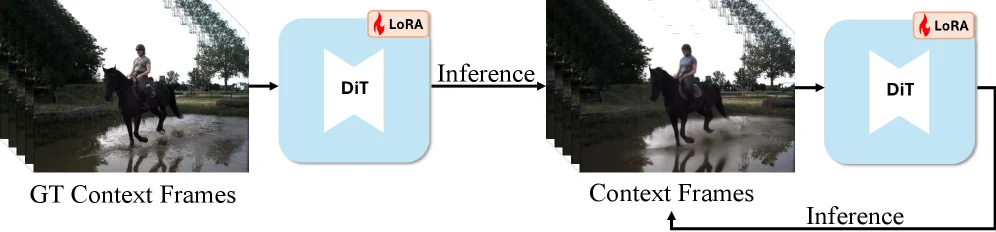
Figure 3. Autoregressive Unrolling. To bridge the domain gap between training and inference, we employ an iterative training strategy. Initially, the model is trained with Ground Truth (GT) context frames for convergence (left). Subsequently, we activate the unrolling mechanism by performing an inference pass to generate predictions, which then replace the GT context frames for fine-tuning (right). This iterative feedback loop forces the model to adapt to its own generation errors, mitigating error accumulation during long video generation.

This figure (Figure 3: Autoregressive Unrolling) visually illustrates a key training strategy proposed in the paper "LongE2V" to address the issue of error accumulation during long-horizon video generation based on event streams. We can break down the process in the diagram into two main phases, understanding its operation through the flow of data and information:

  1. Initial Training Phase (Left Part):

    • Input Data: On the far left, we have "GT Context Frames" (Ground Truth Context Frames). This represents the initial phase of training where the model uses real, high-quality consecutive video frames as input. These frames constitute the "context" or "history" information for the model to learn from.
    • Model Component: In the middle, there is a blue box labeled "DiT" (likely referring to a Diffusion Transformer model, an architecture combining diffusion models and Transformers for video generation), with an "LoRA" logo in its top-right corner. LoRA (Low-Rank Adaptation) is a parameter-efficient fine-tuning technique, indicating that this pre-trained DiT model is being fine-tuned for a specific task.
    • Process and Output: An arrow points from "GT Context Frames" to the "DiT" model, signifying that these real frames are input into the model for processing. Subsequently, an arrow labeled "Inference" points from the first "DiT" model to another set of "Context Frames" on the right. This indicates that after the initial training converges, the model performs an inference (or generation) step. The output of this inference step is "Context Frames," which are predicted frames generated by the model based on the real frames, but they are now labeled as "Context Frames," meaning they will be used for subsequent training iterations.
  2. Autoregressive Unrolling and Iterative Fine-Tuning Phase (Right Part):

    • Input Data Update: Now, the "Context Frames" (i.e., the predicted frames generated by the model in the previous phase) become the new input, replacing the original "GT Context Frames." This step is the core of "autoregressive unrolling"—the model starts making further predictions based on its own generated results.
    • Model Component and Process: The same "DiT" model (with the LoRA logo) receives these new "Context Frames" as input again. Then, another "Inference" arrow points from this "DiT" model back to the "Context Frames" on the left. This arrow forms a feedback loop, indicating that the model will continuously update its context with newly generated frames and perform further fine-tuning.
    • Purpose and Effect: This iterative feedback loop aims to allow the model to adapt to and correct the errors it produces during generation. By repeatedly using newly generated frames (which may contain some errors) as input for retraining, the model can learn to recover from these errors, thereby mitigating error accumulation that might occur during the generation of extremely long video sequences. This method forces the model to "self-correct," improving its long-term prediction stability and accuracy.

In summary, this figure reveals how the "autoregressive unrolling" method in LongE2V operates: it first trains the model using real frames, then allows the model to perform iterative retraining and prediction based on its own generated frames. This process continuously optimizes the model through a feedback loop, enabling it to better handle long-term video generation tasks and reduce error accumulation.

The flow of data or information is: GT Context FramesDiT (with LoRA)InferenceContext FramesDiT (with LoRA)Inference (and feeds back to Context Frames for the next iteration).

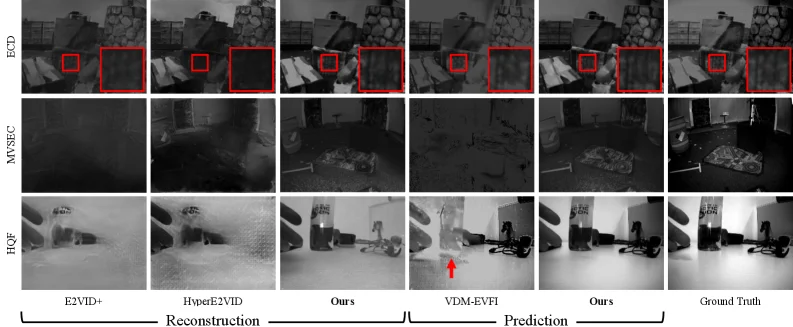
Figure 6. Qualitative comparisons on ECD (Mueggler et al . , 2017 ) , MVSEC (Zhu et al . , 2018 ) , and HQF (Stoffregen et al . , 2020 ) datasets. Our LongE2V recovers high-frequency textures where regression baselines (E2VID+, HyperE2VID) suffer from blurring (Row 1). In prediction tasks, we avoid the severe noise accumulation and ghosting artifacts (red arrow) seen in VDM-EVFI (Rows 2–3), maintaining superior structural fidelity and temporal stability.

This figure is a key result from the paper "LongE2V: Long-Horizon Event-based Video Reconstruction, Prediction, and Frame Interpolation with Video Diffusion Models," used for qualitatively comparing the proposed LongE2V method with existing approaches on different event-camera video tasks. Here's a detailed breakdown:

First, the rows in the figure represent different datasets or task types: * First Row (ECD): Shows reconstruction results on the ECD dataset (Mueggler et al., 2017). These are grayscale images, focusing on scene structure and texture recovery. * Second Row (MVSEC): Shows prediction results on the MVSEC dataset (Zhu et al., 2018). These are also grayscale but from a different scene, emphasizing dynamic scene prediction capability. * Third Row (HQF): Shows reconstruction or prediction results on the HQF dataset (Stoffregen et al., 2020). These are color images, focusing on high-fidelity detail recovery and prediction.

Second, the columns represent different methods or benchmarks: * First Two Columns (E2VID+, HyperE2VID): These are regression-based methods used as baselines for comparison. The images show that these methods tend to suffer from blurring when recovering high-frequency textures (e.g., within the red boxes in the first row). * Middle Column ("Ours"): This is the proposed LongE2V method. In the "Reconstruction" section, LongE2V recovers clearer textures and structures compared to E2VID+ and HyperE2VID. In the "Prediction" section, LongE2V's results also show higher quality. * VDM-EVFI Column: This is another existing generative model method. In prediction tasks (second and third rows), this method exhibits severe noise accumulation and ghosting artifacts (e.g., indicated by the red arrow in the third row), leading to poor structural fidelity and temporal stability. * Last Column ("Ground Truth"): This is the actual reference frame used to evaluate the quality of reconstruction or prediction from various methods. All methods' results should aim to be as close as possible to this column.

The labels at the bottom further explain the column groupings: * Reconstruction: Refers to recovering existing video frames from event streams. This section includes E2VID+, HyperE2VID, and the first "Ours" column. * Prediction: Refers to predicting future video frames from existing event streams or frames. This section includes VDM-EVFI and the second "Ours" column.

How the method works (as revealed by the figure): 1. For Reconstruction Task (part of first and second rows): LongE2V, by leveraging pre-trained video diffusion model priors and techniques like Autoregressive Unrolling and Adaptive Context Switching, effectively recovers clear high-frequency textures and structural details from sparse event streams. Compared to traditional regression methods (like E2VID+ and HyperE2VID), LongE2V avoids texture blurring. 2. For Prediction Task (part of second and third rows): LongE2V, through its proposed methods, mitigates temporal drift in long sequences and ensures precise bidirectional consistency during frame interpolation (via Reencoding Alignment with Cross Residual Correction). This enables LongE2V to avoid severe noise accumulation and ghosting artifacts, as seen with VDM-EVFI, thus maintaining superior structural fidelity and temporal stability when predicting future frames.

Comparison Objects and Conclusions: * Comparison Objects: The figure compares LongE2V with E2VID+, HyperE2VID (regression baselines), and VDM-EVFI (existing generative model). * Conclusion: The figure clearly shows that LongE2V outperforms state-of-the-art methods across all three tasks (reconstruction on ECD, prediction on MVSEC, reconstruction/prediction on HQF). Specifically: * In reconstruction tasks (first row), LongE2V recovers high-frequency textures, while regression baselines suffer from blurring. * In prediction tasks (second and third rows), LongE2V avoids the severe noise accumulation and ghosting artifacts seen with VDM-EVFI, maintaining better structural fidelity and temporal stability. This figure intuitively demonstrates the superior performance of the LongE2V method in handling event-based video reconstruction, prediction, and frame interpolation tasks, especially in managing long-term sequences and maintaining temporal consistency.

← → flip · ↑ ↓ scroll notes · Esc exit