Infinite Worlds with Versatile Interactions
arXiv · HuggingFace · ▲32
Abstract (verbatim)
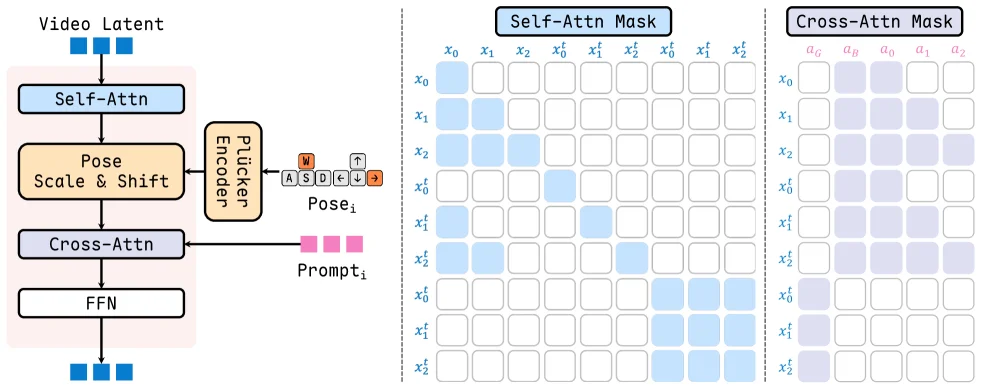
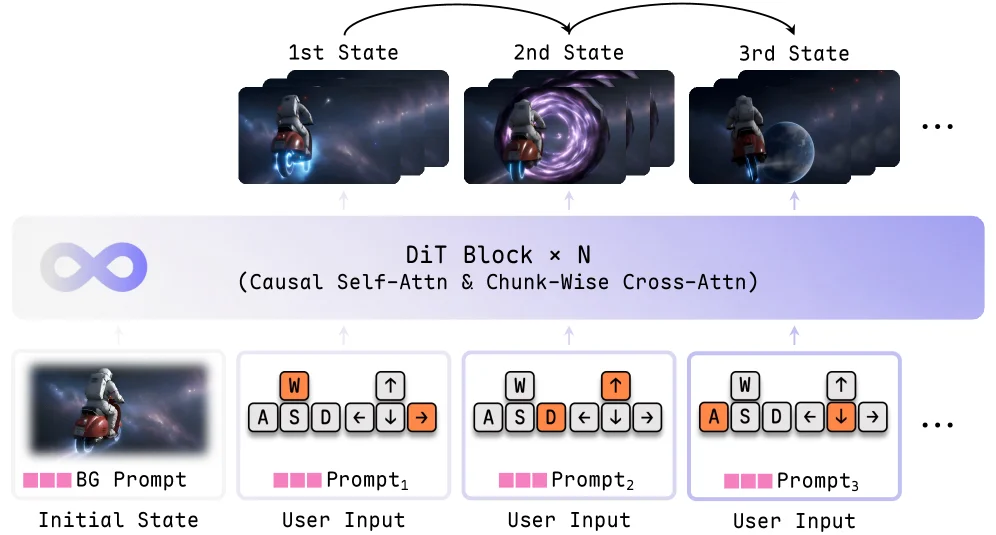
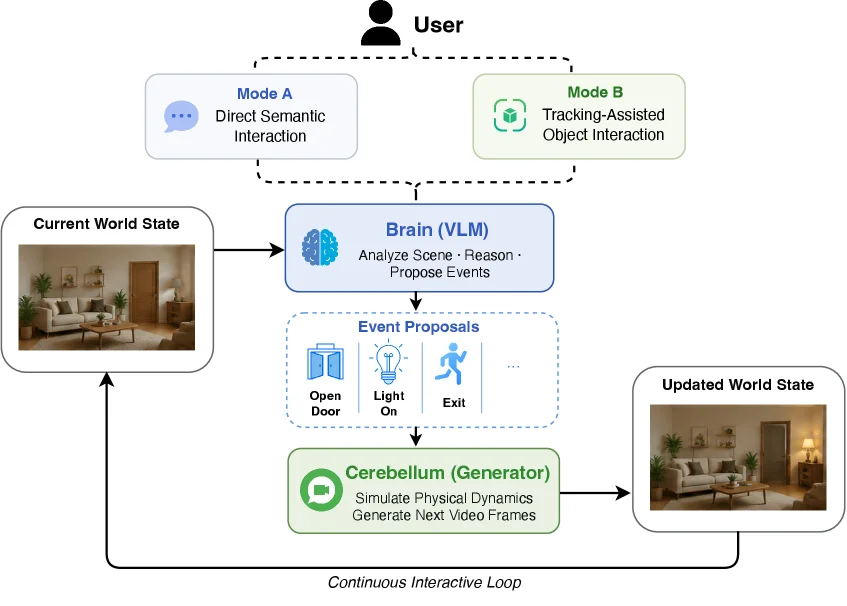
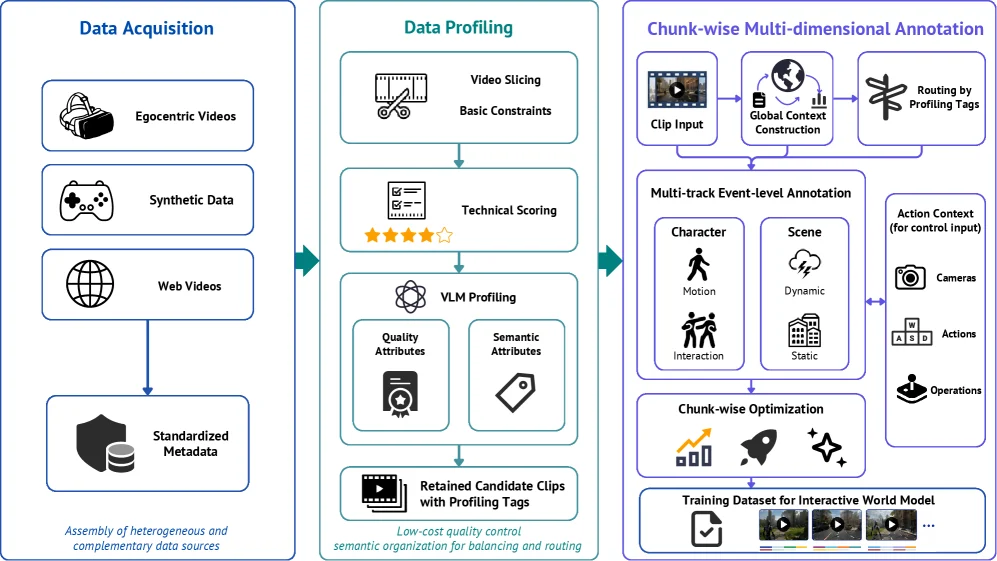
We present LingBot-World 2.0 (also known as LingBot-World-Infinity), an advanced iteration of LingBot-World featuring four distinct upgrades. (1) Our model achieves an unbounded interaction horizon while maintaining consistent output quality, benefiting from a carefully crafted causal pretraining paradigm. (2) Through distilling a real-time variant from the base model, our system guarantees rapid response time, sufficient to drive 720p video streams at 60 fps. (3) Compared to the previous version, this update introduces highly diverse interactive elements, comprising a broader spectrum of actions (e.g., attacking, archery, spell-casting, and shooting) alongside a richer variety of text-driven events. (4) We pioneer the integration of an agentic harness within the domain of world modeling, wherein a pilot agent is tasked with planning and executing character behaviors, while a director agent is responsible for synthesizing novel environmental elements as the scene progresses. Additionally, to facilitate a shared experience, we develop an interface that permits multiple players to simultaneously immerse themselves in this vivid world simulator. We pair our primary 14B model with a lightweight 1.3B counterpart, which supports effortless deployment on a single GPU.
Background
Background Analysis
Technical Context
Interactive world models are technologies that generate environments in real time based on user or agent actions, primarily used in game development and virtual simulation. For example, they can create immersive virtual worlds where players freely explore and interact with the environment, or simulate physical rules (e.g., gravity, collisions) to train robots. The core demand for such technologies is to make virtual worlds "alive"—with realistic visuals and instant responses to user inputs, thus providing an engaging experience.
Previous Limitations
Despite their potential, past approaches suffer from two critical flaws:
1. Lack of long-term stability: Since each frame depends on previous outputs, errors accumulate over time, causing visual distortions (e.g., blurred textures, warped geometry). Most systems only remain stable for seconds to minutes, failing to build a persistent world.
2. Poor high-fidelity interactivity: Real-time rendering of detailed scenes with responsive inputs requires heavy computational resources. Early systems often sacrificed resolution or smoothness, resulting in crude interactions (e.g., slow camera movements).
Proposed Solutions
This paper addresses these issues with four innovations:
1. Stable causal generation model: Improved training methods ensure the model maintains visual quality over extended periods, preventing error accumulation.
2. Real-time distillation: A lightweight version of the model renders dynamic scenes at 720p/60 fps while preserving responsiveness.
3. Rich interaction space: The system supports complex actions (e.g., attacking, spell-casting) and dynamic environmental changes (e.g., weather manipulation).
4. Agent collaboration framework: Two agents—a "pilot" controlling character behavior and a "director" generating new content—enable the world to evolve autonomously rather than following pre-scripted plots.
Unique Approach
Unlike prior work, this study’s key breakthrough lies in combining "stability" and "interactivity": the causal model solves long-term drift, while distillation achieves real-time performance. Additionally, the agent framework introduces autonomy, a departure from script-driven designs in previous research.