Single-Rollout Asynchronous Optimization for Agentic Reinforcement Learning
arXiv · HuggingFace · ▲15
Abstract (verbatim)
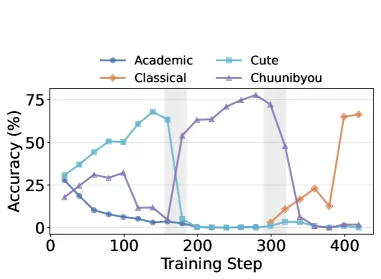
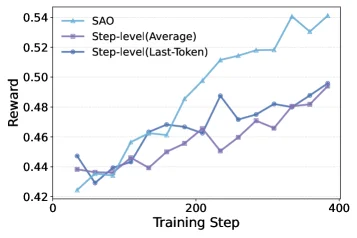
Reinforcement learning (RL) is becoming increasingly important for post-training large language models (LLMs). Previous RL pipelines for LLMs were mostly synchronous and batch-interleaved, which is inefficient for long-horizon agentic tasks. Recently, asynchronous RL has emerged as a more efficient alternative by updating the model as rollouts arrive. However, existing asynchronous RL systems often emphasize throughput, while leaving training stability and task effectiveness largely underexplored. For example, a key challenge is that group-wise sampling in the widely-used GRPO framework does not naturally fit asynchronous agentic training. In this paper, we present Single-rollout Asynchronous Optimization (SAO) to address the stability and off-policy challenges in asynchronous RL. To reduce off-policy effects and improve generalization, we replace group-wise sampling with single-rollout sampling, that is, using one rollout per prompt. We further improve this single-rollout strategy with practical value-model training designs. To improve optimization stability, we introduce a strict double-side token-level clipping strategy. SAO is able to train stably for one thousand steps and consistently outperform GRPO and its variants on agentic coding and reasoning benchmarks, such as SWE-Bench Verified, BeyondAIME, and IMOAnswerBench. We also demonstrate that single-rollout RL is particularly effective in a simulated online learning setting, where the model must adapt to changing evolving environments. To this end, SAO is successfully deployed in the agentic RL pipeline for training the open GLM-5.2 model (750B-A40B).
Background
Background Analysis
1. Technical Context
Recent advances in large language models (LLMs) have shifted focus from supervised pretraining to reinforcement learning (RL) for post-training improvement. The core goal is to enhance model "intelligence" for complex tasks like coding or mathematical reasoning. However, traditional RL pipelines suffer from inefficiency: most approaches use synchronous batch processing, where the policy generates a batch of trajectories before optimization. This is problematic for "long-horizon" tasks (e.g., multi-step coding), as varying trajectory completion times lead to GPU underutilization.
2. Previous Limitations
While asynchronous RL improves resource efficiency, it introduces two critical issues:
- Training instability: Trajectories may be generated by different versions of the old policy, exacerbating "off-policy" effects and causing training volatility.
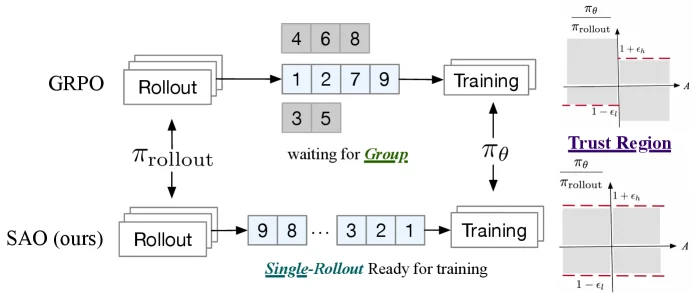
- Mismatched sampling: Methods like GRPO rely on "group-wise sampling," where multiple responses per prompt are averaged. This conflicts with asynchronous environments—groups must wait for the slowest trajectory, wasting resources. Group sampling also fails in online scenarios with dynamic feedback.
3. Proposed Solution
The paper introduces Single-rollout Asynchronous Optimization (SAO), addressing these issues with three key designs:
- Single-rollout sampling: Each prompt uses only one trajectory for updates, reducing off-policy effects and avoiding group delays.
- Strict token-level clipping: Directly uses probabilities from the trajectory generator with tighter clipping to stabilize training.
- Improved value model training: Updates the critic more frequently and freezes attention layers to reduce noise.
4. Key Differences
Compared to prior work, SAO’s innovations lie in:
- Balancing efficiency and stability: Unlike previous asynchronous RL, which prioritized throughput, SAO ensures both efficiency and training stability via single-rollout sampling and clipping.
- Adaptability to online settings: SAO’s sampling and advantage estimation (GAE) are designed for dynamic environments, whereas methods like GRPO excel in static batch tasks.
SAO outperforms GRPO and its variants in coding/math benchmarks (e.g., SWE-Bench) and was deployed for training the 750B-parameter GLM-5.2 model.