RynnWorld-Teleop: An Action-Conditioned World Model for Digital Teleoperation
arXiv · HuggingFace · ▲76
Abstract (verbatim)
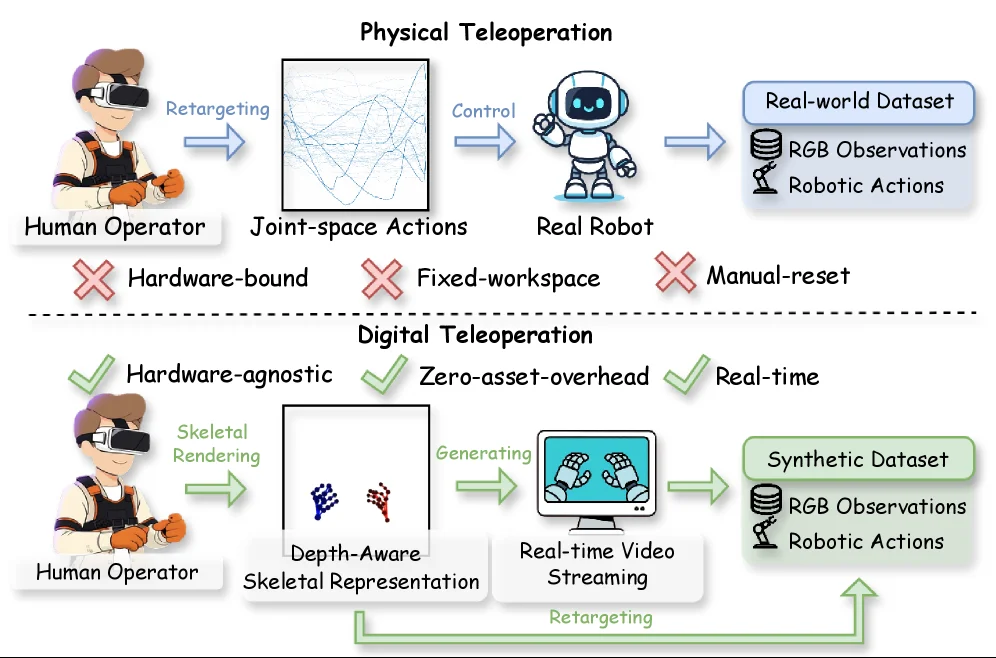
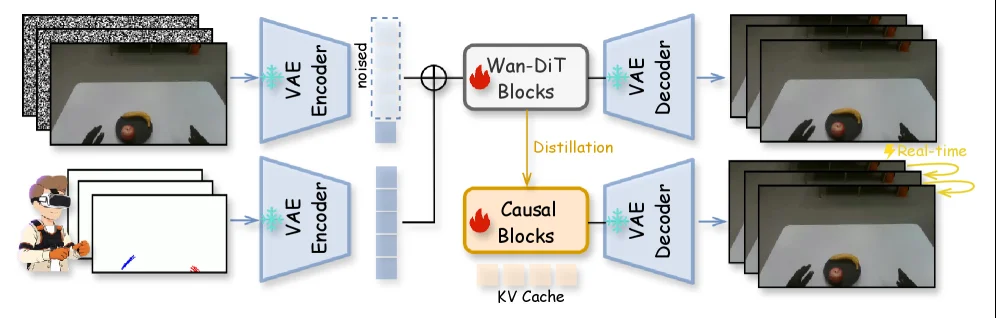
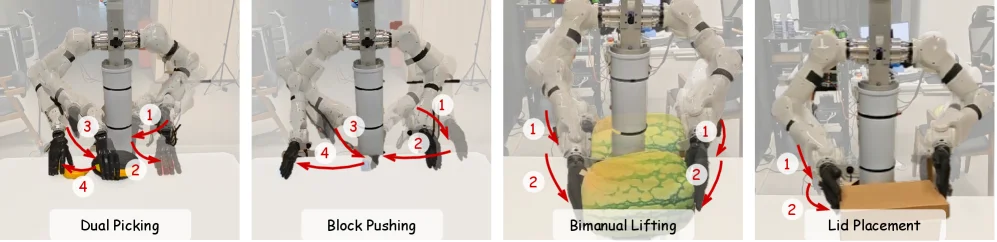
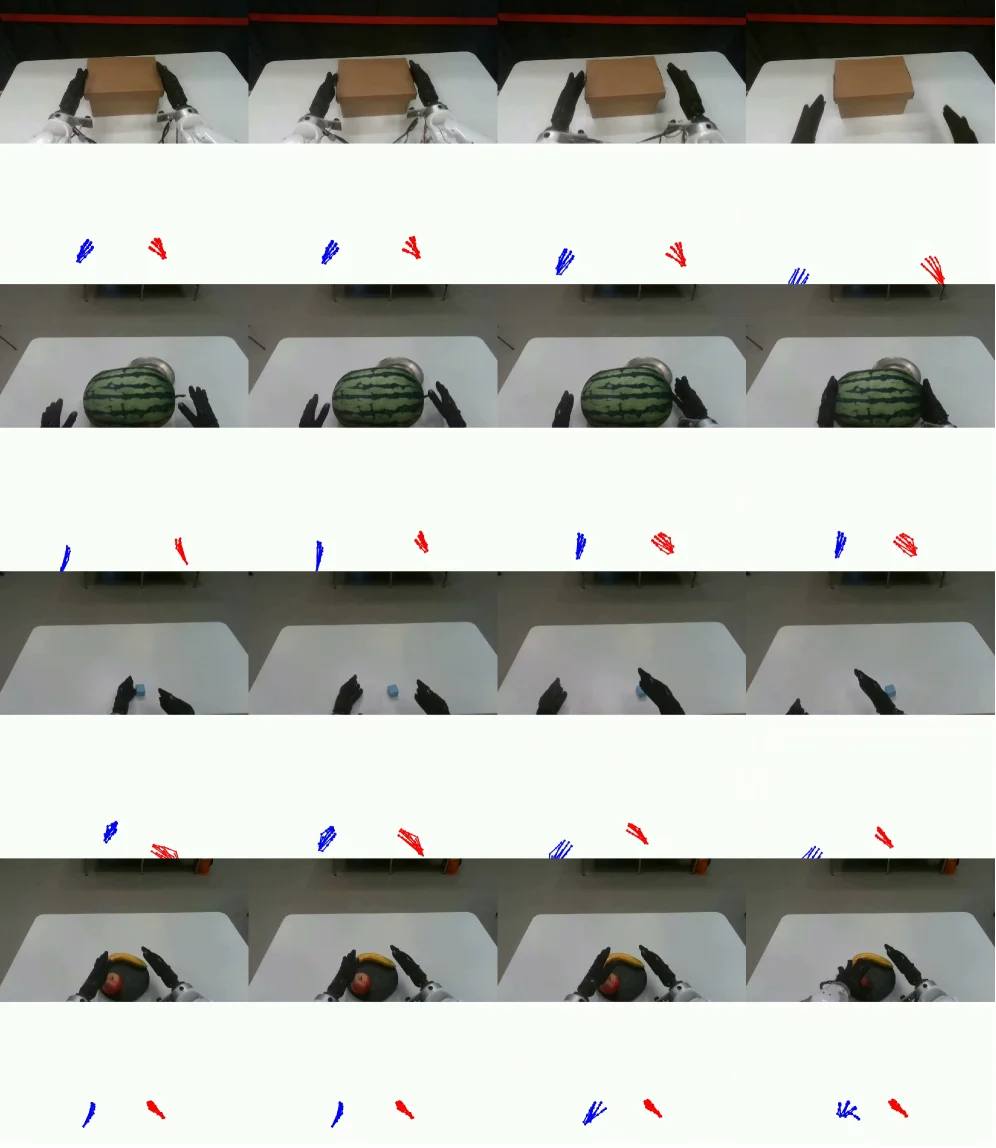
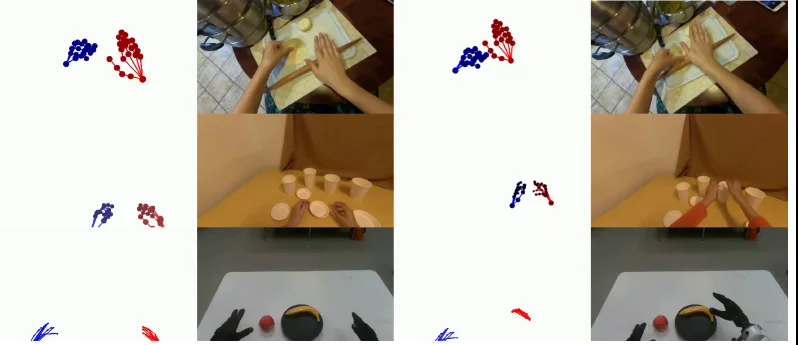
Scaling robot learning requires massive, diverse trajectory data, yet collection is currently bottlenecked by physical teleoperation, where every demonstration binds operator time to specific hardware and workspaces. We introduce digital teleoperation, a paradigm that decouples data collection from physical constraints by replacing the real robot with a generative world model. In this framework, an operator's hand-pose stream drives a robot-centric generative world model to synthesize high-fidelity egocentric videos from a single reference image. The recorded pose stream serves as an embodiment-agnostic action label transferable to any target robot via standard retargeting, yielding complete state-action trajectories for imitation learning independent of physical hardware. We instantiate this paradigm in RynnWorld-Teleop, a system that integrates depth-aware skeletal conditioning, progressive human-to-robot training on a video Diffusion Transformer, and streaming autoregressive distillation. This pipeline compresses the generative process into a single-pass inference, enabling 40+ FPS, real-time interactive generation on a single H100 GPU. Policies trained exclusively on RynnWorld-Teleop-generated data achieve effective zero-shot Sim2Real transfer across dexterous and diverse bimanual tasks. Moreover, augmenting real-world datasets with our digitally teleoperated data consistently improves success rates, demonstrating that RynnWorld-Teleop serves as a high-fidelity, scalable data engine for the next generation of robotic agents.
Background
Background Analysis
1. Technical Context and Need
Robot learning requires massive diverse data, but physical data collection is inefficient—traditional teleoperation (e.g., controlling real robots via VR or mechanical arms) is limited by hardware costs, environment reset times, and object diversity. For example, training a robot to manipulate daily objects requires manual scene setup and trajectory recording, which is time-consuming and hard to scale. Digital teleoperation aims to replace real robots with generative models, allowing operators to control robots virtually via gestures, thus bypassing physical constraints to generate large-scale training data.
2. Limitations of Prior Work
Existing approaches face three core issues:
- Passive observation vs. active control: Early methods (e.g., converting human videos to robot views) generate images but fail to record actionable sequences (e.g., joint movements), making the data unsuitable for imitation learning.
- Human-centric vs. robot-centric perspective: Some models generate videos from a human viewpoint, leading to mismatches between appearance and robot behavior.
- Non-real-time generation: Complex models (e.g., Diffusion Transformers) cannot respond in real time to operators’ actions, breaking interactivity.
3. Proposed Solution
RynnWorld-Teleop addresses these issues with three innovations:
- Robot-centric action capture: Operator gestures are mapped to robot joint spaces, and depth-aware rendering generates high-fidelity videos, ensuring alignment between actions and visual observations.
- Progressive cross-domain training: The model first learns general manipulation priors from human videos, then adapts to robot perspectives via paired human-robot data, eliminating the "appearance-behavior" gap.
- Real-time streaming generation: Causal reasoning and rollout consistency enable long-horizon task generation in a single pass, supporting 40 FPS real-time interaction.
4. Key Differences from Prior Work
Unlike existing methods, RynnWorld-Teleop is the first to satisfy three critical criteria:
- Action interpretability: Generated videos directly correspond to actionable joint-level labels, not just images.
- Robot-centric perspective: All content is rendered from the robot’s viewpoint, ensuring data is directly usable for training.
- Real-time interactivity: Operators see immediate feedback and can adjust strategies, supporting continuous execution of complex tasks.
This framework transforms data collection from "hardware-dependent" to "imagination-driven," providing a scalable, high-fidelity data engine for robot learning.