ResearchStudio-Reel: Automate the Last Mile of Research from Paper to Poster, Video, and Blog
arXiv · HuggingFace · ▲61
摘要(原文)
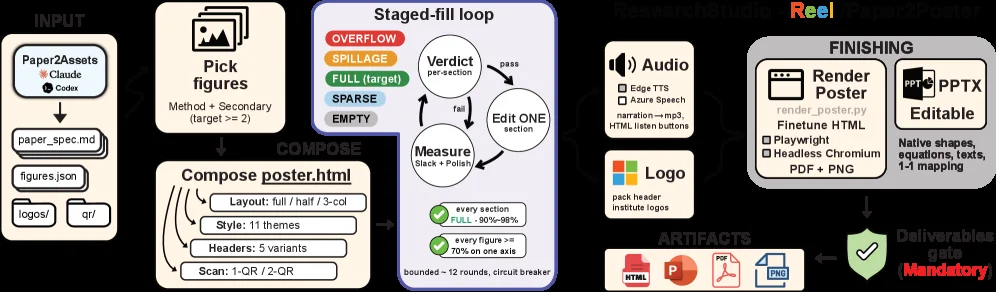
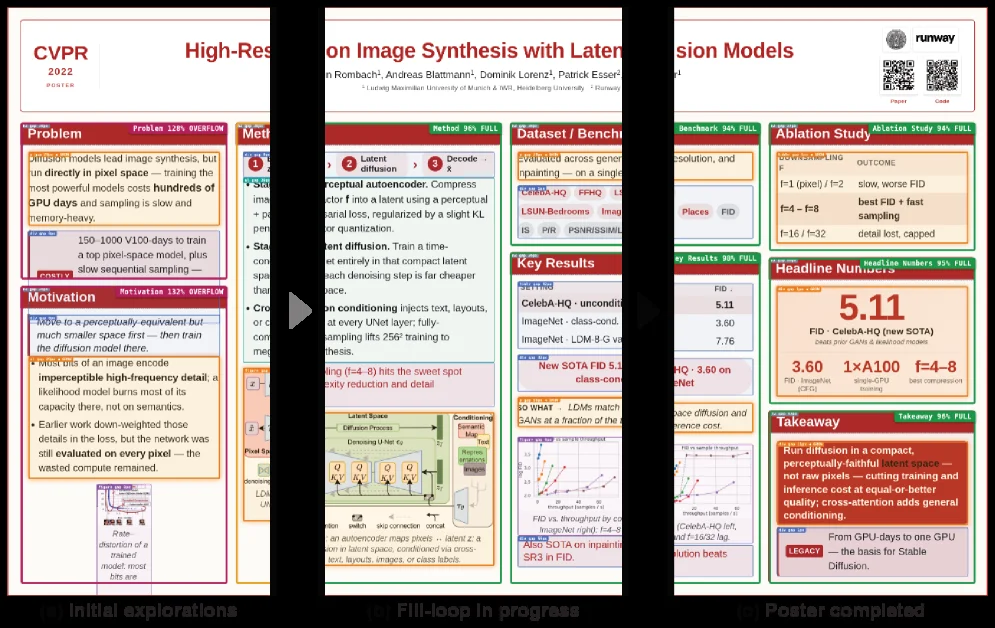
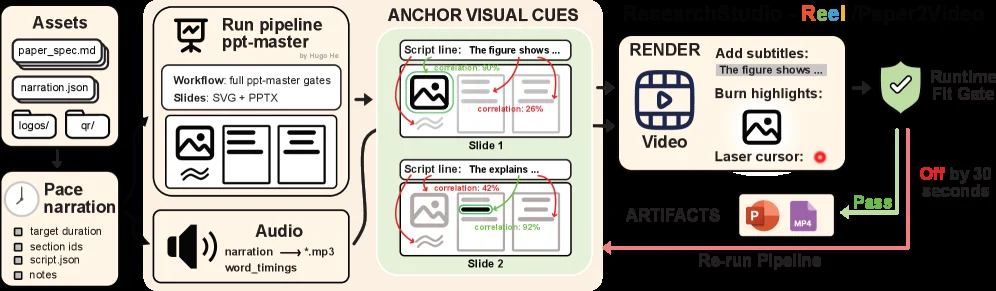
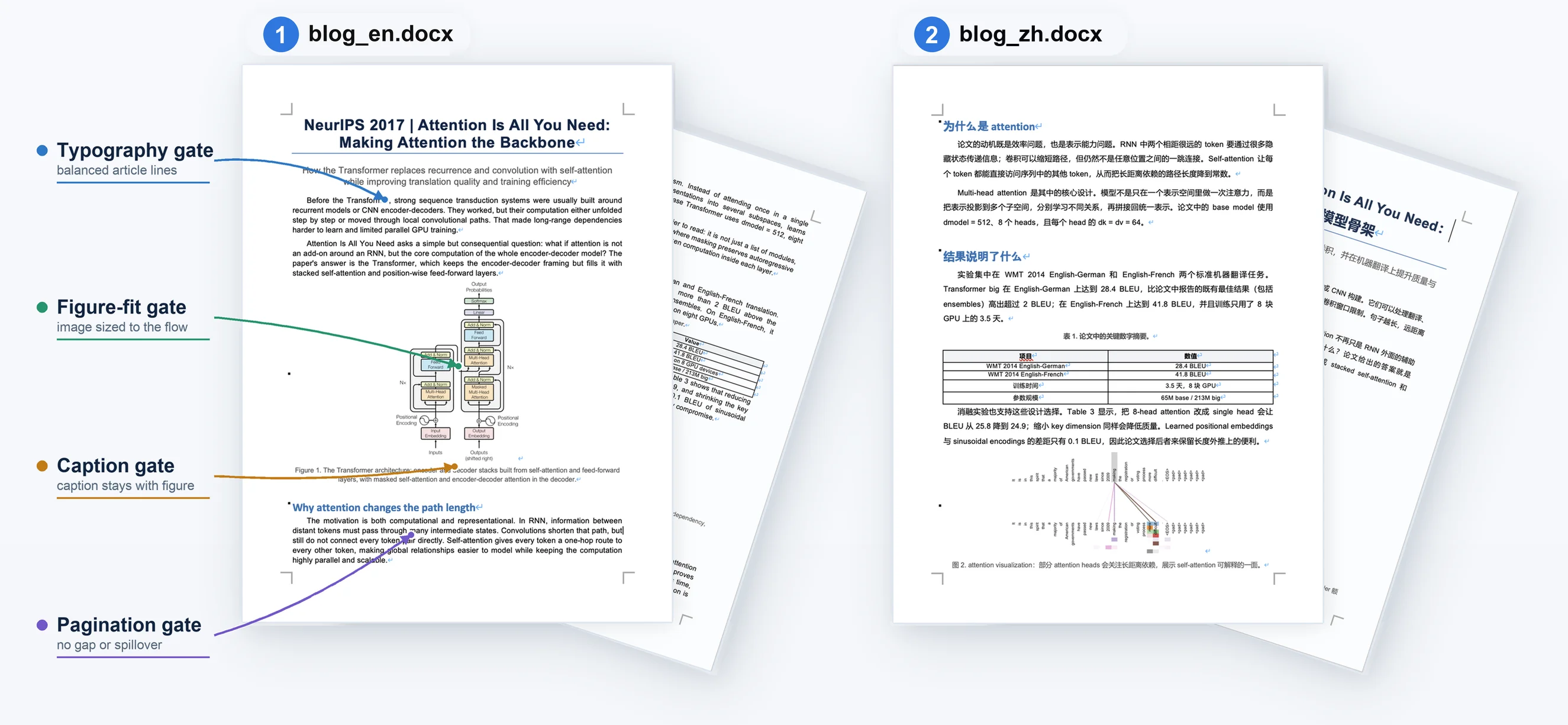
Research dissemination, turning a paper into a poster, a talk video, and a blog post, is still a manual last mile. Prior automation treats each artifact in isolation that each re-extract the paper from scratch, usually ship one-way renders the author cannot reopen in PowerPoint or Word, and gates quality on soft VLM-preference scores that plateau while load-bearing sections still read as empty. We argue this last mile is best built as a composition of skills: thin agent-readable contracts that share one upstream extractor and wrap deterministic primitives in a measured-fill loop whose exits are hard pass/fail render gates. We instantiate this as ResearchStudio-Reel, five Claude Code and Codex skills organized into one shared extractor (Paper2Assets), three editable generators (Paper2Poster, Paper2Video, Paper2Blog), and one interactive convergence layer (Paper2Reel). Paper2Assets extracts each paper once into a shared bundle that can be reused by every downstream skill; The three generators produce a print-ready poster, a synchronized talk video, and a bilingual blog that stay factually consistent and round-trip through PowerPoint or Word; Paper2Reel then binds all three into a self-contained HTML viewer whose section-level clicks jump the video, slides, captions, and blog to matching content. On the Paper2Poster benchmark, our posters lead every aesthetic and information sub-criterion against both prior automated systems and single-shot frontier LLMs, surpassing the authors' own on aesthetics under two held-out VLM judges and winning overall on 84% to 93% of papers; capability audits further show that, by uniquely pairing narration-aligned on-slide highlights with a bilingual blog gated by layout-aware DOCX repair, ResearchStudio-Reel is the only pipeline to ship all three editable artifacts. Project is available at https://aka.ms/ResearchStudio
摘要(中译)
研究传播(Research dissemination),即将一篇论文转化为海报(poster)、演讲视频(talk video)和博客文章(blog post),目前仍是一个需要人工完成的“最后一公里”工作。先前的自动化方法将每个成果孤立处理,每个成果都从零开始重新提取论文内容,通常只能单向生成作者无法在PowerPoint或Word中重新打开的文件,并且将质量评估基于软视觉语言模型(VLM)偏好分数,而这些分数在关键部分仍有空白时就会达到瓶颈。我们认为,这“最后一公里”最好被构建为一组技能的组合:轻量级的、智能体可读的契约(thin agent-readable contracts),它们共享一个上游提取器(upstream extractor),并在一个受控填充循环(measured-fill loop)中包装确定性原语(deterministic primitives),其出口是严格的通过/失败渲染门(hard pass/fail render gates)。我们将这一理念具体化为ResearchStudio - Reel,它由五个Claude Code和Codex技能组成,组织成一个共享提取器(Paper2Assets)、三个可编辑的生成器(Paper2Poster、Paper2Video、Paper2Blog)和一个交互式收敛层(Paper2Reel)。Paper2Assets将每篇论文提取一次到一个共享包(shared bundle)中,该包可被每个下游技能重复使用;这三个生成器生成一份可打印的海报、一个同步的演讲视频和一篇双语博客,它们在事实内容上保持一致,并且可以通过PowerPoint或Word双向转换;然后,Paper2Reel将这三者绑定到一个独立的HTML查看器(HTML viewer)中,其中章节级别的点击可以将视频、幻灯片、字幕和博客跳转到匹配的内容。在Paper2Poster基准测试(Paper2Poster benchmark)中,我们的海报在每个美学和信息子标准上都领先于先前的自动化系统和单次前沿大型语言模型(LLMs),在两位保留的视觉语言模型评审员(VLM judges)的美学评估中超过了作者自己的成果,并且在84%到93%的论文上整体获胜;能力审计(capability audits)进一步表明,通过独特地将与叙述对齐的幻灯片亮点(on - slide highlights)与受布局感知的DOCX修复(layout - aware DOCX repair)控制的双语博客相结合,ResearchStudio - Reel是唯一能够交付所有三个可编辑成果的流程。该项目可在https://aka.ms/ResearchStudio获取。
背景剖析
背景剖析
研究传播的最后环节——将学术论文转化为会议海报、演讲视频和科普博客——长期依赖人工完成,而这正是研究者最忙碌的阶段。这些成果需要面向不同受众:会议海报用于现场展示,视频用于线上分享,博客则面向非专业读者。当前自动化方案存在三个核心缺陷:首先,每个成果都需单独提取论文信息,导致跨媒介的事实一致性(如图表编号与引用)需要手动校对;其次,生成的文件多为不可编辑的PDF或视频,作者无法用PowerPoint或Word进行后续修改;最后,质量评估依赖模糊的视觉评分,可能忽略关键内容的完整性。
本文提出的ResearchStudio-Reel通过模块化架构解决这些问题。其核心思路是构建一个共享的知识提取层(Paper2Assets),一次性处理论文中的图表、元数据和关键主张,然后通过三个可编辑生成器(海报、视频、博客)复用这些信息。例如,视频生成器直接基于可编辑的PowerPoint幻灯片制作,确保叙事与视觉高亮同步。更关键的是,系统引入了“确定性循环”机制,只有在内容完全符合标准时才会结束生成,而非依赖机器学习模型的主观评分。
该方案与前人工作的本质区别在于:1)首次实现跨媒介的事实一致性,避免重复劳动;2)所有输出均为原生可编辑格式,支持后续调整;3)通过统一的交互式界面(Paper2Reel)将三个成果关联,读者可点击海报章节跳转至对应视频片段和博客内容。实验表明,其生成的海报在美学和信息完整性上超越现有系统和人类作者,视频则实现了字幕与旁白的精确对齐。这种将分散任务整合为协同工作流的方法,标志着研究传播自动化从“单点工具”向“系统级解决方案”的转变。