Embodied.cpp: A Portable Inference Runtime of Embodied AI Models on Heterogeneous Robots
arXiv · HuggingFace · ▲3
Abstract (verbatim)
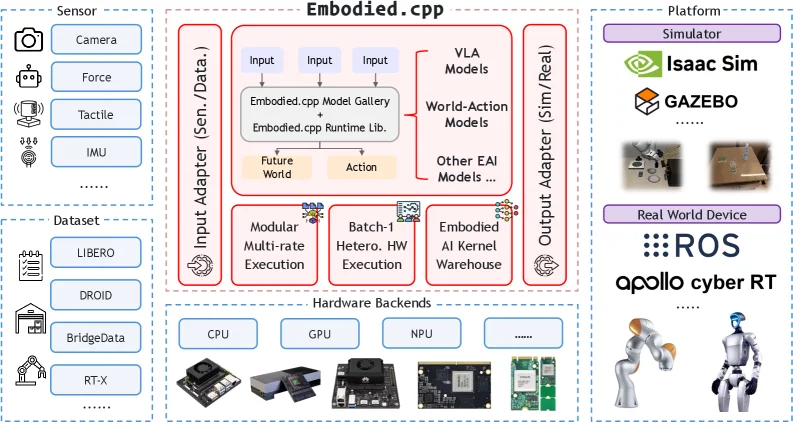
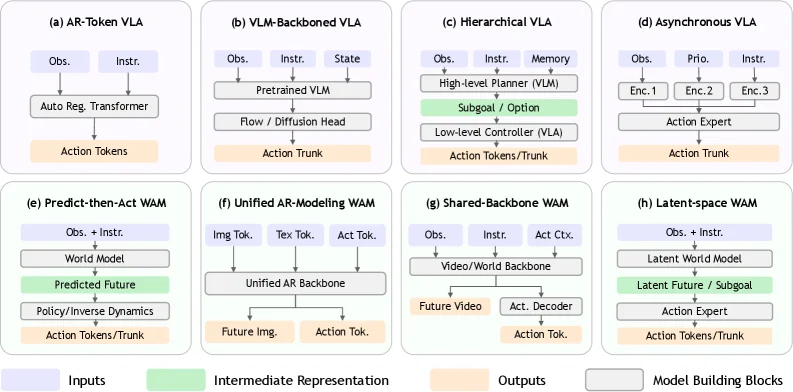
Embodied AI models now span vision-language-action (VLA) models and world-action models (WAMs), but practical deployment remains fragmented across model-specific Python stacks, backend assumptions, and robot-side glue code, especially on heterogeneous edge devices. Existing inference runtimes are designed mainly for request-response serving and therefore do not satisfy the runtime contract of embodied deployment: multi-rate execution inside closed-loop control, latency-first batch-1 inference on heterogeneous hardware, and extensible embodied interfaces beyond fixed token I/O. We present Embodied.cpp, a portable C++ inference runtime for embodied models. Based on an architectural analysis of representative VLA models and WAMs, Embodied.cpp captures a shared execution path and organizes it into five layers: input adapters, sequence builders, backbone execution, head plugins, and deployment adapters. The runtime provides modular multi-rate execution, latency-first fused inference, and extensible operator and I/O support, enabling deployment across heterogeneous devices, robots, and simulators through one backend abstraction. We evaluate Embodied.cpp on two VLA models, HY-VLA and pi0.5, and on a preliminary WAM benchmark using a LingBot-VA Transformer block. The VLA deployments achieve successful closed-loop execution with 100.0% and 91.0% task success rates, respectively. The WAM benchmark reduces block memory from 312.2 MiB to 88.1 MiB. These results show that Embodied.cpp improves deployment efficiency while preserving high accuracy across diverse embodied model architectures.
Background
Background Analysis
With the rapid development of artificial intelligence technology, embodied AI has become a hot spot in research and application. This technology is mainly used in robots and simulation environments, enabling machines to interact with the physical world through perception, decision-making, and execution. However, although academia and industry have developed a large number of embodied models, such as vision-language-action (VLA) models and world-action models (WAMs), there are still many challenges in practical deployment.
Firstly, the deployment of embodied models needs to meet the requirements of real-time and stability, which requires the inference system to execute components such as perception encoders, transformer backbones, and predictive branches at different rates within a closed-loop control. Secondly, due to the limitations of hardware resources, the inference system needs to achieve low latency, low jitter, and small-batch execution on heterogeneous edge devices. Finally, the interface of embodied models needs to be more flexible to adapt to multimodal inputs and diverse outputs.
However, previous inference runtimes are mainly designed for request-response serving and cannot meet the needs of embodied deployment. These systems usually have relatively uniform token interfaces and throughput-oriented optimizations, while embodied inference needs to handle dependencies on the robot and simulator sides, as well as custom operators and heterogeneous outputs. Therefore, even a powerful model needs to be stitched with Python research code, backend-specific inference paths, hand-written sensor wrappers, and platform-specific control logic before it can work on a robot.
To solve these problems, this paper proposes Embodied.cpp, a portable C++ inference runtime for embodied models. By analyzing representative VLA models and WAMs, this runtime reveals a shared execution path and organizes it into five layers: input adapters, sequence builders, backbone execution, head plugins, and deployment adapters. This design enables Embodied.cpp to achieve efficient deployment on heterogeneous devices, robots, and simulators while maintaining high accuracy.
In summary, the key difference of Embodied.cpp is that it is optimized for the specific needs of embodied deployment, providing a modular multi-rate execution environment, latency-first fused inference, and extensible operator and I/O support. This enables embodied models to be efficiently deployed in various heterogeneous environments while maintaining high accuracy.