The Mirage of Optimizing Training Policies: Monotonic Inference Policies as the Real Objective for LLM Reinforcement Learning
arXiv · HuggingFace · ▲6
摘要(原文)
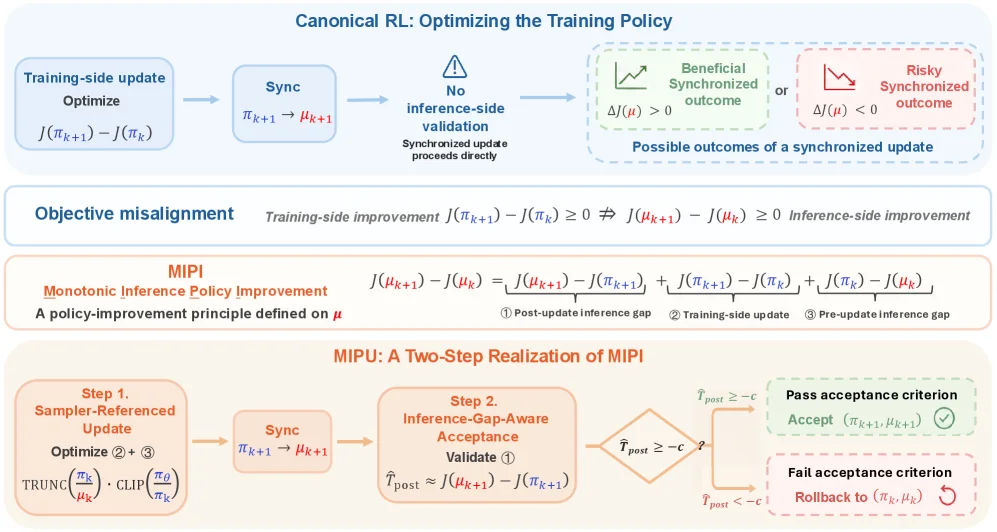
Reinforcement learning (RL) has gained growing attention in large language model (LLM) post-training, yet RL training remains fragile and can suffer from instability or collapse. One vital cause is training-inference mismatch: LLM adopts separate inference and training engines for generation efficiency and training precision, which in practice exhibits inconsistent probabilities for the same trajectories on training and inference sides, even with synchronized model parameters. This naturally induces a special type of off-policyness ever existing and poisoning the training. Prior works have made various efforts in addressing the off-policyness to stabilize the training policies under the mismatch. In this paper, we point out the objective misalignment neglected by existing works that an effective update to the policy in the training engine not necessarily ensures the improvement of the inference policy, i.e., the one used in deployment. To this end, we propose a new policy optimization objective for LLM RL, named Monotonic Inference Policy Improvement (MIPI). Following this principle, we introduce Monotonic Inference Policy Update (MIPU), a two-step LLM RL framework that constructs sampler-referenced candidate updates and selectively accepts synchronized candidates using an inference-side gap proxy. Experiments conducted on two model scales under high mismatch show that MIPU improves average reasoning performance and training stability.
摘要(中译)
强化学习(Reinforcement learning, RL)在大语言模型(large language model, LLM)后训练中越来越受到关注,然而RL训练仍然很脆弱,可能会出现不稳定或崩溃的情况。一个关键原因是训练-推理不匹配:LLM为了生成效率和训练精度采用了独立的推理和训练引擎,即使在模型参数同步的情况下,实际上在训练和推理两侧对相同轨迹的概率表现并不一致。这自然会引发一种特殊类型的偏离策略(off-policyness),这种策略一直存在并影响着训练。先前的工作已经在解决偏离策略问题上做出了各种努力,以在匹配不匹配的情况下稳定训练策略。在本文中,我们指出了现有工作忽略的目标不对齐问题,即在训练引擎中对策略的有效更新并不一定确保推理策略的改进,即在部署中使用的策略。为此,我们提出了一种新的LLM RL策略优化目标,名为单调推理策略改进(Monotonic Inference Policy Improvement, MIPI)。遵循这一原则,我们引入了单调推理策略更新(Monotonic Inference Policy Update, MIPU),这是一个两步LLM RL框架,它构建了基于采样器的候选更新,并使用推理侧的差距代理选择性地接受同步候选。在高匹配的情况下,对两个模型规模进行的实验表明,MIPU提高了平均推理性能和训练稳定性。
背景剖析
随着推理导向模型(如DeepSeek-R1)的出现,强化学习(RL)已成为大语言模型(LLM)后训练的重要范式,主要用于提升指令遵循、对齐和推理能力。由于LLM规模庞大,现代RL流程通常将生成(由推理引擎完成)与梯度计算(由训练引擎完成)分离。这种分离导致训练策略和推理策略在相同轨迹上可能分配不同概率,即使参数同步也是如此,从而引发训练-推理不匹配问题。
先前方法主要通过修正采样比例、过滤不稳定样本或缩小系统差异来缓解这一问题,但这些努力仅关注训练侧稳定性,未解决核心矛盾:训练策略的改进未必能提升实际部署的推理策略。例如,即使训练策略在优化目标下表现更好,推理端可能因量化或解码差异而性能下降。
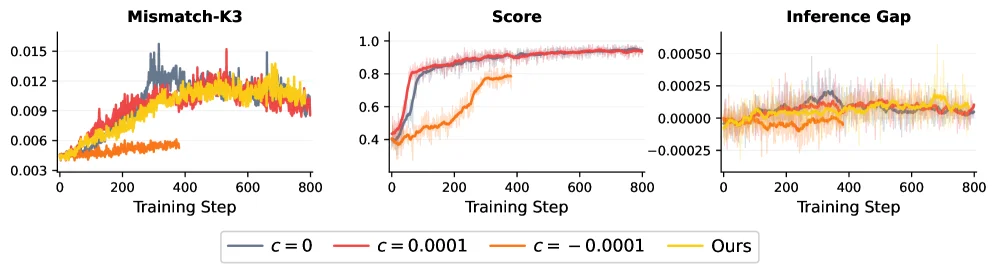
本文提出“单调推理策略改进(MIPI)”原则,强调优化应直接针对推理策略的性能提升。基于此,设计了“单调推理策略更新(MIPU)”框架,分两步解决问题:第一步通过采样参考更新生成候选模型,确保部分单调性;第二步通过推理端差距代理选择性接受更新,保证剩余单调性。实验表明,在高不匹配场景(如FP8量化推理)下,MIPU显著提升了推理性能和训练稳定性。
与前人工作相比,本文的关键差异在于:1)重新定义优化目标,从“改进训练策略”转向“改进推理策略”;2)提出两阶段框架,明确分离候选生成与接受步骤;3)首次通过推理端差距代理实现选择性更新,而非单纯减少不匹配。这种方法更贴近实际部署需求,为RL在LLM中的稳定应用提供了新方向。