VoxAct-B: Voxel-Based Acting and Stabilizing Policy for Bimanual Manipulation
Abstract (verbatim)
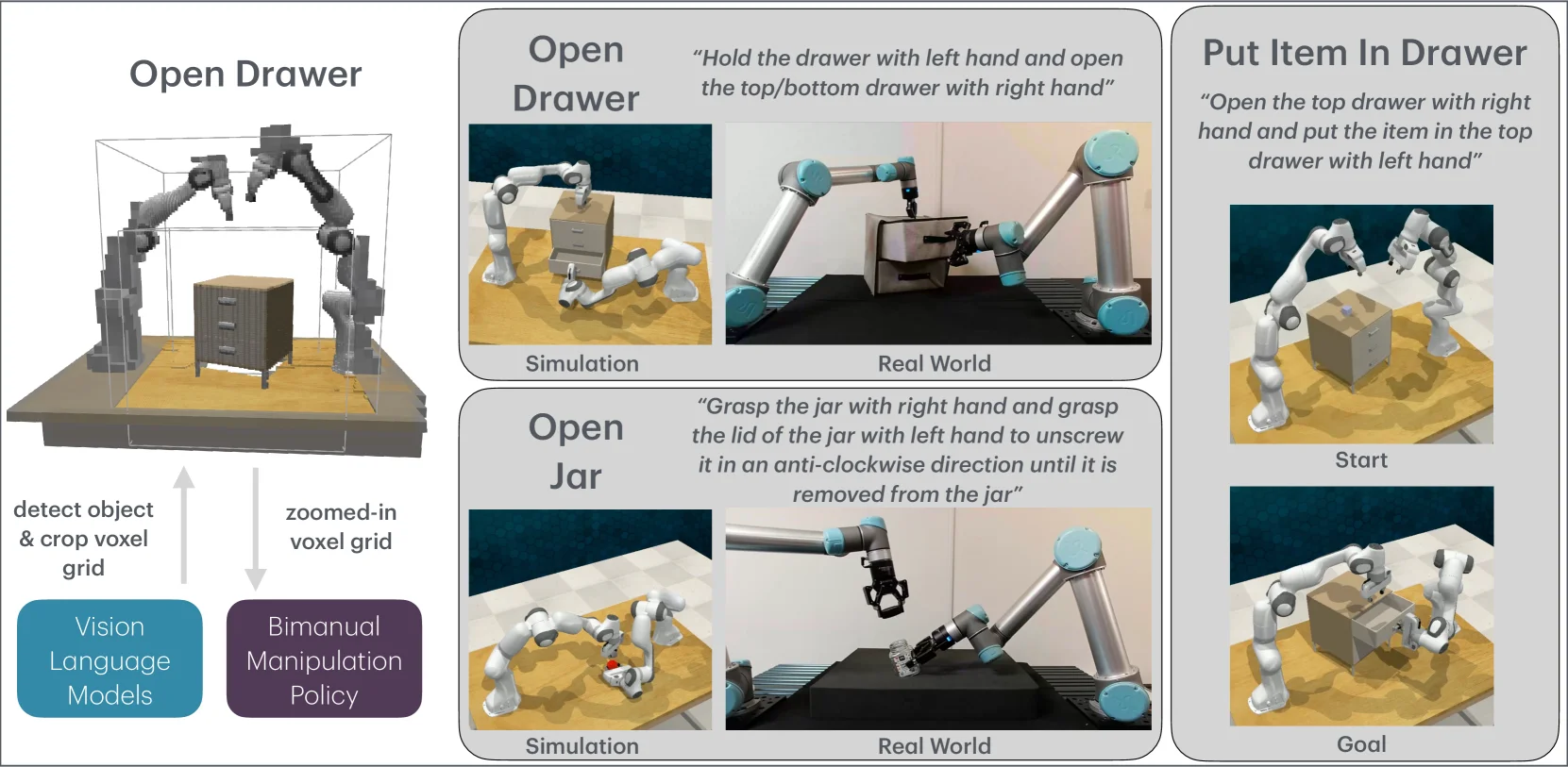
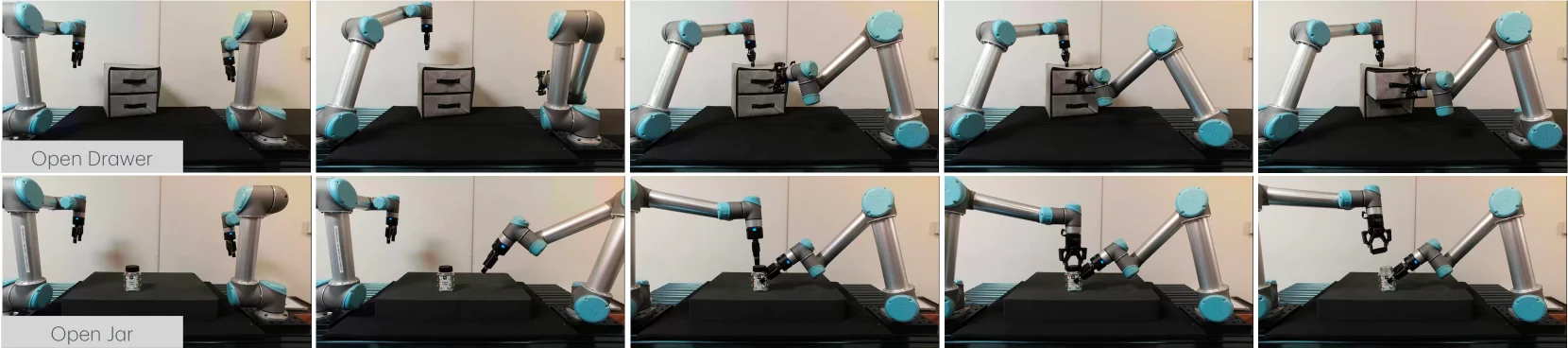
Bimanual manipulation is critical to many robotics applications. In contrast to single-arm manipulation, bimanual manipulation tasks are challenging due to higher-dimensional action spaces. Prior works leverage large amounts of data and primitive actions to address this problem, but may suffer from sample inefficiency and limited generalization across various tasks. To this end, we propose VoxAct-B, a language-conditioned, voxel-based method that leverages Vision Language Models (VLMs) to prioritize key regions within the scene and reconstruct a voxel grid. We provide this voxel grid to our bimanual manipulation policy to learn acting and stabilizing actions. This approach enables more efficient policy learning from voxels and is generalizable to different tasks. In simulation, we show that VoxAct-B outperforms strong baselines on fine-grained bimanual manipulation tasks. Furthermore, we demonstrate VoxAct-B on real-world $\texttt{Open Drawer}$ and $\texttt{Open Jar}$ tasks using two UR5s. Code, data, and videos are available at https://voxact-b.github.io.
Background
Background Analysis
Bimanual manipulation technology is widely applicable in robotics, especially in scenarios where objects are too large or heavy for a single arm to handle, or when one arm needs to stabilize an object while the other performs precise operations. This technology is crucial in both household services (e.g., cooking, cleaning) and industrial production (e.g., assembly, packaging), enhancing efficiency and accuracy.
However, existing bimanual manipulation methods face several limitations. Traditional approaches typically rely on large-scale datasets for training policies or decompose actions into primitive steps, which are not only sample-inefficient but also struggle to generalize across different tasks. Additionally, bimanual tasks often require high coordination and fine control, posing challenges to current robotic systems.
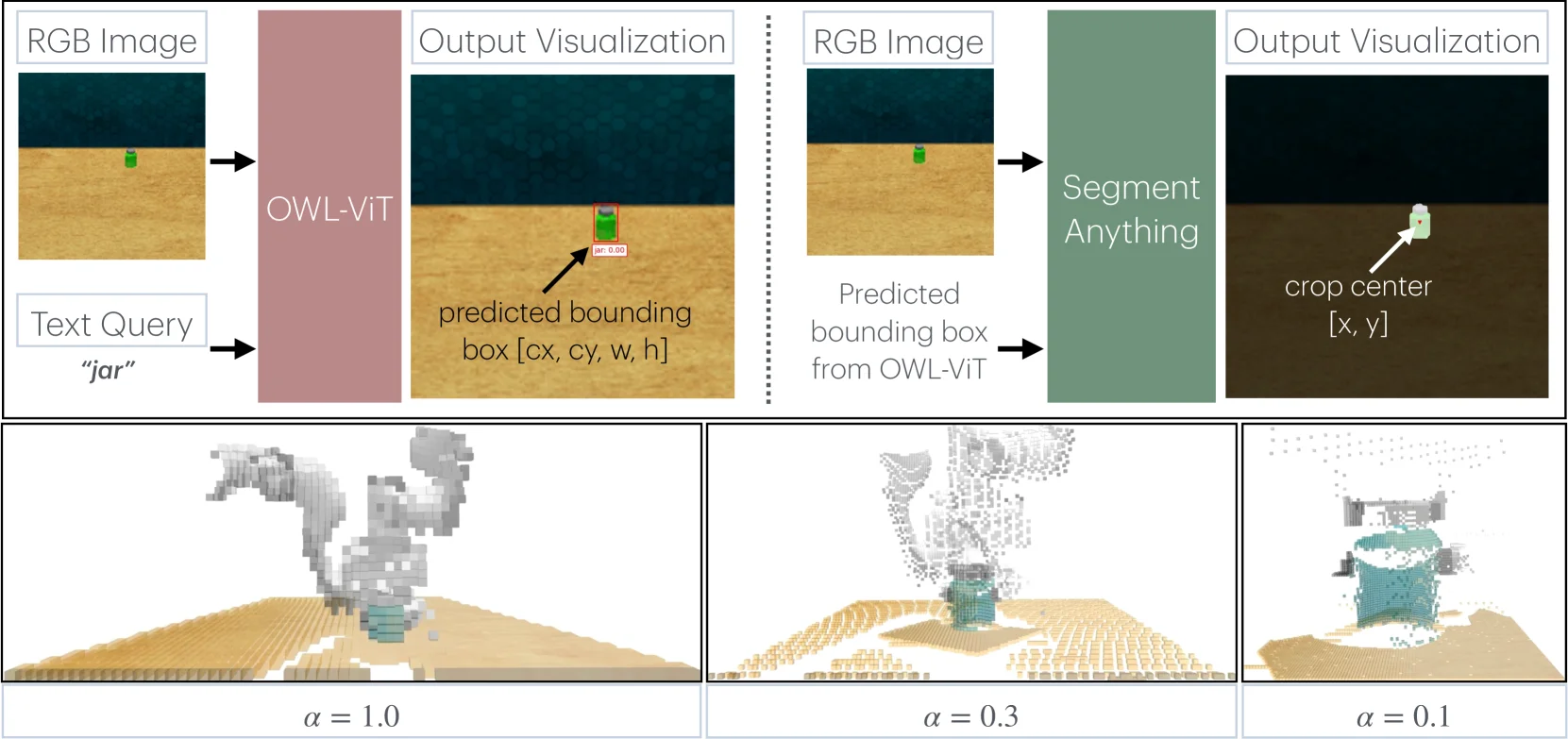
To address these issues, this paper proposes a novel method called VoxAct-B. This approach combines voxel representations with Vision Language Models (VLMs) to reduce computational burden while improving sample efficiency and generalization. Specifically, VoxAct-B uses VLMs to identify and crop relevant regions within a scene, constructing a high-resolution voxel grid without increasing computational costs. Moreover, the method employs language instructions to determine the role of each arm (stabilizing or acting), enabling more efficient collaboration.
Compared to previous work, the key innovation of VoxAct-B lies in its integration of voxel representations and VLMs to tackle computational efficiency and generalization challenges in bimanual manipulation. Additionally, the method extends existing benchmarks by introducing asymmetric bimanual tasks and validates its performance in real-world environments. Through these improvements, VoxAct-B demonstrates superior performance in both simulation and practical applications, offering new insights into the development of bimanual manipulation technology.