DOPD: Dual On-policy Distillation
arXiv · HuggingFace · ▲99
摘要(原文)
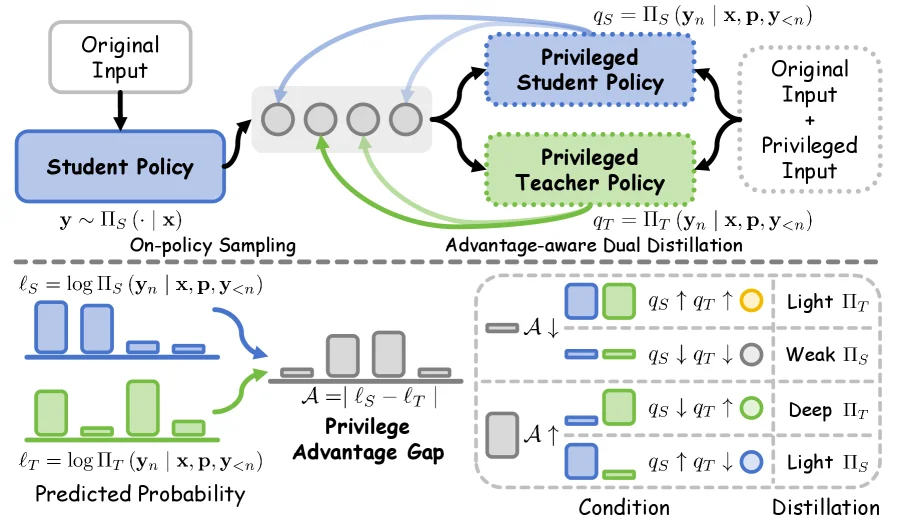
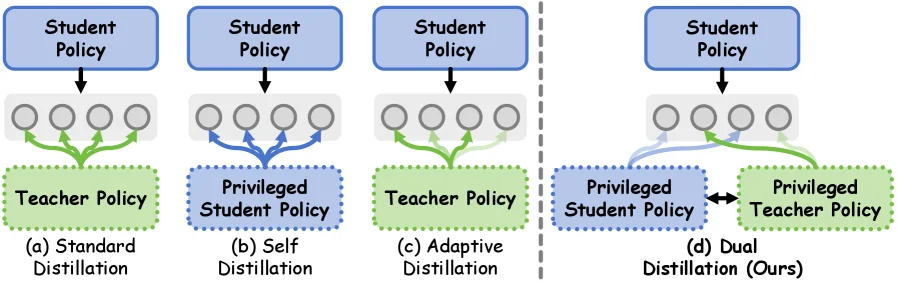
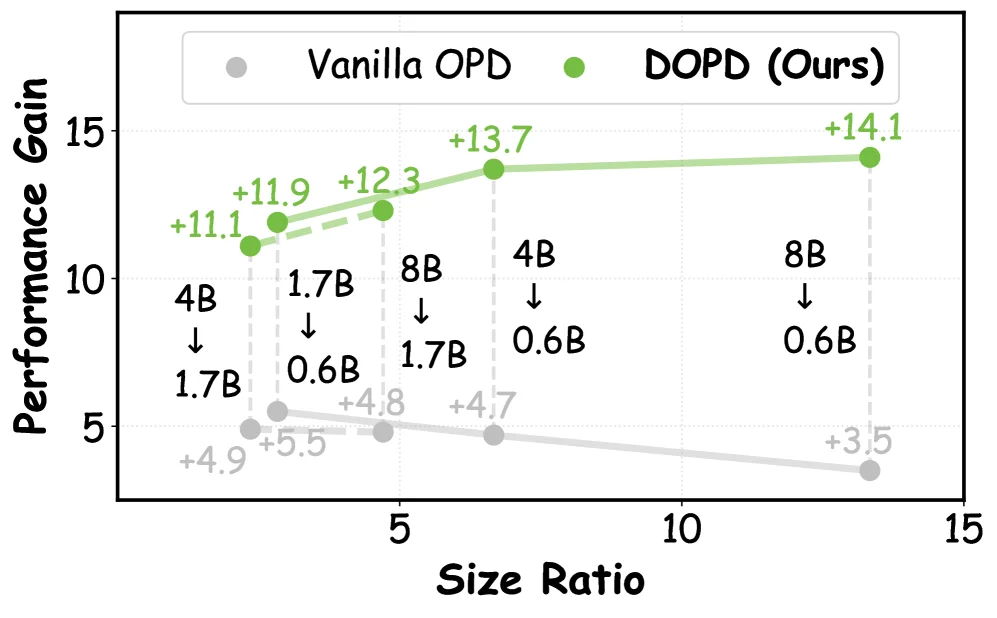
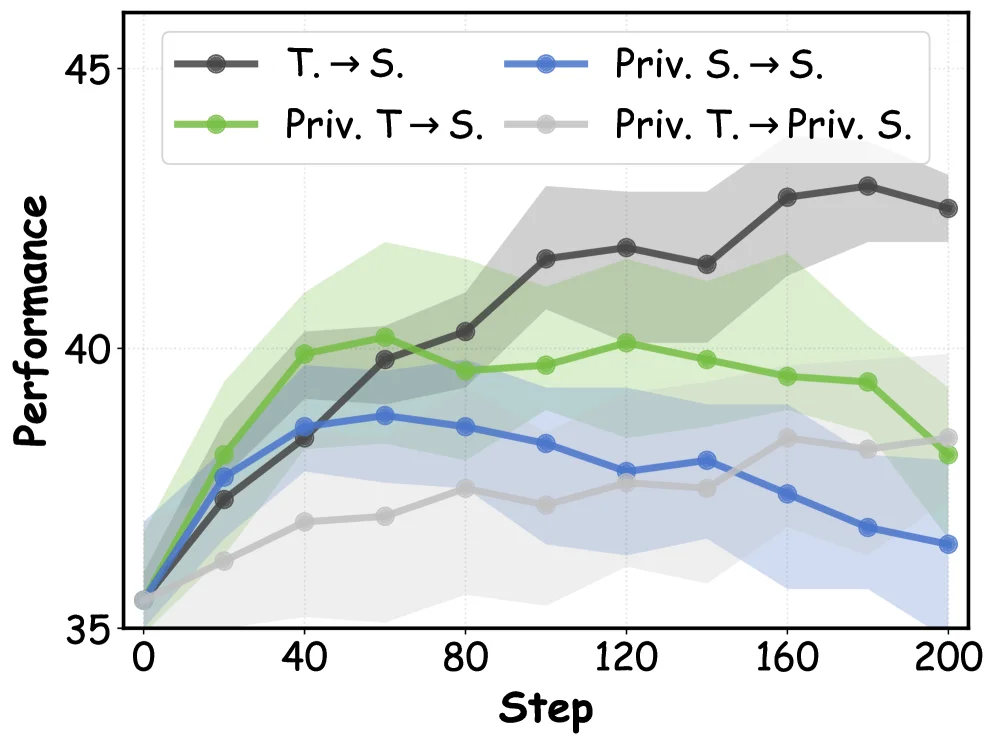
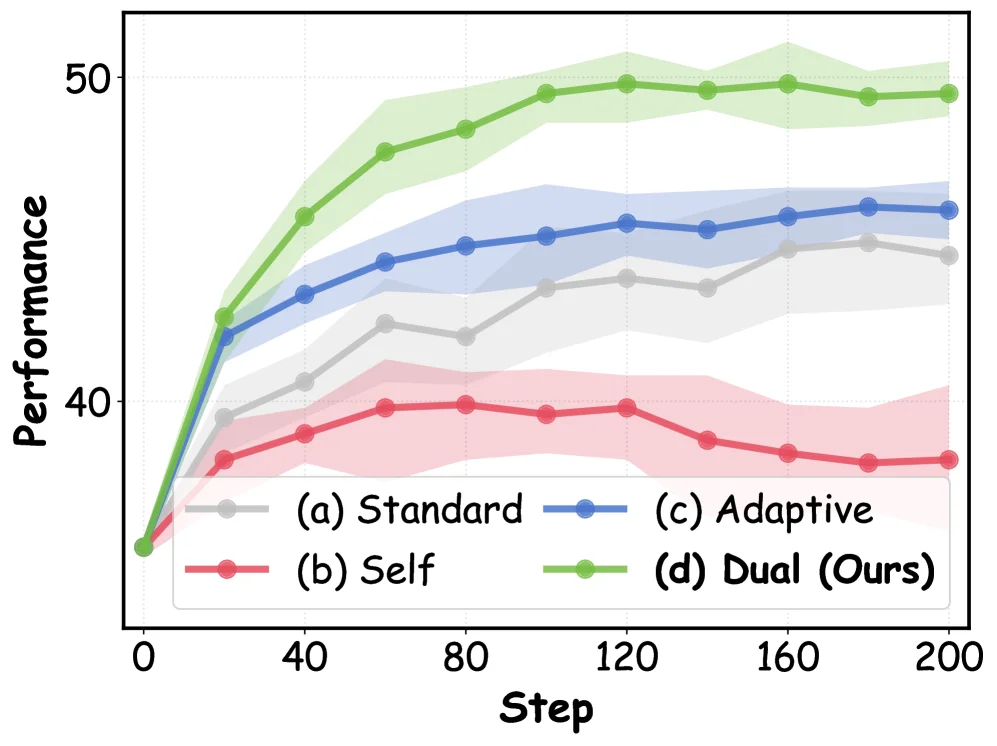
On-policy distillation (OPD) offers superior capacity transfer by supervising student-sampled trajectories with dense token-level signals. To furnish high-quality supervision sources and thereby elevate the performance frontier of distillation, an intuitive direction is to infuse privileged information to either teacher or student itself. However, this additional input induces a potential failure mode we dub privilege illusion: a pattern that conflates the transferable capability gap that students are meant to close, and the information asymmetry gap that can only be mimicked but never replicated. This issue is further amplified by the inherent non-uniformity of token-level supervision, where only a small subset of tokens carries pivotal capability-bearing signals. To this end, we propose DOPD, an advantage-aware dual distillation paradigm that dynamically routes token-level supervision between privileged teacher and privileged student policies based on their advantage gap and relative probabilities. Each token receives supervision of different strength, objective, and strategy from either teacher or student itself, which transfers credible capability while simultaneously receiving auxiliary signals, to alleviate privilege illusion. Extensive experiments on both large language model (LLM) and vision-language model (VLM) settings demonstrate that DOPD consistently outperforms Vanilla OPD and other counterparts. Further results on stability, robustness, continual learning, and out-of-distribution tasks validate its superiority.
摘要(中译)
On - policy distillation (OPD) 通过使用密集的 token - 级信号监督学生采样的轨迹来提供卓越的能力转移。为了提供高质量的监督源并从而提升蒸馏的性能前沿,一个直观的方向是向教师或学生本身注入特权信息。然而,这种额外的输入会引发一种我们称之为特权幻觉的潜在故障模式:一种混淆学生应该缩小的可转移能力差距和只能模仿而无法复制的信息不对称差距的模式。这个问题进一步被 token - 级监督的固有不均匀性放大,在这种监督中,只有一小部分 token 携带关键的能力承载信号。为此,我们提出了 DOPD,这是一种优势感知的双重蒸馏范式,它根据特权教师和特权学生策略之间的优势差距和相对概率在它们之间动态分配 token - 级监督。每个 token 从教师或学生本身接收不同强度、目标和策略的监督,这既传递了可信的能力,同时又接收辅助信号,以缓解特权幻觉。在大型语言模型(LLM)和视觉 - 语言模型(VLM)设置上的大量实验表明,DOPD 一直优于普通 OPD 和其他对应方法。在稳定性、鲁棒性、持续学习和分布外任务上的进一步结果验证了它的优越性。
背景剖析
背景剖析
这项研究聚焦于“策略蒸馏”技术,其核心目标是将高性能模型(教师)的能力高效传递给性能较弱的模型(学生)。这类技术在人工智能领域至关重要,例如让大型语言模型(LLM)或视觉-语言模型(VLM)将复杂推理、多模态理解等能力迁移给更小的模型,以实现更低成本的高效部署。真实需求包括提升小模型的决策质量、减少对大规模数据的依赖,同时保持任务适应性。
然而,传统蒸馏方法存在显著局限。早期依赖“离策略”数据的方法会因数据分布与学生实际行为不匹配而降低效果。后续提出的“在策略”蒸馏(OPD)通过让学生自主生成轨迹并用教师提供逐token级监督,缓解了这一问题,但引入了新的瓶颈:当教师或学生获得“特权信息”(如额外推理提示或结构化标注)时,学生可能过度拟合这些信息带来的表面优势(即“特权幻觉”),而非真正学习可迁移的能力。更严重的是,现有方法对所有token采用统一的监督策略,忽略了不同token在能力传递中的价值差异——少数关键token承载核心能力信号,而多数token可能依赖特权信息,导致监督效率低下。
为解决这些问题,本文提出了DOPD(双重在策略蒸馏)框架。其核心思路是动态区分token的监督来源:对于教师具有可信能力优势的token,使用更强的教师监督以传递高价值能力;对于受特权信息主导或低能力的token,则采用更轻量的监督以保持稳定性并鼓励探索。这种方法通过“优势感知”机制,将监督强度、目标和策略动态分配给教师或学生自身,从而减少特权幻觉的影响。
与前人工作相比,DOPD的关键差异在于:1)不再假设所有token对能力传递同等重要,而是基于token的实际价值调整监督策略;2)将特权信息的使用从“全局增强”转向“选择性利用”,避免学生过度依赖不可迁移的信息;3)通过双监督源(教师和学生)的协同优化,平衡了能力转移与探索稳定性。实验表明,这种方法在LLM和VLM任务中均显著优于传统OPD,验证了其有效性和普适性。