Orca: The World is in Your Mind
arXiv · HuggingFace · ▲234
Abstract (verbatim)
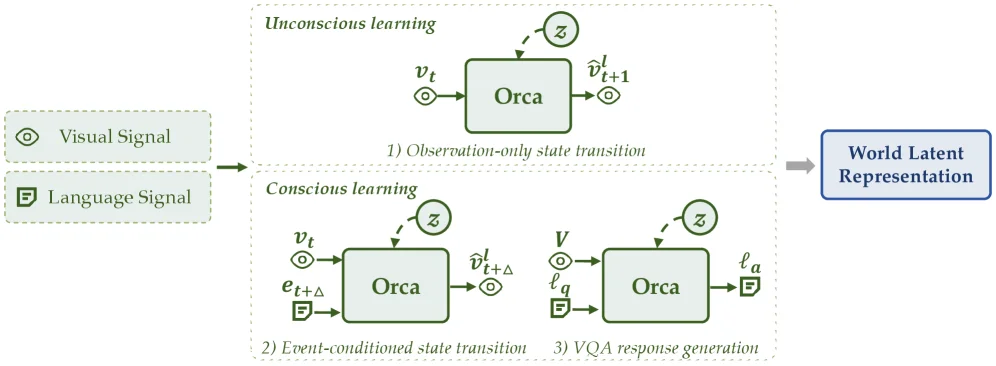
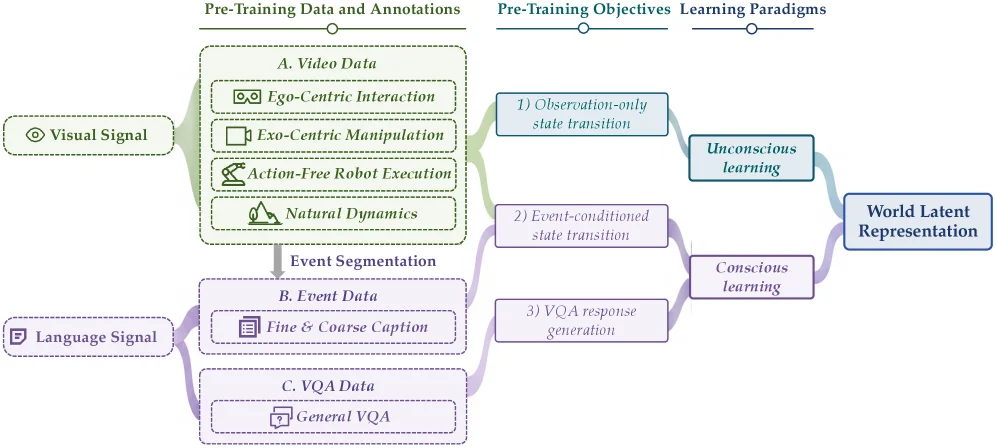
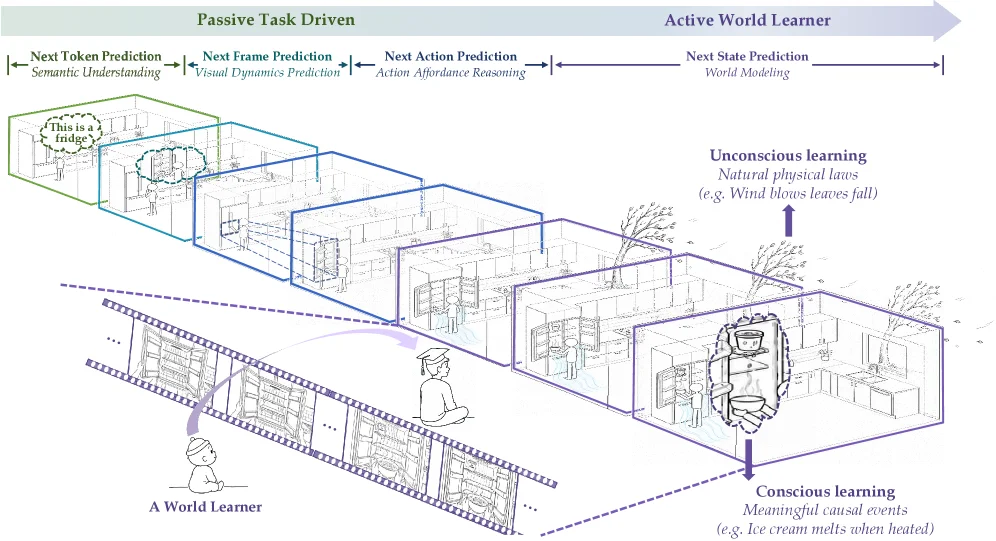
We introduce Orca, an initial instantiation of a general world foundation model. Orca learns a unified world latent space from multimodal world signals and exposes it through multimodal readout interfaces. Rather than optimizing isolated next-token, next-frame, or next-action prediction, we are centered on Next-State-Prediction modeling, offering a unified state-transition modeling route toward understanding, predicting, and acting upon the world. Orca learns through two complementary paradigms: unconscious learning captures dense natural state transitions from continuous videos, and conscious learning models sparse meaningful state transitions by language-described events and VQA supervision. For pre-training, we construct a large-scale world-learning inventory data, including 125K hours of video data and 160M event annotations. After pre-training, Orca learns a unified world latent space. To examine whether the learned latent supports downstream, we evaluate it by three representative downstream readouts: text generation, image prediction, and embodied action generation. Orca's backbone is frozen, and only the lightweight modality-specific decoders are trainable. Experiments show the scalability of the proposed paradigm and verify that stronger world latent enables stronger downstream readouts. Orca outperforms similar-sized specialized baselines. These results show that Orca, as a general world foundation model, presents a promising approach to understanding, predicting, and acting upon the world. Finally, we discuss the current limitations, aiming to provide useful insights and inspiration for the community.
Background
Background Analysis
1. Technical Context
A core challenge in artificial general intelligence (AGI) is building a system that learns and understands the world like humans, enabling it to predict and act across diverse scenarios. Real-world needs include robots reasoning about physics (e.g., object motion), humans interacting with AI systems that grasp causal relationships (e.g., "turning on a light brightens a room"), and models generalizing to unseen domains. Such technology aims to create self-evolving agents capable of surpassing human cognitive limits in specific tasks.
2. Previous Limitations
Traditional approaches (e.g., next-token prediction, next-frame generation) fail to model the world holistically. They optimize isolated tasks (e.g., text generation or video prediction) without unifying dynamic understanding. For example, language models excel at text but struggle with visual-physical interactions, while video models generate frames but lack semantic context. Additionally, they rely heavily on labeled data, ignoring abundant unlabeled signals (e.g., continuous videos) and sparse but meaningful events (e.g., "a person picks a cup"). This limits their ability to generalize to new or cross-domain tasks.
3. Proposed Solution
Orca addresses these issues by learning a unified "world latent space" through two complementary paradigms:
- Unsupervised learning: Captures dense, natural state transitions from continuous videos (e.g., object movements) without labels, mimicking how humans learn from observation.
- Conscious learning: Learns sparse but task-relevant state transitions using language descriptions (e.g., "opening a door") and visual question answering (VQA), aligning with human-like reasoning.
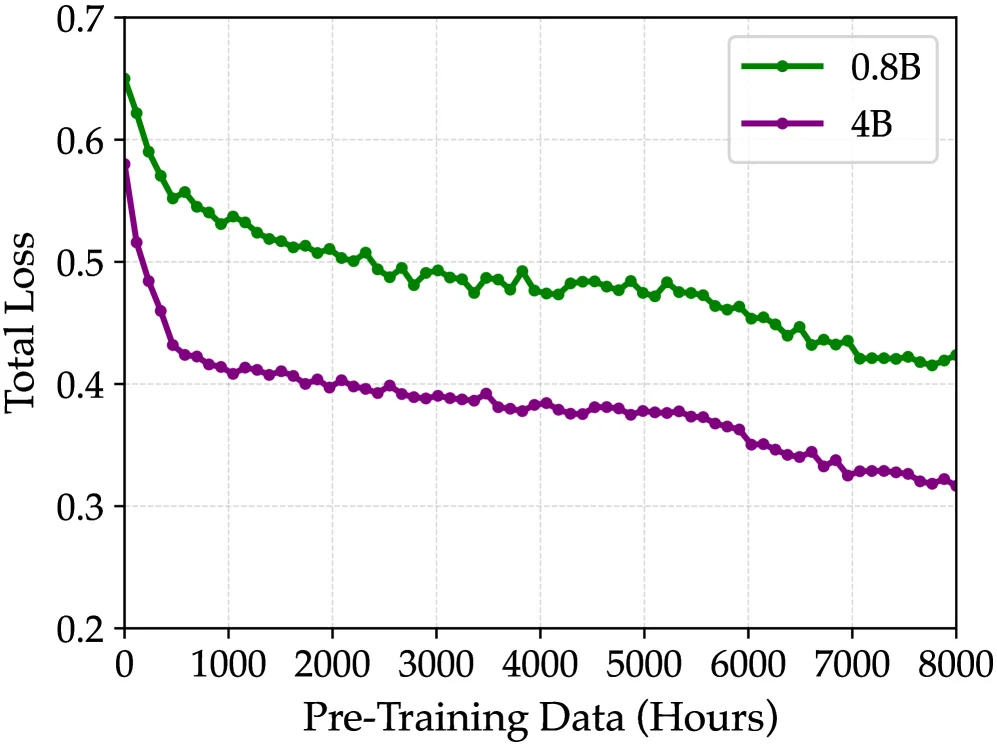
This approach enables Orca to support downstream tasks (text generation, image prediction, action generation) with a shared latent space. Experiments show its performance scales with model size and data, outperforming specialized baselines.
4. Key Differences
Unlike prior work, Orca prioritizes general world modeling over task-specific optimization. Its innovations include:
- Dual learning: Balances unsupervised natural dynamics (from videos) and supervised task-oriented learning (from language/events).
- Frozen backbone: Trains only lightweight modality-specific decoders, preserving the generality of the latent space.
- Large-scale multimodal data: Uses 125K hours of video and 160M event annotations to cover diverse real-world scenarios.
This design positions Orca as a foundational step toward AGI, demonstrating that stronger world modeling enables better downstream capabilities.