Dockerless: Environment-Free Program Verifier for Coding Agents
arXiv · HuggingFace · ▲105
Abstract (verbatim)
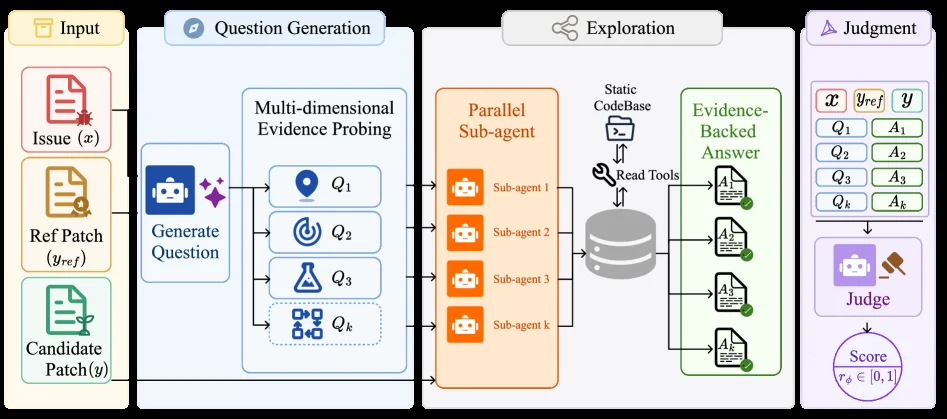
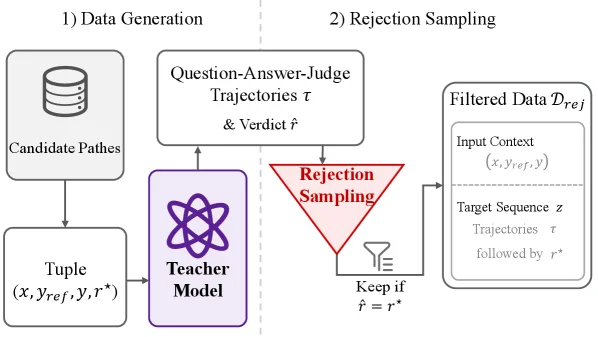
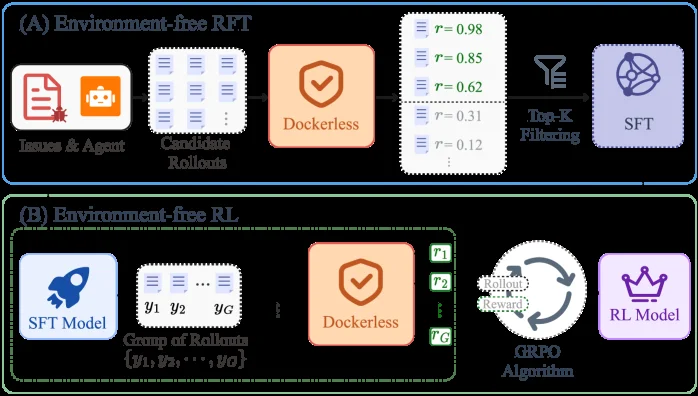
Program verifiers play a central role in training coding agents, including selecting trajectories for supervised fine-tuning (SFT) and providing rewards for reinforcement learning (RL). Standard execution-based verification requires running unit tests inside per-repository environments such as Docker images, incurring substantial environment setup costs. We propose Dockerless, an environment-free agentic patch verifier that evaluates generated code patches without executing them. Rather than simply matching candidate patches to references, Dockerless judges patch correctness using evidence gathered through agentic repository exploration. On a verifier evaluation benchmark, Dockerless outperforms the strongest open-source verifier by 14.3 AUC points. Using Dockerless as both the SFT trajectory filter and the RL reward enables a fully environment-free post-training pipeline. The resulting model reaches 62.0%, 50.0%, and 35.2% resolve rate on SWE-bench Verified, Multilingual, and Pro, respectively. It surpasses the Qwen3.5-9B baseline by 2.4, 8.7, and 2.9 points, matching environment-based post-training.
Background
Background Analysis
1. Technical Context and Real-world Needs
Program verifiers are essential for training automated coding agents (e.g., AI models solving software engineering problems). Their role is to judge whether a code modification correctly solves a problem, thereby guiding the model’s learning (e.g., filtering high-quality training data or providing rewards for reinforcement learning). Traditionally, verification requires running test cases in isolated environments (e.g., Docker containers per repository) to ensure correctness under specific dependencies and configurations. This need arises because real-world projects—especially enterprise or open-source codebases—demand context-aware validation; otherwise, trained models may fail in practice.
2. Previous Limitations and Bottlenecks
However, traditional methods face significant challenges. First, environment setup is costly: configuring Docker containers for each repository involves resolving dependency conflicts, writing test scripts, and other engineering work, which is often infeasible for private or legacy systems. Second, existing "environment-free" verifiers (those not relying on Docker) judge correctness based only on surface-level text matching, lacking understanding of codebase context. For example, they cannot determine if a modified function is actually called or integrates correctly with surrounding modules. This leads to unreliable verification, especially for complex tasks (e.g., benchmarks like SWE-bench requiring deep code logic understanding).
3. Proposed Solution
The paper introduces Dockerless, an environment-free "intelligent verifier." Its core idea is to let the verifier actively explore codebase context instead of relying on simple text matching. Specifically, Dockerless generates key questions (e.g., "Does the modified function solve the target problem?") and dispatches sub-agents to collect evidence (e.g., function call relationships, module dependencies) from the codebase. It then aggregates this information to judge correctness. This approach combines code understanding with logical reasoning to handle complex scenarios.
4. Key Differences from Prior Work
Compared to Docker-dependent traditional methods, Dockerless eliminates environment setup costs. Unlike shallow environment-free verifiers, it improves accuracy by actively exploring codebase context. Additionally, Dockerless supports a fully environment-free training pipeline: from data collection to model optimization, no per-repository configuration is needed. Experiments show its performance surpasses the strongest open-source verifier and enables models to achieve performance comparable to Docker-dependent methods on multiple benchmarks.
The key innovation is removing environment dependency from verification while compensating for shallow methods through intelligent exploration, providing a scalable solution for training coding agents at scale.